
MTF trading journal
Borrowed money isn't free. Your P&L should say so.
Qbartrade - MTF trading journal records what a margin-funded trade actually cost you. It tracks borrowed capital, your own margin, blended leverage and interest accruing daily against each position — so profit is measured after funding, not before it.



Works with India's top mtf brokers






























The problem
The cost that never appears next to the position
Margin funding is quoted at the moment of entry, in the smallest unit it will ever be expressed in: a rupee figure per day. At that moment it reads as noise. Then the position is held for three weeks, the charge lands on the ledger separately, and the two numbers are never put side by side.
A position showing a healthy gain on your broker's screen may have already paid out a meaningful part of it in funding. Held across a long weekend, it accrues on days the market never opened. The broker isn't hiding anything — the interest is on your ledger, correctly. It simply isn't attached to the trade, so it doesn't reach the number you use to decide whether the strategy works.
Which means the MTF strategy you believe is working is being measured gross.
Exposure
Leverage is not a decision. It accumulates.
Nobody sits down and chooses to run at 3.6×. You take one funded position, then another, then a third while the first two are still open — and the blended figure arrives on its own. Because leverage rises, interest rises with it, and the compounding is the part that catches people out.
QbarTrade keeps broker-funded capital, your own margin, gross exposure and blended leverage in one view across every account, so the number you're actually running is a number you can see rather than one you'd have to derive from statements.
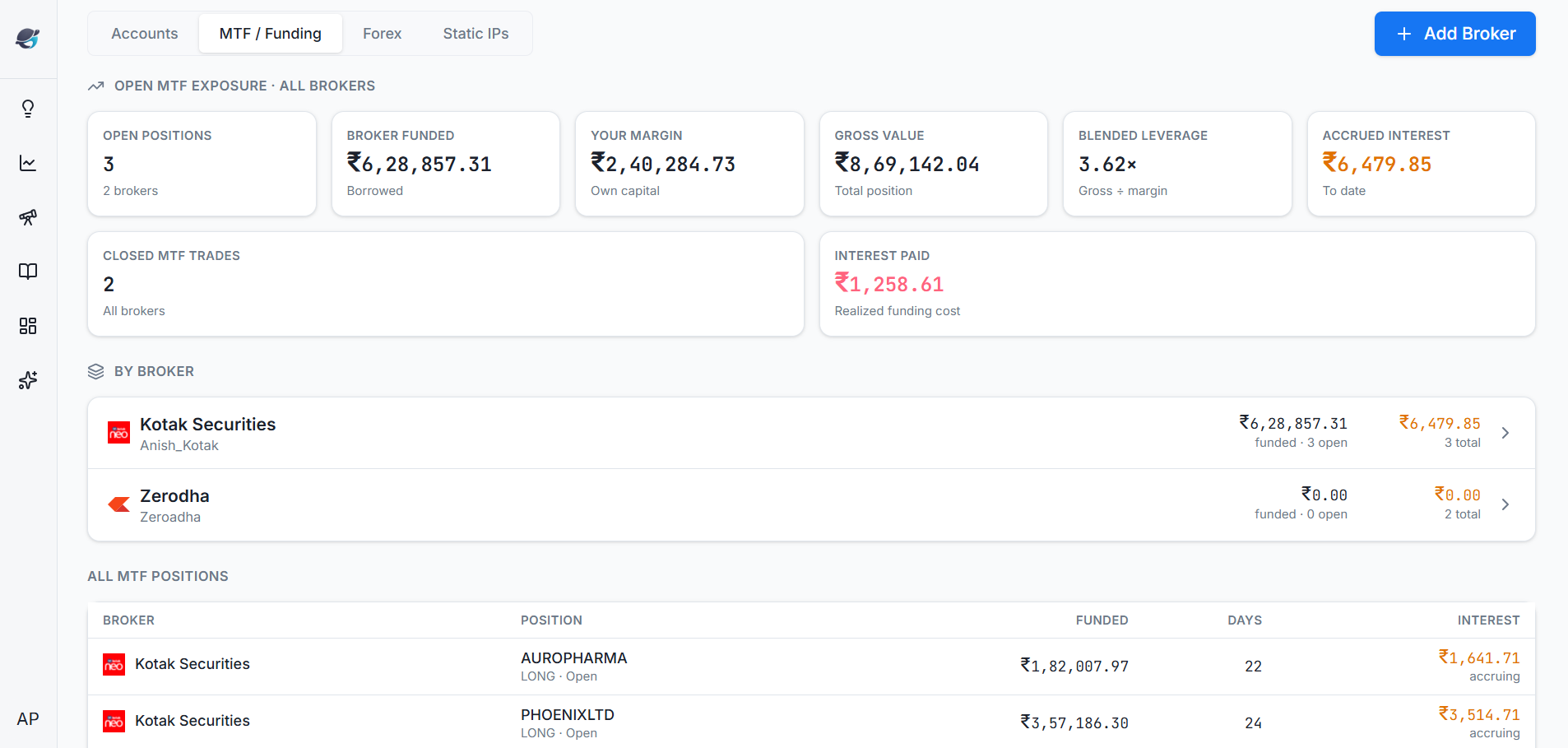
Broker by broker, position by position
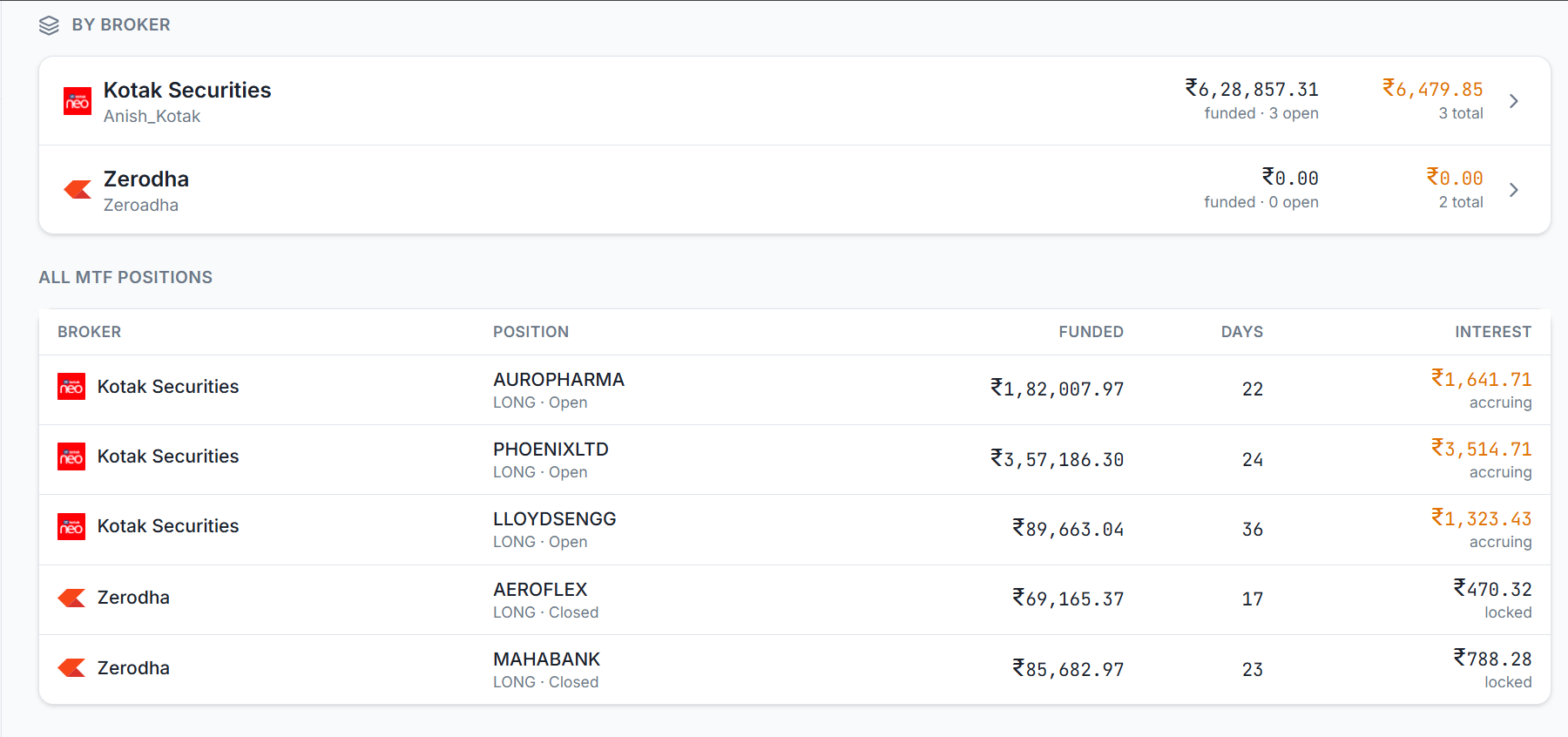
Funding, interest and days held in Qbartrade MTF trading Journal
Most active traders run more than one account, but their capital is really one balance sheet. QbarTrade separates funded exposure and accrued interest per broker, then drops to each funded position: its instrument, the amount the broker funded, how many days it has been held, and the interest accrued against it. Open positions keep accruing. Closed positions lock to a final figure. Running cost and realised cost never blur into each other.
Days held is the column worth staring at. The rate is fixed by your broker and the funded amount is fixed at entry — the only variable you control after that is how long you hold, and it's the one traders predict worst.
Getting trades in
Two ways to get a funded trade into the journal
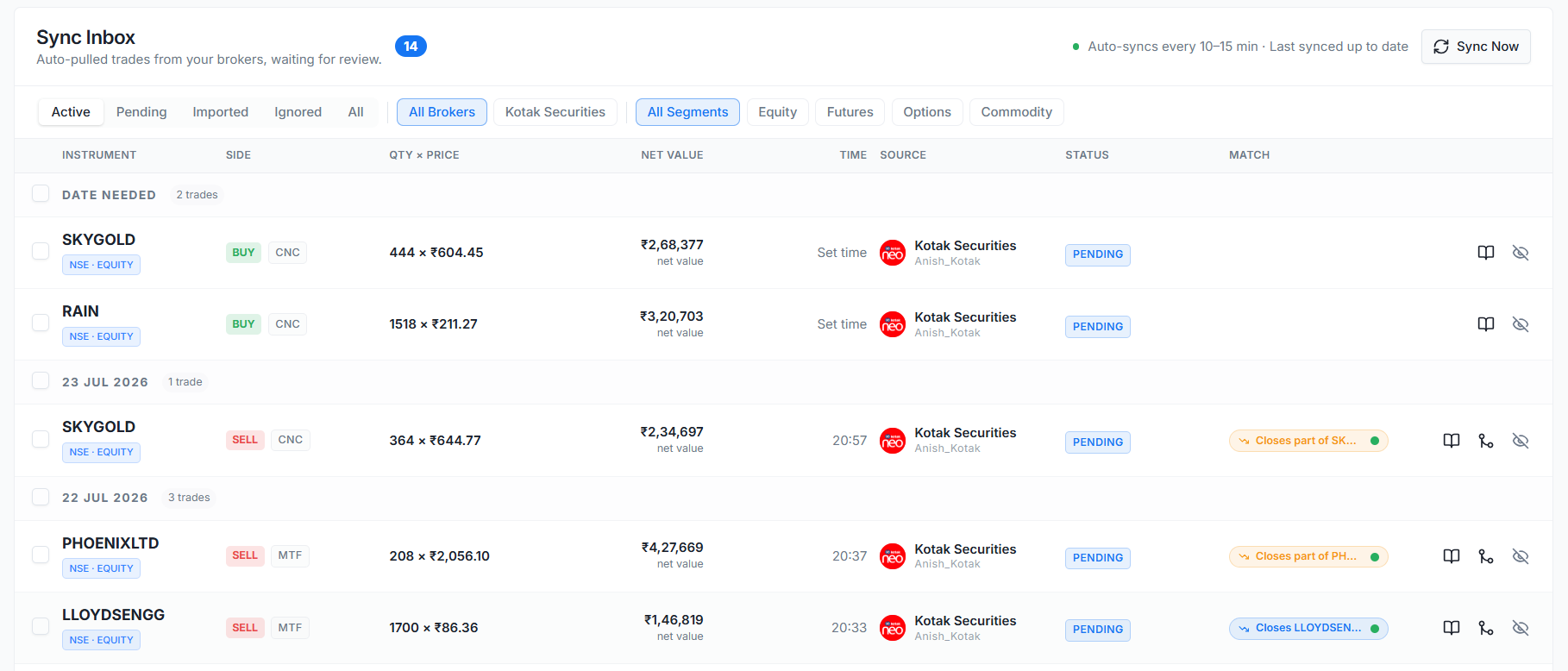
Sync automatically
Connect a supported broker and executed orders arrive on their own, with the funding details attached. Nothing to re-type, nothing to reconcile at the end of the week.
Record it in Quick Entry
Symbol, side, price, quantity — then flip the MTF toggle. QbarTrade attaches the funding breakdown and applies the basis for the broker account you selected. Any broker offering margin funding can be tracked, connected or not.
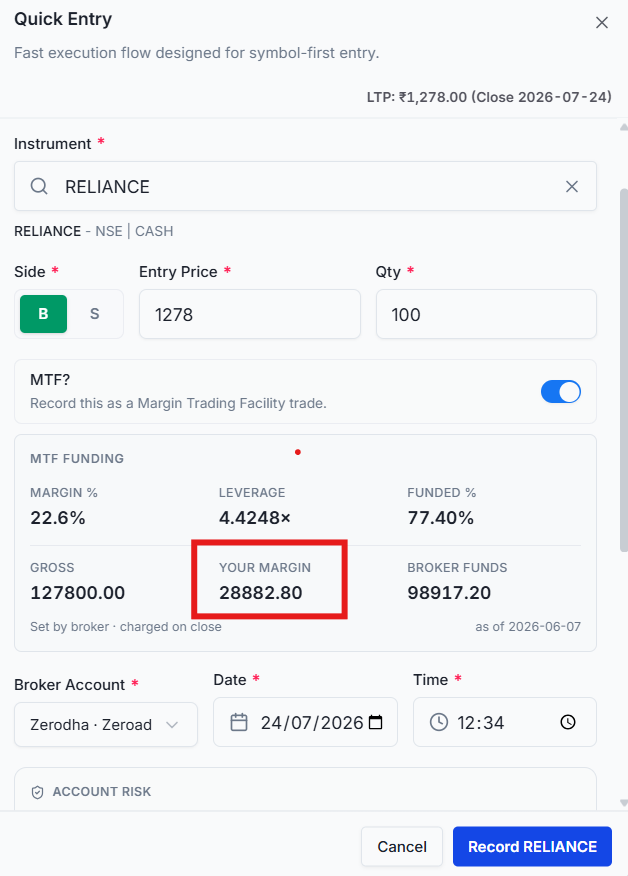
One switch is the whole interaction. From that point the position carries its margin percentage, leverage, funded amount and accruing interest — visible per trade, per broker, and across the portfolio.
MTF trading rules
MTF trading rules: what a funded position actually costs
None of this is advice about what to buy. It's the arithmetic that governs whether a funded position can work at all.
Cost of carry starts on day one
Interest accrues from day one, so the trade must clear the cost of carry before it clears zero. The longer the intended hold, the larger the move it has to make just to break even — and that threshold should be part of the entry decision, not a discovery at exit.
Blended leverage is the number that matters
Any single position can look conservative while the portfolio does not. Blended leverage — gross exposure divided by your own margin — is the number that describes your actual risk, and it moves every time you open another funded trade.
Holding period drives your MTF interest
The rate is your broker's and the funded amount is set at entry. Holding period is the only input left, which makes intended-hold versus actual-hold the single most useful comparison in an MTF journal.
Margin requirements change per stock
Margin requirements are revised, and they differ by instrument — a large-cap and a mid-cap of identical trade size can be funded at different ratios. Assuming one flat ratio across a portfolio quietly misstates both leverage and cost.
MTF-eligible stocks can change mid-position
Approved-stock lists get revised on exchange guidance and broker risk policy. A name can leave the eligible universe mid-position, which is a risk event no P&L report flags and only a journal that recorded the position's status at entry will surface.
MTF interest accrues on weekends too
Funding accrues on calendar days. A position carried over a long weekend accrues on days the market never opened — one of the commonest sources of "why is this number bigger than I expected".
Compatibility
Qbartrade - MTF trading journal, Works with the broker you already use
Funded positions from any broker offering margin funding can be tracked in one journal — synced where a connection exists, recorded manually where it doesn't. Each account keeps its own funding basis rather than being flattened into a single assumed rate.
FAQ
MTF Trading Journal - Common questions
Why doesn't MTF interest show up in my broker's P&L?
Because it isn't part of the trade. Your broker's P&L screen reports the price movement on the position; the funding charge is a separate debit that lands on the ledger, often days later and sometimes only at close. Both numbers are correct — nothing joins them, which is why a funded position can look profitable while a slice of that profit has already been paid out.
How is MTF interest actually calculated?
Daily, on the funded portion only — not on your own margin, and not on the full position value. The rate comes from your broker and the funded portion depends on the margin requirement for that specific instrument, so two trades of identical size can accrue different amounts. Days held is the variable that moves most.
Does QbarTrade - Best MTF trading journal apply a different rate for each broker?
Yes. Each connected or recorded account carries its own funding basis, so positions on two different brokers accrue at their own rates rather than a single blended assumption. That is why the same instrument, funded identically, can show different accrued interest depending on which account it sits in.
What makes a good MTF trading journal?
A trading journal that helps you track the MTF charges and interest charges, And let you focus more on trading rather than accounting. Traders looking for the best MTF trading journal usually want this
What happens to accrued interest when I close a position?
It stops accruing and locks. Open positions keep accumulating daily, so the number moves every day you hold; closed positions carry a final, fixed figure that feeds your realised cost. Both stay in the journal, so realised funding cost and running funding cost are never mixed together.
Can I record an MTF trade manually if my broker isn't connected?
Yes. Quick Entry has an MTF toggle — switch it on, pick the broker account, and the funding breakdown attaches to the trade. Any broker offering margin funding can be tracked this way, whether or not a live connection exists for it.
How much MTF leverage is too much?
There is no universal number, but blended leverage across all open funded positions is the figure to watch rather than any single trade. Leverage rarely gets chosen deliberately — it accumulates one position at a time, which is exactly why it needs to be visible in one place rather than inferred from a margin statement.
Track the funding, not just the trade.
Inside the best MTF trading Journal - Qbartrade
Free to start · read-only access · no custody · no signals · no guaranteed returns.
Start free