
FUTURES
Position first.
Keep contract, direction, quantity, entry, stop, target, risk and execution together around the futures position you actually traded.
Contract context
Lot-based quantity
Risk & R-multiple
Execution review
Futures positions. Option buys. Multi-leg strategies. Intraday trades. Positional ideas. QbarTrade keeps the complete F&O trade connected — from the plan you made to the execution you took and the review that follows.
A futures position is not reviewed like an options spread. An option buyer faces different decisions from an option seller. A directional trade is not the same as a multi-leg structure. Your F&O trading journal should preserve those differences instead of flattening every execution into the same trade log.
Keep contract, direction, quantity, entry, stop, target, risk and execution together around the futures position you actually traded.
Keep calls, puts and related option legs connected to the strategy behind the trade so the final review reflects the position — not scattered broker rows.
An order history can tell you what was bought, sold and filled. It cannot explain why you entered, what invalidated the setup, whether you followed your risk plan or why you exited early. QbarTrade gives those executions context so you can review the complete F&O decision.
What made this futures or options trade worth taking?
Where was the idea wrong, and how much were you prepared to lose?
Did your entry and exit match the F&O trade you planned?
What would you repeat — and what should change next time?
Spreads, straddles, strangles and other multi-leg option positions only make sense when the legs are reviewed together. Keep the structure, trade idea and outcome connected so your option strategy journal reflects what you actually traded.
Review calls and puts around the directional setup that triggered the position.
Keep both sides of the spread connected instead of evaluating each execution independently.
Review the complete position as a strategy with its own entry logic and outcome.
Tag recurring multi-leg option structures and compare them across your own trading history.
Use QbarTrade as an option strategy journal for directional options, CE/PE trades and multi-leg positions while keeping the trade structure visible during review.
Put the setup, entry, stop, target, direction and intended position on paper before the trade becomes emotional. For futures, keep quantity and contract risk connected. For options, record the structure you intended to execute.
Record the instrument, setup, direction and market context before the trade is live.
Set the entry, stop, target and intended quantity before execution.
Once the trade closes, compare what you intended with what you actually did.
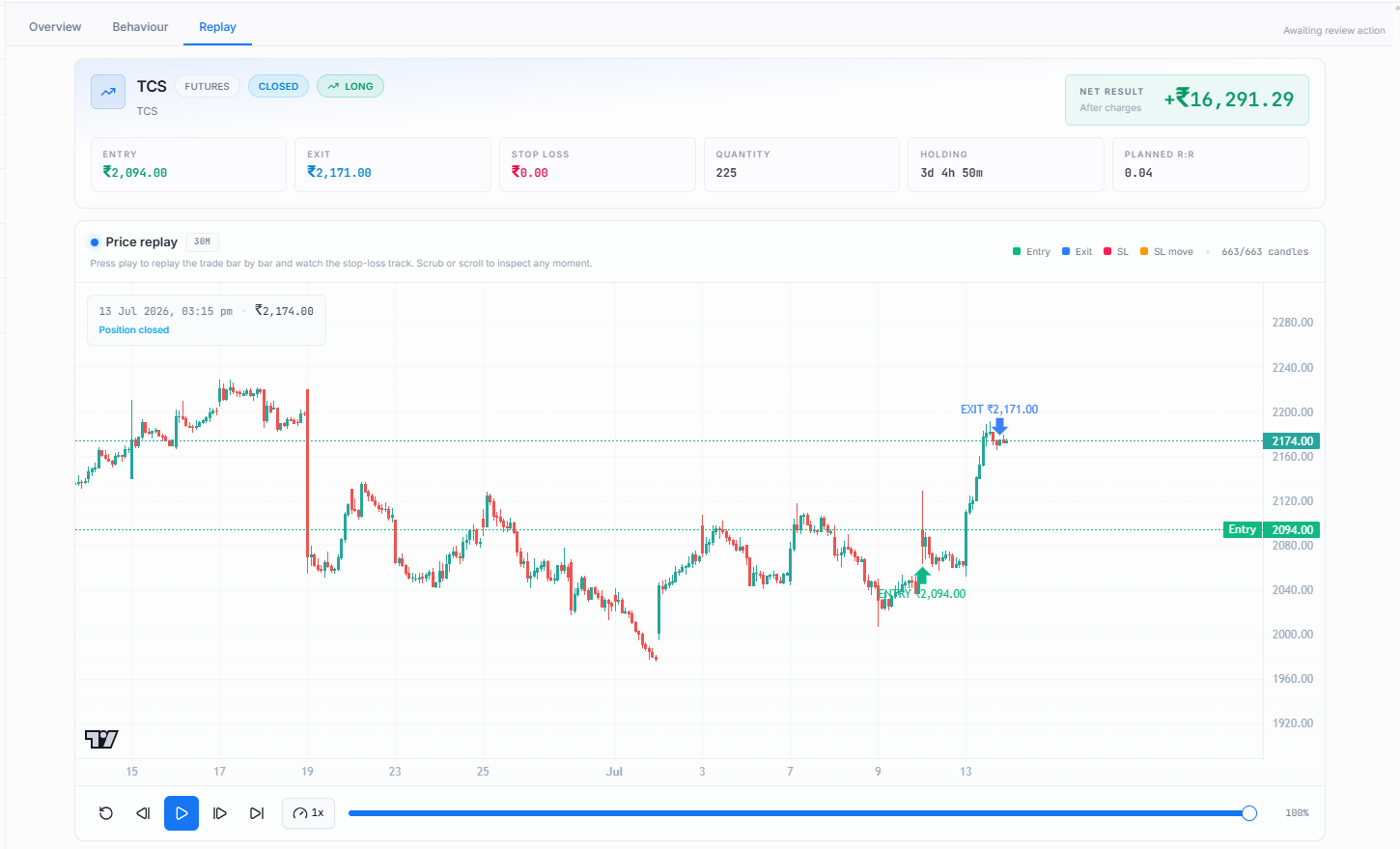
Replay a completed F&O trade around the candles where your decisions happened. See the entry, exit and market movement in sequence instead of judging yourself only from the final P&L.
Watch the entry again
Was the setup actually ready when you entered?
Study the exit
Did you follow the plan, react to noise or leave the move too early?
Review execution
Turn an old trade into something you can learn from instead of another row in your F&O trading diary.
An F&O intraday journal should help answer different questions from a positional F&O trading journal. Separate holding styles so timing, frequency, thesis and risk are analysed in the context in which the trade was taken.
Review timing, trade frequency, execution speed, charges and repeated decisions across the trading session.
Keep the thesis, risk, intended hold and exit decision beside futures and options positions that remain open across sessions.
A strategy can be fine while the execution around it is not. Use your F&O journal to separate planned trades from chasing, overtrading, moving stops or taking another position simply because the previous one lost.
Did you enter after the planned level or setup had already gone?
Did trade quality fall as the number of positions increased?
Did the stop, target or position structure change once money was at risk?
Which futures and options trades were executed exactly as planned?
Your total profit or loss tells you the result. Your F&O performance tracker should help explain what created it. Break your trading history down by instrument, trade type, setup, holding style, direction and behaviour.
Illustrative F&O trade analytics view
Compare index and stock derivatives in your journal.
Separate futures, option buying, selling and multi-leg activity.
See how recurring F&O setups compare.
Compare planned trades with repeated behaviour patterns.
Bring executions into QbarTrade through supported broker and import workflows, then spend your time adding the information only you know — the setup, strategy, plan, behaviour and lessons behind the trade.
Bring executed futures and options trades into the journal through supported workflows.
Tag the setup, option strategy, holding style and trading behaviour around the execution.
Use your F&O trade history to find patterns that are worth acting on.
Connect preparation, execution and post-trade review in one repeatable F&O trading workflow. Replay becomes part of the loop, so improvement is based on what actually happened around the trade.
Define the setup, position and risk.
Take the trade through your broker.
Bring the execution into QbarTrade.
Review what happened around entry and exit.
Use your data to decide what deserves repeating.
An F&O trading journal records futures and options trades together with the plan, position structure, risk, execution, charges, result and post-trade review. It helps traders study the decisions behind performance instead of looking only at final P&L.
Yes. QbarTrade can be used to organise and review futures and options trades while preserving the different context needed for a futures position, a directional option trade or a multi-leg options strategy.
Yes. Related option legs can be reviewed around the position or strategy they belong to, so spreads, straddles, strangles and other structures do not have to be analysed as disconnected executions.
Yes. You can separate short-duration and multi-session F&O trades so timing, frequency, holding style, plan quality and results can be reviewed in the right context.
QbarTrade trade replay lets you review entry and exit markers with the surrounding chart movement, helping you study how the trade developed after execution instead of judging it only from the final result.
QbarTrade supports connected broker and flexible import workflows. Availability depends on the broker and integration supported for the account.
Your review can include net P&L, win rate, expectancy, profit factor, average R-multiple and performance grouped by factors such as instrument, setup, direction or strategy.
You can start using QbarTrade free and build your F&O journal around your own futures and options trading activity.
Looking for a free F&O trading journal? Start with QbarTrade free and build your futures and options journal from your own trades.
Plan the position. Capture the execution. Replay the decision. Learn from the pattern.
Start free