

It's a T20 match.
The opening batsman walks in — the most aggressive hitter in the team.
And in the first over... he mostly defends.
A careful single. A leave. A soft push to cover.
Is he scared?
No. He's reading the pitch.
Is the ball bouncing? Swinging? Coming on slow?
The first over is not for scoring.
It's for information.
Once he's read the pitch, then the big shots come — with far better odds.
The stock market opens at 9:15 every morning, and the first fifteen to thirty minutes are the messiest of the entire day.
Overnight global news is being digested.
Pending orders are being filled.
Big institutions are repositioning.
Everyone is acting at once, and price jumps around like a pitch nobody has read yet.
Trading inside those first minutes is like swinging blind at the first ball.
So professional intraday traders do something beautifully simple.
They wait.
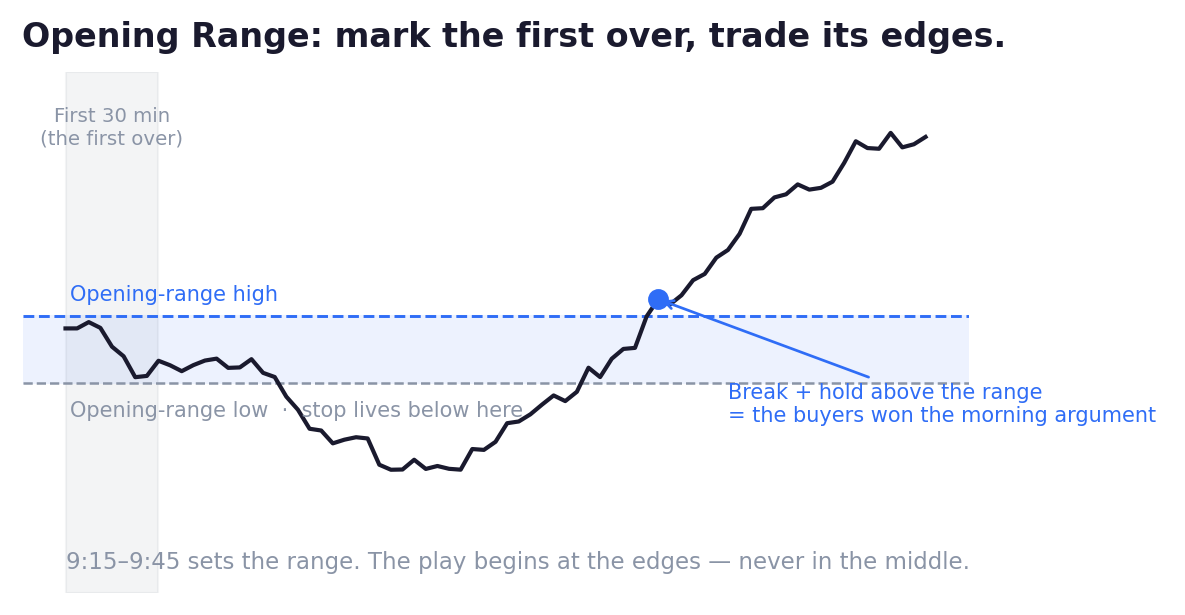
They let the first fifteen or thirty minutes finish, and then they mark two lines on the chart:
- The highest price of that opening period.
- The lowest price of that opening period.
That's it. The zone between those two lines is called the opening range.
Think of it as the market's first over — the first honest information of the day.
The opening range is the day's first agreement zone: the prices where buyers and sellers were willing to meet while the overnight noise settled.
(Remember from the School of Market Science — every price is an agreement between two sides.)
And now the play. It's called the Opening Range Breakout, or ORB:
- If price breaks above the opening-range high and holds there, the buyers have won the morning argument. You trade with them — long — with your stop-loss below the range.
- If price breaks below the opening-range low and holds, the sellers won. Same logic, mirrored.
The fingerprints of a breakout worth taking:
- The break is fast and confident — strong candles, not a slow drip over the line.
- Price does not immediately fall back inside the range.
- The break agrees with the day's bigger story — a break upward on a strong gap-up morning is very different from one fighting the tide.
And now the classic mistake, the one that quietly bleeds beginners:
Trading inside the range.
The middle of the opening range is where the whipsaw lives. Price crosses back and forth, triggering entries and stop-losses in both directions, charging you brokerage for the privilege.
The play begins at the edges.
Never in the middle.
One more honesty rule before we move on: the first break sometimes fails.
That's not the playbook being wrong.
That's why the stop-loss exists — and why it lives on the other side of the range, decided before you ever click Buy.
Key Takeaway
The opening range is the market's first over. Don't predict it — mark its high and low, then trade what happens at the edges. The middle is where accounts go to chop.
Think About It
When you've entered trades in the first fifteen minutes of the day, were you acting on information — or on impatience dressed up as conviction?
Playbook Lab — The Five-Day Range Log
For the next five sessions, mark the first fifteen-minute high and low on Nifty at 9:30.
Then just observe, and note two things at the end of each day:
Five days of this teaches more about the open than a hundred videos.