

Somewhere right now, a movie is showing a trading algorithm: green code raining down a black screen, an AI whispering predictions, money materialising.
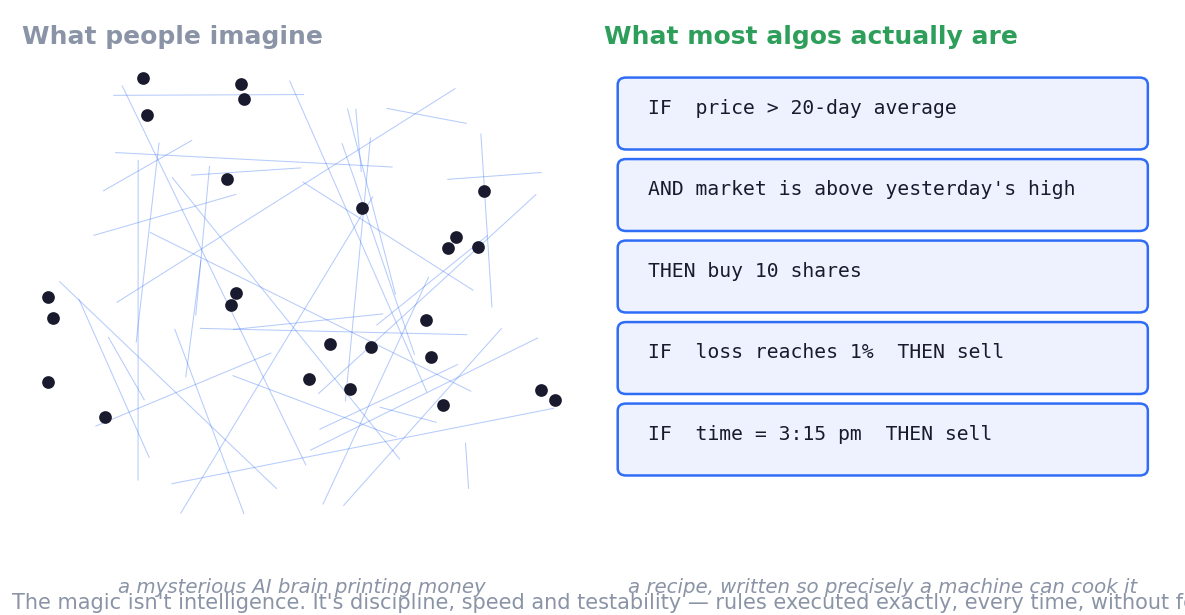
Now here is a real algorithm — a complete one, the kind that actually runs in the world:
IF today's price crosses above the 20-day average
AND the overall market is also rising
THEN buy a fixed small quantity
IF the position loses 1% THEN sell everything
IF the clock reaches 3:15 pm THEN sell everything
That's it. No brain. No prophecy. Five lines of if-then — a recipe, written so precisely that a machine can cook it.
Algorithmic trading is exactly this: trading rules made so explicit that a computer can execute them without you.
The word 'algorithm' sounds intimidating, but you've used algorithms your whole life. A cooking recipe is an algorithm. The steps for tying shoelaces are an algorithm. Your morning routine is an algorithm you happen to run on a human. The only thing special about a trading algorithm is the ingredient list: prices in, orders out.
So why did something so simple eat the financial world? Because the machine brings three superpowers to any recipe — and notice that none of them is intelligence:
It never gets tired, scared, or greedy. The machine takes trade number 47 with exactly the energy and exactly the rules of trade number 1 — after three losses, after three wins, at 9:16 am and at 3:14 pm. Every school in this Academy has shown you how human wiring bends decisions. The machine has no wiring to bend. (Chapter 2 is entirely about this — it's the real reason to automate.)
It's fast — at the boring things. Not Hollywood-fast (Chapter 6 will show you the speed ladder and your actual rung on it). But faster than any human at the unglamorous work: watching 500 stocks simultaneously, reacting in a fraction of a second, never missing a signal because it was making tea.
And it can be tested on the past. This is the quiet superpower. Because the rules are exact, you can ask: what would these rules have done over the last ten years? — and get an answer in minutes. A human's 'strategy', full of judgment and mood, can never be tested that way. A recipe can. (It can also be tested wrongly in fascinating, expensive ways — Chapter 5 is the most important chapter in this school.)
Now let's kill the myths before they cost you money:
Myth: algo trading = AI predicting the future. The overwhelming majority of running algorithms contain no AI at all — they're rule automation, like the five lines above. Machine learning exists in the field (Chapter 8, honestly), but it's a small, difficult corner, not the definition.
Myth: algos are a money-printing machine. An algorithm is an amplifier of a recipe. Automate a good recipe: disciplined profits. Automate a bad recipe: disciplined, tireless, high-speed losses. The machine adds no edge of its own — it only executes yours perfectly, whichever direction it points.
Myth: it's all one thing. 'Algo trading' spans a hobbyist's moving-average bot placing two orders a week, a fund's systematic model rebalancing monthly, and a high-frequency firm's machines trading in microseconds from inside the exchange building. Same word, utterly different games — and knowing which game is playable at your size is half this school (Chapter 4 draws the map).
Who actually runs algorithms today? Nearly everyone above a certain size: by most estimates, well over half of all trading volume in major markets worldwide is machine-executed — from giant asset managers automating rebalancing, to market-making firms quoting prices, to a fast-growing global crowd of individual traders running simple systems through broker APIs. The machines aren't coming. They ran past us years ago.
Which raises this school's real question — not "how do I get the magic robot?" but:
"Do I have a recipe worth automating — and can I test, run, and supervise it honestly?"
Nine chapters. That's the journey. And it starts, next chapter, with a confession every human trader must make.
🇮🇳 The India Angle
- Algorithms already dominate Indian exchanges too: exchange data has long put algo-driven orders at roughly half or more of turnover — the same machine-majority as global markets.
- India's retail algo wave runs through broker APIs — programmatic order interfaces offered by major brokers — which is how individual traders' recipes reach the exchange.
- The regulator (SEBI) rolled out a framework for retail algorithmic trading during 2025 — algos routed via registered brokers with exchange oversight of strategies. Rules evolve; whatever you build, check your broker's current implementation before going live.
Key Takeaway
An algorithm is a recipe made so precise a machine can cook it — no brain, no prophecy. Its superpowers are discipline, tireless attention, and testability; it adds no edge of its own, only perfect execution of yours, in either direction. The real question is never 'how do I get the robot' — it's 'do I have a recipe worth automating?'
Think About It
Take your best recent trade. Could you write the EXACT rules that produced it — precise enough that a machine (or a stranger) could repeat it? If not, was it a strategy... or a mood that worked?
Algo Lab — Write One Recipe
Pick one trade you actually took recently. Now write it as a machine would need it — pure if-then, no judgment words:
Notice where you get stuck — every place you can't write the rule is a place you were improvising.
Keep the recipe. Chapter 3 will give it a skeleton, and Chapter 5 will teach you to test it. This school is that one piece of paper, growing up.