



TradeZella
Best for
AI automation and broad international broker support
A widely used, polished journal known for AI-assisted trade analysis and wide US/international broker coverage. Built primarily for US markets and priced in USD.
Compare the leading trading journals and see how QbarTrade combines AI-powered review, pre-trade planning, broker sync, trade replay, performance insights and MTF-aware journaling for Indian traders.
Updated July 2026 · Built for Indian traders · Comparison based on publicly available product features
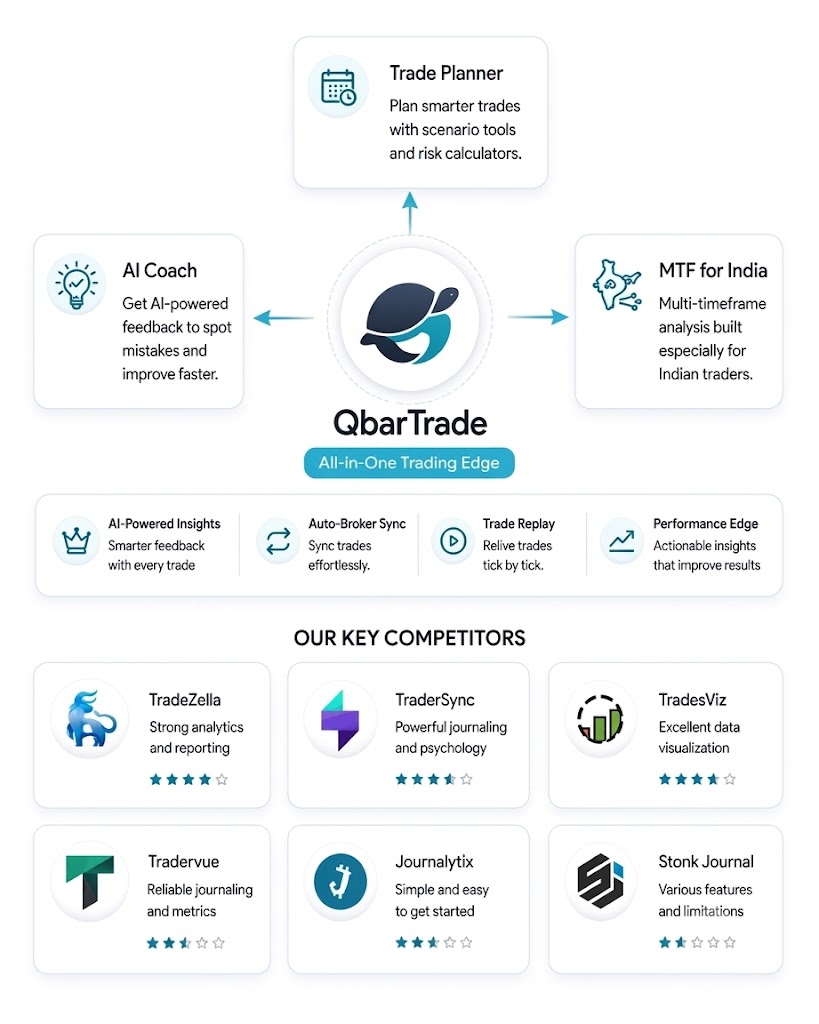
Plan the trade, sync the execution, tag the behaviour, review the result — QbarTrade keeps the whole loop in one workspace instead of scattered across a broker app, a spreadsheet and your memory.
QbarTrade workspace
See the trade. Then review the decision.
Switch view
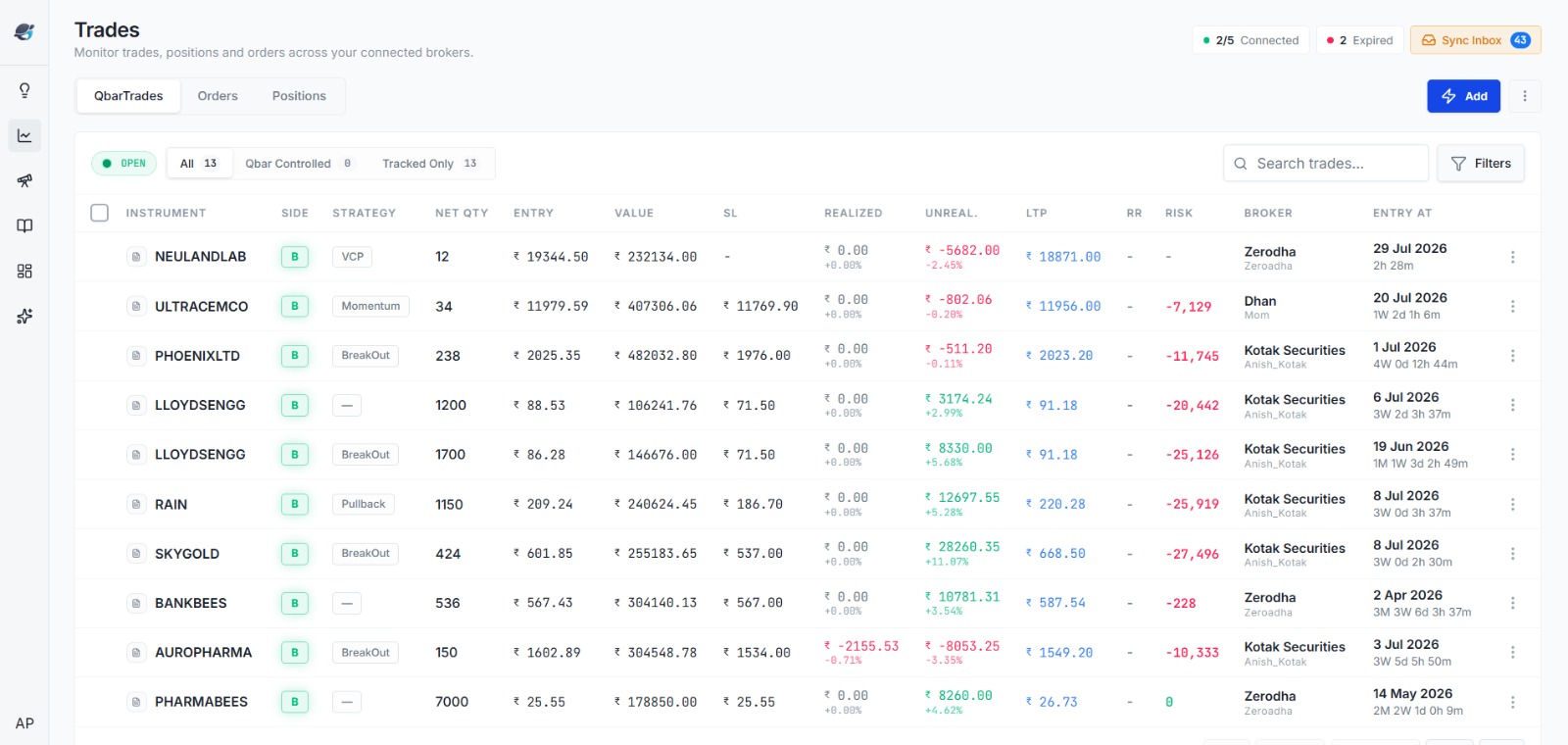
TRADER VIEW
See what happened.
Review executions, positions and trading history across your workflow.
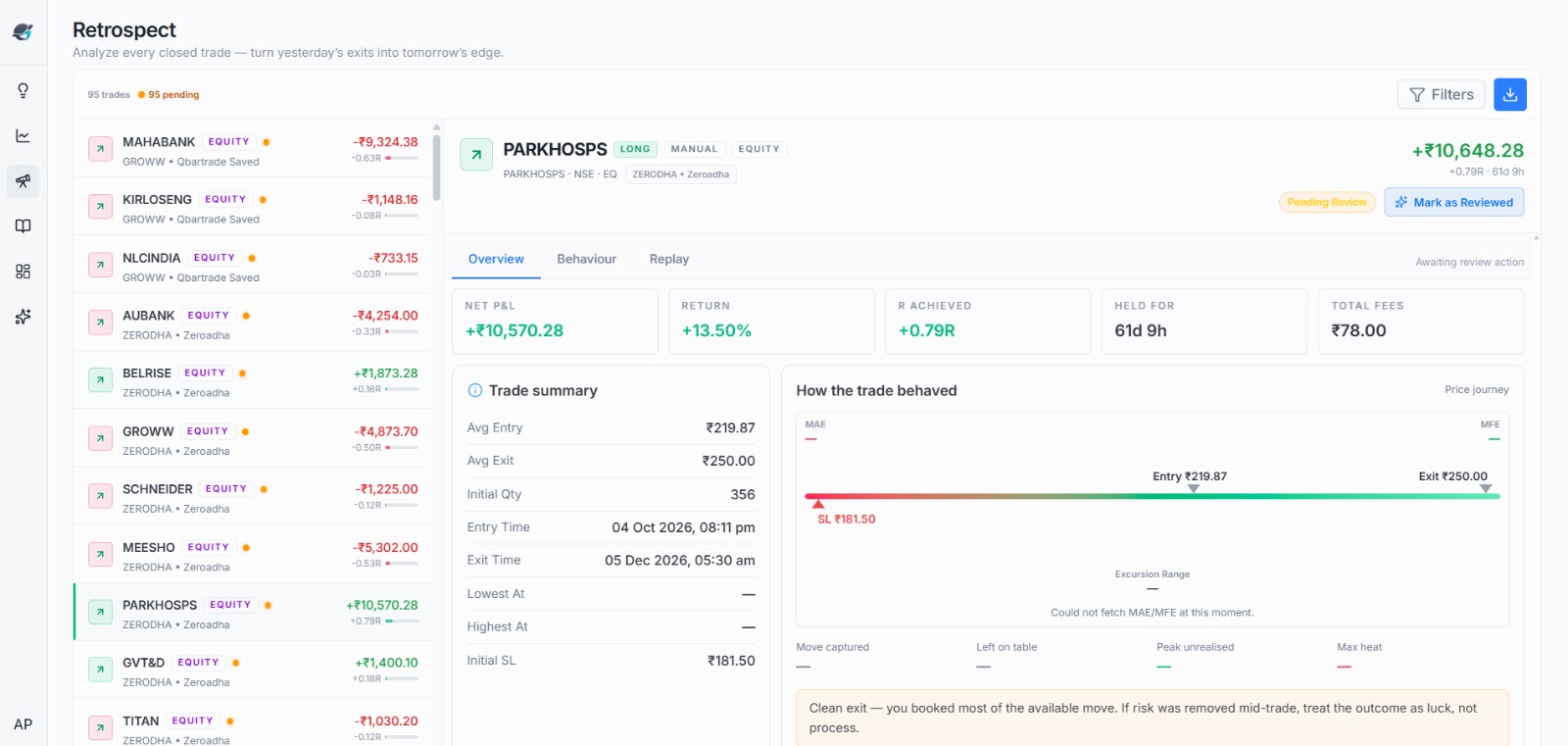
JOURNAL VIEW
Understand the decision behind it.
Keep the plan, behaviour, notes and retrospective review beside the trade you actually took.
You perform best in breakout setups between 9:30 AM – 11:30 AM.
Avoid trading after 2 PM – your win rate drops by 23%.
View all insightsYour broker knows what you bought, when, and what it closed at. It does not know why you entered, whether you followed your plan, which setup keeps losing you money, or what a strategy really earns after charges and funding. That gap — between what you did and why it worked or didn't — is where improvement actually happens, and no broker statement covers it.
A trading journal is supposed to close that gap. Most don't, because they turn logging into a second job you quietly abandon. The right one removes the manual work and gives you back the part that matters: a clear read on your own trading.
Broker shows
What you traded, the outcome, the charges
Broker can't show
The plan, the reason, the discipline, the pattern
A journal adds
The decision layer that turns a year of trades into a year of lessons
Each of these journals is strong at something different. Here's the short version of who each one suits best, so you can find the right fit fast. Positioning reflects each product's publicly stated focus; verify current features on their sites.
Pre-trade planning with strategy rules, execution history auto-synced from Indian brokers, emotion and behaviour tags, retrospective review, and analytics — including F&O grouping and MTF interest tracking that international tools don't cover.
Includes
Best for
AI automation and broad international broker support
A widely used, polished journal known for AI-assisted trade analysis and wide US/international broker coverage. Built primarily for US markets and priced in USD.
Best for
Psychology-focused journaling
A long-standing journal known for its emphasis on behavioural and psychological review — popular with traders who want to study their own tendencies in depth.
Best for
Traders prioritising mobile-accessible analytics
Offers broker sync and a mobile-friendly experience with detailed analytics, suited to traders who want to review performance on the go.
Best for
Quantitative analytics and a free entry point
A data-heavy journal known for extensive charts and statistics, with a free tier that appeals to analytically minded traders.
Best for
Straightforward trade logging
One of the older journals, valued for clean, no-frills trade logging and sharing.
Only one of these is built first for Indian markets — broker sync, F&O lots, MTF interest and the Indian charge stack. If that's how you trade, that's the short list of one.
Descriptions are positioning-level and based on publicly available information as of July 2026. Verify current product features before choosing a journal.
Most journals fail the same way: they ask you to type every trade in by hand, so you stop. The best one removes that friction and measures what a broker statement can't. Five things separate a journal you'll keep from one you'll abandon.
Auto-sync from your broker, or one-file import; never re-typing a tradebook line by line.
Multi-leg positions grouped as one strategy, lot size carried through, not four disconnected rows.
Brokerage, STT, GST, stamp duty and MTF interest subtracted, so P&L is net, not gross.
Why you entered, where the stop was, what you were thinking; the layer that turns trades into lessons.
Which setups make money, which rule you break most, what each strategy earns; from tags, not guesswork.
Executed orders arrive on their own; nothing to re-type. Import a tradebook to backfill.
Explore broker connectLegs grouped with strikes, expiry, net premium; futures carry lot size.
For options tradersFunding cost accrued daily and subtracted from P&L.
Explore MTF journalingTag by setup and rule; see which setup pays and which rule you break.
See AI Coach| Capability | Spreadsheet | Generic journal | QbarTrade |
|---|---|---|---|
| Trade entry | Manual, until you stop | Manual or partial import | Auto-synced |
| Indian broker sync | — | Rare | 35+ brokers |
| F&O lot & option legs | By hand | Often flattened | Grouped & correct |
| MTF interest tracking | — | — | Per position |
| Indian charge stack | Manual | Sometimes | Subtracted automatically |
| Discipline / strategy tags | Ad hoc | Basic | Built in |
| SEBI-compliant, read-only | n/a | Varies | Yes |
The gaps in the first two columns aren't oversights — most journals are built for US markets, where MTF, F&O lots and the Indian charge stack don't apply. That's the difference between a journal adapted for this market and one built for it.
Review multi-leg positions around the strategy, not disconnected executions.
Keep the original thesis, execution and retrospective tied to the trade.
Review lot-based positions, risk and performance in one workflow.
Bring funding cost into the journal instead of looking at gross P&L alone.
Turn tagged trading behaviour into patterns you can review and improve.
Use planning tools before execution, starting with position sizing.
The best trading journal is one you will actually keep using. It should reduce manual trade entry, handle the instruments you trade correctly, account for real trading costs, capture the decision behind the trade, and help answer useful questions about setups, rules and behaviour.
For Indian traders, the useful criteria are Indian broker sync, correct F&O and options handling, MTF interest tracking, the Indian charge stack, and a workflow that connects planning with post-trade review. QbarTrade is built around those Indian-market requirements.
Yes. Some journals offer a free entry point, and QbarTrade is free to start. The more important question is whether the journal supports the workflow, market structure and review depth you need before you commit to using it long term.
For F&O and options, look for a journal that understands lot size and can group multi-leg executions into the strategy you actually traded. QbarTrade is designed to review options and futures in that strategy-level context rather than flattening every leg into an unrelated row.
A broker statement tells you what happened. A trading journal adds the plan, reason, discipline and behavioural context behind it. That extra decision layer is what lets you review repeated patterns instead of only looking at final P&L.
Yes, when the journal supports broker sync or tradebook import across the brokers you use. QbarTrade is designed to bring executions into one review workspace so planning, behaviour and performance do not stay scattered across separate broker accounts.
Free to start · auto-sync · read-only access · no custody · no signals · no guaranteed returns.
Start free