

A judge hears a case with one witness.
Confident. Articulate. Convincing.
And the judge still won't convict — because a century of courtrooms proved that a single witness, however sure, is wrong alarmingly often.
But four unconnected witnesses, questioned separately, describing the same event the same way? Now the story is probably true. Not certainly. Probably — and probably, with defined risk, is everything a trader gets or needs.
Here's what this school did quietly while teaching you tools: it handed you a witness at the end of almost every chapter. You may have noticed the questions accumulating. Line them up and look at what you own:
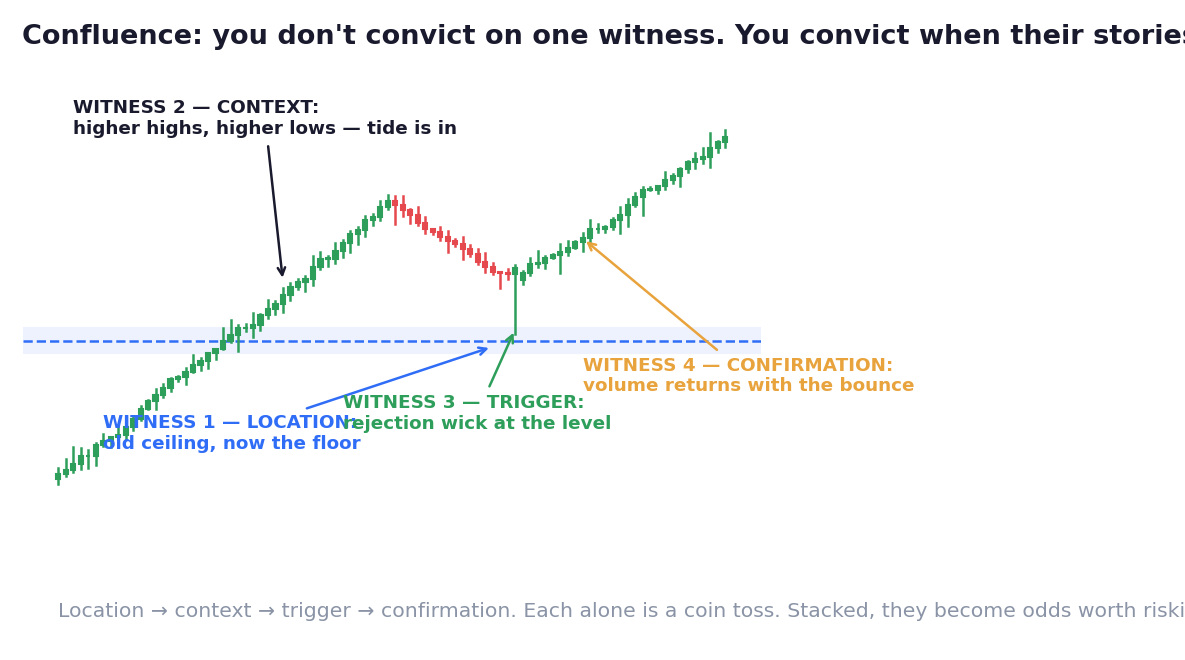
Witness 1 — LOCATION (Chapter 04): Where is price standing — does memory live here? A scar-tissue zone, a role-reversal level, a round number, the crowd's walking receipt (Ch 08). No memory, no case — this single filter deletes the middle-of-nowhere trades, which is to say, most losing trades ever taken.
Witness 2 — CONTEXT (Chapter 05): Which way is the tide on the map frame? With it, ordinary evidence suffices. Against it, evidence must be overwhelming — and 'it's gone up a lot' is not evidence, it's a feeling with a brokerage account.
Witness 3 — TRIGGER (Chapter 06): Did the fight at my level go my way? Not 'price arrived at my zone' — price arriving is an invitation, not information. The rejection printing, the stalemate resolving, the conviction candle confirming: the zone being defended, on the tape, in front of you. The trigger also fixes your risk: the fight's extreme is the stop, because past it, the fight was a lie.
Witness 4 — CONFIRMATION (Chapter 07): Is the hall full? Participation behind the trigger — the volume that separates the flood from the fake, the whale-signed rejection from the decoy. It testifies last and settles arguments.
Four questions. Under a minute to answer. Yes or no, no poetry. And two supporting witnesses on retainer — the crowd's receipt line (Ch 08) sharpening location and context, the speedometer (Ch 09) whispering early warnings — support, never verdicts.
Now watch the whole school work one case, start to finish:
A stock has been in a clean uptrend on the daily — higher highs, higher lows (tide: in). Three weeks ago it broke a five-month ceiling at ₹840 on enormous volume; it's now pulling back toward that exact zone for the first time (location: old ceiling, freshly reversed — three crowds waiting, Ch 04 told you their names). Price drifts down into 845... and prints a long lower wick on the daily — sellers drove it to 838 intraday and someone bought every share, closing at 851 (trigger: the rejection, exactly where the mandi buyer should be working). The wick day's volume: twice the recent average (confirmation: full hall — the elephant signed it).
The trade writes itself, because every decision was made by the checklist: entry on the defence, stop under 838 — the wick's extreme, where the story dies — first target back at the recent high. Four witnesses, one story, defined risk. If it loses anyway? It loses. Probably was the deal. The checklist never promised certainty; it promised that when you're wrong, you're wrong small, on a real case — not wrong big, on a mood.
And that word — mood — is the second thing confluence quietly does, the thing nobody advertises:
The checklist filters you. Four witnesses align rarely — a handful of times a month per instrument, not a handful of times an hour. Every boredom trade, revenge trade, FOMO chase and middle-of-nowhere impulse fails the stack automatically, because none of them were ever cases. They were feelings wearing a chart. Pull up your last ten losers and cross-examine them honestly: how many had four witnesses? How many had one — and a mood?
Notice, finally, what the checklist has turned your analysis into: a recipe. Named situation, pre-decided response, executed on recognition. You've seen that structure before — it's the Saturday Night Kitchen. Every confluence setup you define is a playbook, and playbooks can be named, tagged, and measured —
— which is the last chapter. Because four witnesses make a case.
Only a ledger makes a verdict.
Key Takeaway
The school was building this all along: LOCATION (does memory live here?) → CONTEXT (which way is the tide?) → TRIGGER (did the fight go my way?) → CONFIRMATION (is the hall full?) — with the receipt line and speedometer as support. Four yeses = a case with the stop at the trigger's extreme. Anything less was a mood wearing a chart.
Think About It
Take your last ten trades and cross-examine each: how many witnesses did it truly have? If most had one — was the missing ingredient knowledge... or the patience to wait for a real case?
Chart Lab — Build the Case File
Write the four questions on a card — or as your QbarTrade pre-trade plan template: LOCATION / CONTEXT / TRIGGER / CONFIRMATION.
For the next two weeks, paper-hunt: find just THREE setups where all four answer yes. Log each with a screenshot, the planned stop (trigger's extreme), and the planned target. Trade them on paper or tiny size only.
Also log the two most TEMPTING setups that failed the checklist — and track what they did anyway.
Compare at the end: case files vs rejects. That little ledger is your first taste of the final chapter — where this school stops teaching and starts measuring.