

Let's end this school at its most dangerous moment.
This one. Right now.
Ten chapters ago, charts were noise. Now they speak: fights in candles, memory in levels, tides in structure, whales in the water level. That new fluency feels wonderful.
And it is exactly where most technical traders' accounts quietly begin to die. Because:
Chart reading feels like skill long before it is one. Fluency and edge are different things, and the gap between them is invisible from inside. Three honest reasons:
Your memory is a highlight reel with a marketing department. The Psychology school proved it: memory vividly stores the divergence that nailed the top and silently deletes the six that led nowhere. Every chartist alive 'remembers' being better than their ledger says — because the ledger keeps the failures and the memory doesn't.
Hindsight is a chart's native language. Scroll backward and every turn had a signal — visible now, drowned then in a hundred signals that fired and failed. Reading backwards is free. Money only pays for reading forwards.
And the outside world is genuinely hard. The Market History school introduced you to sixty years of researchers showing that simple, public, famous signals — tested honestly, after costs — carry little edge alone. Everyone sees the same hammer. Chapter 10 was half the answer: corroborated cases beat lone signals. This chapter is the other half:
Put every setup on trial.
Not 'technical analysis' on trial. Not an indicator on trial. Your named setup, as you actually trade it, in your market, with your fingers — the only edge whose existence matters to your account.
The trial runs on four rules, and they fit on a card:
Rule one — no anonymous trades. Every trade is charged under a named setup, chosen BEFORE entry: 'Zone rejection with tide', 'Breakout + full hall', 'Divergence at level'. In QbarTrade, that's the Strategy tag picked in the Planner before you click — your four-witness checklist becomes a dropdown. And when a trade fits no named setup? That's not a tagging gap. That's the finding: you were about to trade a mood. The tag requirement catches it mid-air.
Rule two — the sample decides, not the streak. A setup earns its verdict over 30 to 50 tagged trades — enough for luck to start washing out. Three wins prove nothing; three losses refute nothing. Until the sample exists, the setup trades at trial size only. Defendants don't get your full capital.
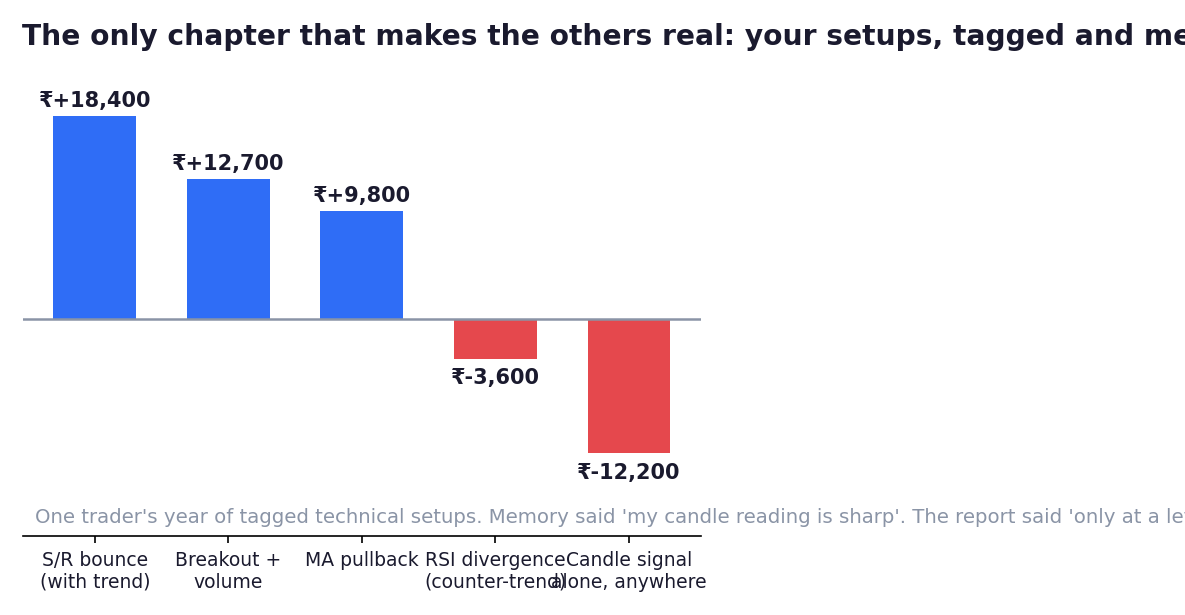
Rule three — judge process, then outcome, never feelings. When the sample is in, the strategy-filtered Report reads the verdict: win rate, average R, expectancy, drawdown — per setup. Read it with Psychology-school eyes: good setups have losing months and broken setups have lucky streaks, which is why you also tagged the witnesses (all four present? or three and a hunch?). A setup executed correctly and losing over 40 trades is refuted. A setup executed sloppily and winning is untested. The ledger knows the difference. You don't.
Rule four — sentence accordingly. The verdicts write your toolkit for you. The setup with 45 trades and positive expectancy: sized up. The one that only works with the tide: its counter-tide version banned (you watched a trader make this exact discovery in the Playbooks' final chapter — 'my retest entries win, my first-tick entries lose'). And the beloved setup that 40 honest trades expose as your donation channel: retired. However good it feels. The menu prunes itself — and you already know what short menus mean.
Run this honestly for two quarters and something almost funny happens:
Your chart gets emptier. The seventeen-lens kaleidoscope dies of natural causes — untested lenses stop earning screen space. What remains: a clean chart, your two frames, your zones, one receipt line, maybe one speedometer, two or three setups with ledgers behind them.
That's what a professional's screen actually looks like. Not minimalism as fashion —
everything on it has survived a trial.
Remember Chapter 01's lab? You wrote down what you saw on a chart, before any of this. Go do the second half now — fresh chart, same two minutes. Read your 'before' note. That distance is what you built.
And remember the tracker one last time. Ask him how he knows a deer's print from a goat's, and he won't quote a book. He'll tell you about the hundred times he followed the print all the way to the animal — and checked.
You can see the footprints now.
Go follow yours to the ledger. And check.
Key Takeaway
Fluency isn't edge — memory keeps highlights and deletes failures. So: no anonymous trades (Strategy tag before entry), 30–50 trade samples at trial size, verdicts from strategy-filtered Reports (process first), sentences executed without mercy. Indicator soup dies naturally; what survives your trials is your actual edge.
Think About It
Name your favourite setup — now state its win rate and expectancy over its last 30 trades. If you can't, complete this sentence honestly: 'I have been risking money on it because ___.'
Chart Lab — The Trial Begins (Graduation)
The graduation exercise. It runs for one month:
One month of this teaches more about YOUR edge than a year of watching other people's charts. The school ends here.
The trial never does.