

You've waited five chapters for candles, and that was deliberate.
Because here is the dirty secret of every candlestick course ever sold: a candle, by itself, means almost nothing. Teaching candles first — the way everyone does — is teaching words to someone with no sentences to put them in. You now have sentences: you know who fights (Ch 02), where the battles matter (Ch 04), and which way the war is going (Ch 05).
Now you're ready to read the fights. Start where candles started.
In the 1700s, in Osaka, Japan, the world's first real futures market traded rice — and its legendary figure was a merchant named Munehisa Homma. Folklore credits him with runs of winning trades so long they made him a myth, and a private network of messengers relaying prices across Japan.
But Homma's edge, by his own tradition, wasn't faster rice news. It was a realisation that was revolutionary then and is still under-taught now: the price of rice reflected the emotions of rice traders as much as the rice. Fear and greed left marks — and if the marks could be drawn, the crowd could be read.
The drawing his tradition produced is on your screen right now: the candlestick. (It stayed a Japanese secret for two centuries, until a Western analyst named Steve Nison imported it around 1990. Within a decade, it owned every platform on Earth.)
So — what IS a candle? Not a symbol to memorise. This:
A candle is the summary of one round of a fight.
For its timeframe — five minutes, one day (your shutter, Ch 03) — buyers and sellers fought. The candle records the round in two parts:
- The body — open to close — is the territory actually captured and held. Green: buyers ended the round in control. Red: sellers.
- The wicks — the thin lines beyond the body — are the failed attacks: prices reached during the round that could not be held. Every wick is a rejection. Someone pushed there. Someone else threw them out.
Body = who won. Wicks = who tried and got rejected.
That's the entire grammar. Ten words. Every exotic pattern name ever coined is a sentence written in it — which means once you can read the grammar, you can read patterns nobody ever taught you. That was Promise One from the intro, and it comes due today.
But before a single example — the rule that governs ALL of them, the intro's deepest idea coming home:
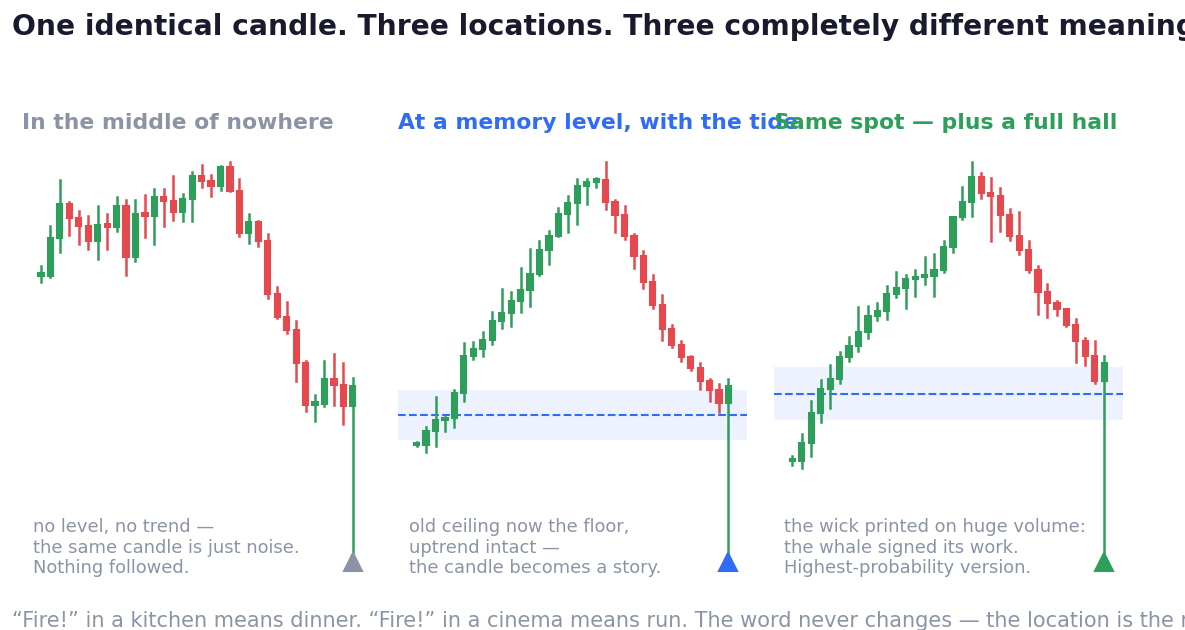
*"Fire!" in a kitchen means dinner. "Fire!" in a cinema means run.*
A candle is a word. The location is the meaning. Look at the figure below before reading on — the same identical candle, in three locations, with three completely different meanings. In the middle of nowhere: noise (fights happen constantly; most decide nothing). At a memory zone, with the tide: a story. At the zone, with the tide, in a full hall: the highest-probability version of the story. Same wick. Same body. The location did all the work.
Every course that showed you a pattern floating in empty space taught you a word with no sentence. Never read a candle again without first asking Chapter 04's question: where is this standing?
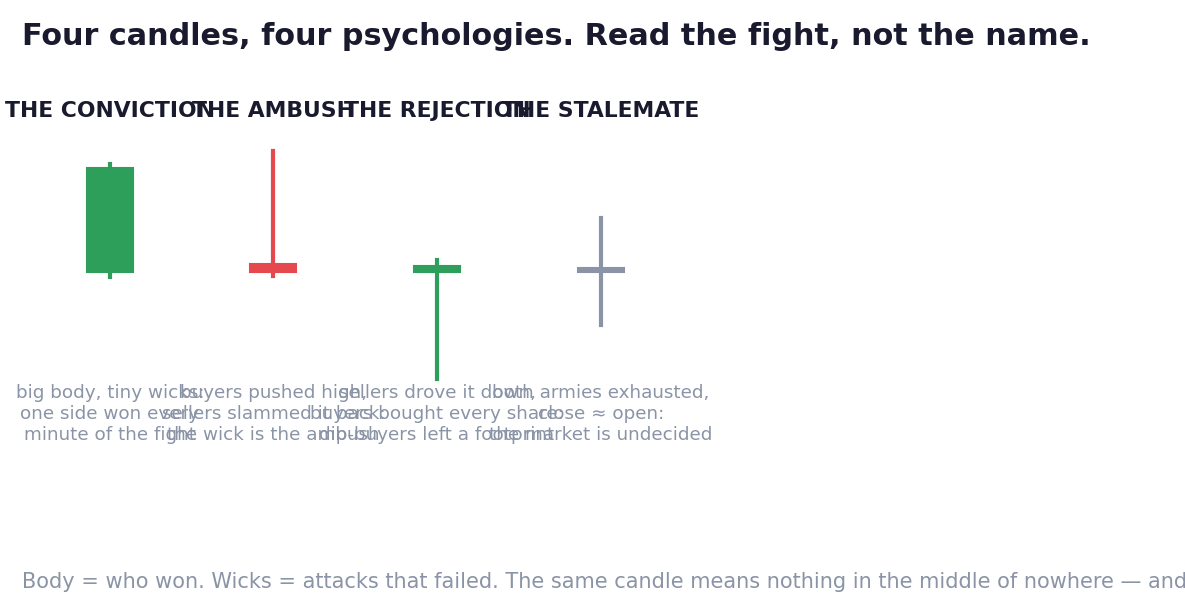
Now — the four fight-psychologies that replace the forty flashcards. Each one taught IN a location, the only way they should ever be taught:
1. The Conviction. A huge body, almost no wicks — one side won every minute of the round, no rejection, no argument. (Flashcard sellers call it a marubozu; you don't need the word.) Read it by location: a conviction candle breaking a memory level is the dam bursting with real force — three crowds buying at once. The same candle in the middle of a range is just a lurch between the walls. Urgency at a level is information. Urgency in a vacuum is Tuesday.
2. The Ambush. After a rally, into a resistance zone: a long upper wick, small body closing near the lows. Read the round: buyers charged into the ceiling — and met sellers who threw them ALL the way back. Everyone who bought that wick is now trapped above the market, in loss, hoping (you know from Ch 04 exactly what they'll do at break-even). And ask Chapter 02's question: who had enough supply to absorb a full charge of buying at the ceiling? The wick is somebody's distribution, printed.
3. The Rejection. After a decline, into a support zone: a long lower wick, body closing near the highs. Sellers panicked price deep into the zone — and someone bought every share they threw, lifting the round back before the bell. The crowd doesn't absorb panics; the crowd IS the panic. Long lower wicks at meaningful zones are the mandi buyer's signature — the dent the elephant leaves. This is the exact candle in the figure, and the exact read Meera made in Chapter 01.
4. The Stalemate. Open and close nearly equal, wicks both ways — both armies attacked, neither held ground. (The doji, if you must.) In empty space: the market resting, meaning nothing. But after a long, steep trend? The side that was winning effortlessly suddenly couldn't win at all. The first silence after a long argument — and silences after arguments deserve attention. At distribution-suspect tops (Ch 05), stalemates are how the handover often looks up close.
(An honourable fifth you can now read unaided: one candle's body completely swallowing the previous one — the Engulfing. Don't memorise it. Just ask: what happened to every trader who acted during the first candle? All of them, underwater in one round. That's what a change of control with force looks like.)
Two final disciplines, and they're both warnings:
Wicks are also weapons. The obvious rejection wick at the obvious level is exactly what a stop hunt looks like while it's happening (Ch 02's painted footprints; the Playbooks' dam chapter). One candle — even a beautiful one, even in the right location — is ONE witness. Your checklist exists because witnesses lie alone and rarely lie together. Which brings the third question home:
Checklist question #3 — the trigger: at my level, with my tide, did the fight itself go my way? You don't buy a zone because price arrived there. You buy it when the round shows the zone being defended — the rejection printing, the stalemate breaking your way, the conviction candle confirming. And the fight hands you your risk for free: the wick's extreme is where your stop-loss lives, because if price returns past the rejection, the rejection was a lie.
One witness to go. The one that checks whether the hall was full.
Key Takeaway
A candle is one round of a fight: body = territory held, wicks = attacks rejected — ten words of grammar that replace forty flashcards. But the word only means something somewhere: the same candle is noise in a vacuum, a story at a memory zone with the tide, and a case when the hall is full. Checklist question #3: did the fight AT my level go my way? The wick's extreme is your stop.
Think About It
The last candle pattern you traded because it 'appeared' — where was it standing? Was it a word in a sentence, or a word floating in space? And who might have wanted you to see it?
Chart Lab — Narrate the Fight (In Its Place)
Every evening for two weeks, narrate yesterday's daily Nifty candle in plain words — who won the round, where did attacks fail, who's trapped and hoping. No pattern names allowed.
Then, the location drill this chapter exists for: find in the last six months —
Put the two side by side. That comparison — same word, different sentence — is this entire chapter in one screenshot. Save it. It will make you more money than every pattern PDF you've ever downloaded.