

Let's play a game.
I'll flip a coin.
Heads — you win $150.
Tails — you lose $100.
One flip. Real money. Do you accept?
Take a second and answer honestly.
If you hesitated — or said no — you're completely normal.
When psychologists offer this exact bet to people, most refuse it.
Now look at the math.
Half the time you win $150. Half the time you lose $100.
On average, this game pays you $25 every single flip.
A bank would beg to play this game all day, every day, forever.
Yet most humans walk away from it.
Why?
Because somewhere in your brain, a $100 loss feels bigger than a $150 win.
Psychologists spent decades studying this, and what they found changed economics forever — it even won a Nobel Prize.
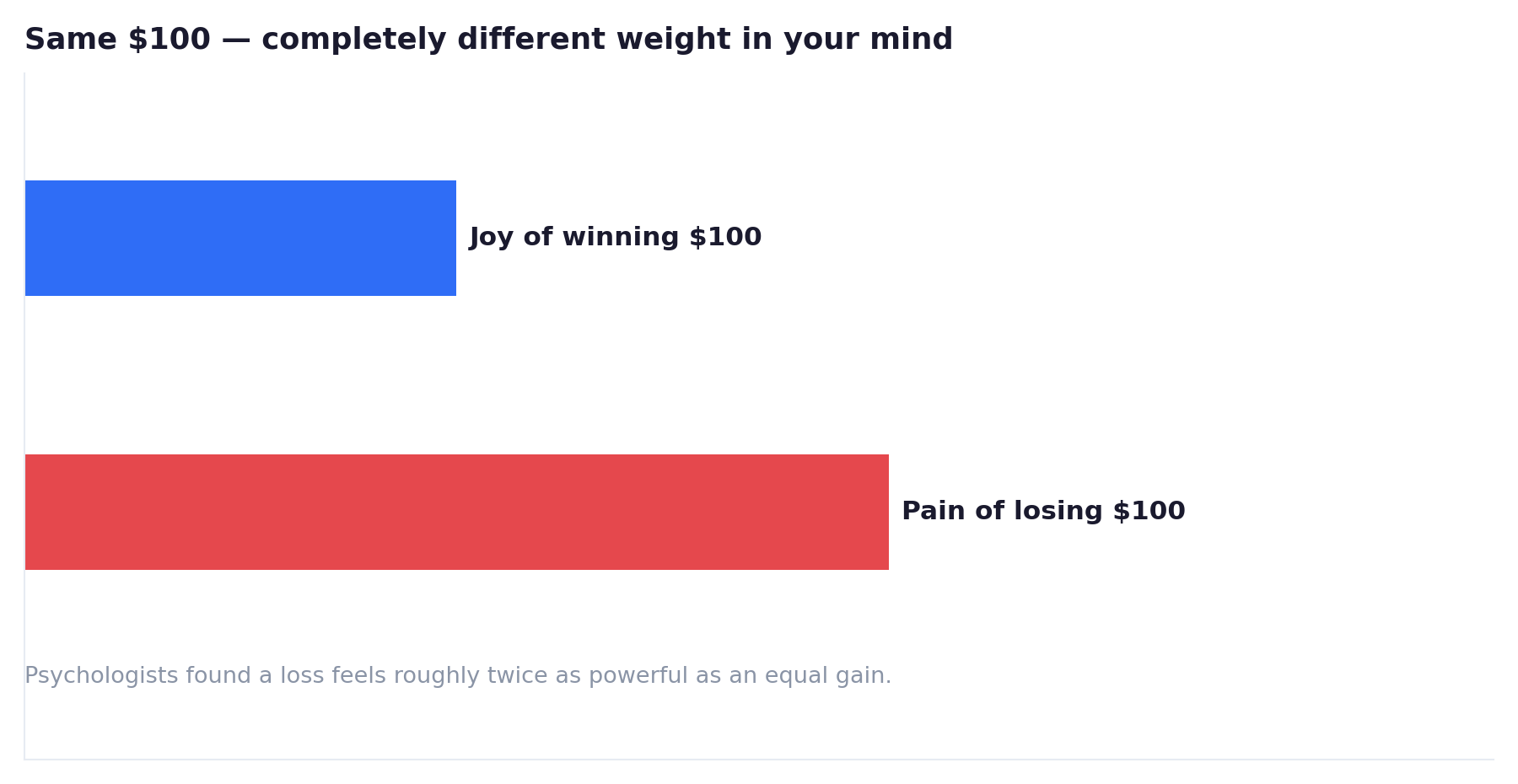
A loss feels roughly twice as powerful as a gain of the same size.
Losing $100 hurts about as much as winning $200 feels good.
Think about your own life for a moment.
Imagine walking down the street and finding $500.
Great feeling. You'd smile. You'd tell someone.
Now imagine opening your wallet and discovering you've lost $500.
That feeling is not the same size.
It's sharper. It lingers. You'd replay it all day. Where did I drop it? How could I be so careless?
Same amount of money.
Completely different weight in your mind.
Nothing about this is stupid or weak — it's ancient wiring.
For your ancestors, losing their food supply could mean death, while gaining extra food was merely nice.
So the brain learned to treat losses as emergencies.
Now bring this wiring into the market, and watch what it does.
A trader buys a stock at $100.
It falls to $80.
Logic says: ask whether the reason you bought is still true. If not, sell, take the small loss, move on.
But the wiring says something else.
The wiring whispers the most expensive sentence in trading:
"It's not a loss until I sell."
So the trader waits.
Not because they believe in the company.
Because as long as they don't sell, they don't have to feel the loss.
The falling stock is like a wound they refuse to look at — as if not looking could heal it.
$80 becomes $60.
$60 becomes $40.
A small cut has become a deep one, all in the name of avoiding pain.
Now watch the same wiring on the other side.
Another stock the trader bought rises from $100 to $115.
The gain feels wonderful — and fragile.
What if it disappears? Lock it in. Take it before the market changes its mind.
So they sell — quickly.
And often watch the stock keep climbing for months without them.
Put both habits together and you get the strangest pattern in all of trading:
Beginners hold on to their losers and rush to sell their winners.
It's like tending a garden by pulling out your flowers and watering your weeds.
Nobody would garden that way.
But almost everybody feels that way.
Because holding the loser avoids pain today, and selling the winner grabs pleasure today.
The wiring always votes for today.
The account balance pays for it tomorrow.
Key Takeaway
Losses feel about twice as powerful as equal-sized gains. Until you know this about yourself, you will hold losing trades too long and sell winning trades too early — not because it's smart, but because it feels better.
Think About It
If a loss only becomes "real" the moment you sell... where exactly was it hiding before that?
Psychology Lab — The Coin-Flip Test
Run the coin-flip experiment on three friends or family members.
Offer them the bet from the start of this chapter: heads they win $150, tails they lose $100 (imaginary money is fine).
Count how many say no.
Then show them the math — that the game pays $25 per flip on average — and watch their faces.
Most people will still feel uneasy, even after seeing the numbers.
That gap — between what the math says and what the feeling says — is exactly the gap this entire school is about.