

It's Saturday night.
The most popular restaurant in your city is completely full.
Two hundred people. Two hundred orders. One kitchen.
Now walk into that kitchen and watch the head chef.
No panic. No confusion. No debate.
An order comes in — "two butter chicken, one dal makhani" — and hands start moving before the sentence is even finished.
Here's the secret, and it's almost disappointingly simple.
Nothing being cooked tonight is being invented tonight.
The menu was decided months ago.
Every dish on it has been cooked hundreds of times.
Every recipe has exact steps: how much butter, how long on the flame, when to plate.
When an order arrives, the kitchen doesn't decide anything.
It recognizes the order, and it runs the recipe.
And when a customer asks for something that isn't on the menu?
The restaurant politely says no.
Not because the chef couldn't attempt it.
Because attempting dishes you've never practiced, during your busiest hour, is how kitchens burn food — and money.
Now imagine the opposite kitchen.
No menu. Every dish invented on the spot, based on the chef's mood and a quick glance at the customer.
Some dishes would be brilliant.
Most would be inconsistent.
And on a stressful night, that kitchen would fall apart completely.
Here's the uncomfortable question.
Which kitchen is your trading?
Most traders run the second kitchen.
Every morning is improvised. Every trade is a new invention. Every decision is made live, under pressure, with money on the stove.
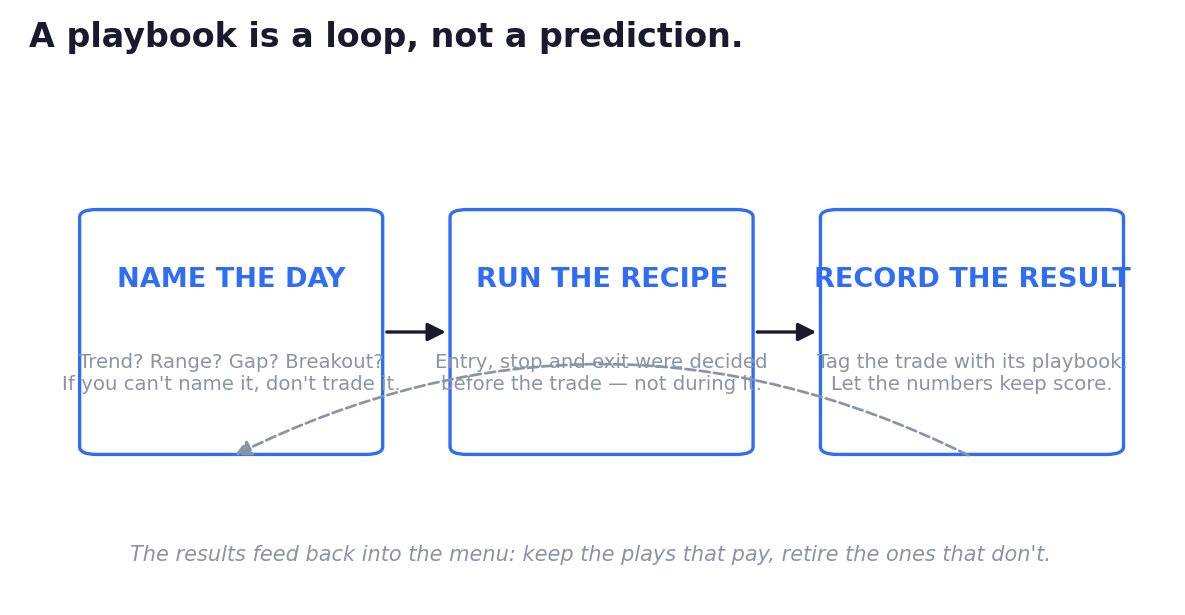
A playbook is how you become the first kitchen.
A playbook is a short menu of market situations you've studied deeply — each with a name, a recipe decided in advance, and a rule for when it applies.
When you see the situation, you don't decide. You recognize, and you run the recipe.
And when the market serves up a day that isn't on your menu?
You politely say no.
Here's the good news that makes all of this possible.
The market feels infinite, but it isn't.
It keeps serving the same handful of dishes, over and over:
- Some days it opens with a jump and has to decide what that jump means.
- Some days it picks a direction in the first hour and trends relentlessly until close.
- Most days it just ping-pongs between a floor and a ceiling.
- Sometimes it breaks out of a box it's been stuck in for days.
- Sometimes it stretches too far from its average and snaps back like a dog on a leash.
- And in India, twice a week, the options market throws its own strange party called expiry.
That's the menu.
Seven classic plays. This school teaches you to recognize each one, hands you the recipe, and shows you the trap hiding inside it.
Then the final chapter shows you the step that separates a hobby from an edge: putting a name tag on every trade, so the numbers — not your memory — tell you which plays actually pay you.
Welcome to the School of Playbooks.
Stop inventing. Start recognizing.
Key Takeaway
A playbook is a named market situation plus a response decided in advance. Amateurs make decisions during the trade. Professionals make them before it — and politely refuse the days that aren't on their menu.
Think About It
Think about yesterday's market session. Could you describe it in one word — trend, range, gap, breakout? If you can't name the day, what exactly were you trading?
Playbook Lab — Name the Day
For the next five trading sessions, do nothing except this:
At 3:30, write down one word describing the day: Trend, Range, Gap & Go, Gap Fill, or Breakout.
Don't trade differently. Don't judge yourself. Just name.
By day five, something strange happens: the chart stops looking like chaos and starts looking like a menu.
That's the moment this school begins to work.