

You're at the airport, running late.
You step onto the travelator — that long, flat moving walkway — and suddenly you're gliding. Normal steps, double the speed.
Now watch a child play the opposite game: walking against it.
Working furiously. Going nowhere. Slowly sliding backwards.
The travelator doesn't care how determined the child is.
It just keeps moving in its direction.
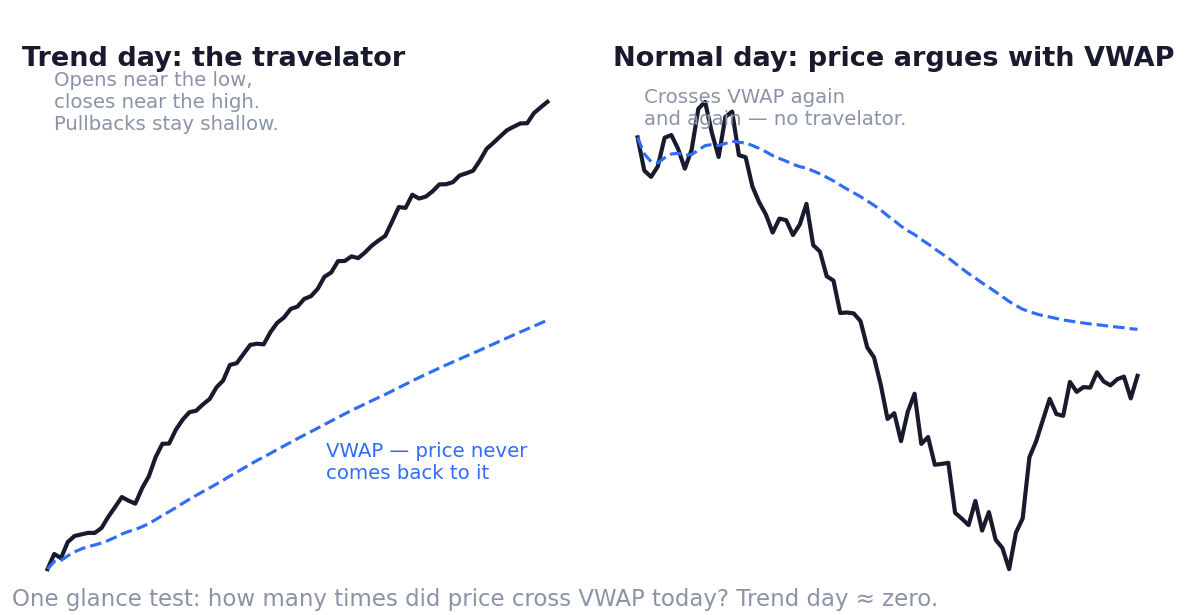
Two or three days a month, the entire market becomes a travelator.
These are trend days — and they are the most dangerous and the most profitable days on the calendar, depending entirely on which direction you're walking.
The fingerprints of a trend day:
- The market opens near one extreme of the day and closes near the other.
- If it gapped up, the gap never fills — early sellers keep getting run over.
- Pullbacks are shallow and brief. The dips keep getting bought (or, on a down-trend day, the bounces keep getting sold).
- Price stays on one side of VWAP almost the entire session, barely touching it.
- And every hour, some voice — on TV, on X, inside your own head — says "it's gone too far, it has to reverse." It doesn't.
That last fingerprint is the killer.
Because the most expensive sentence in intraday trading is:
"It can't go any higher."
It can.
Remember the School of Market Science: price rises because buyers keep outbidding each other for a limited number of willing sellers.
The market does not know it has "already gone up a lot."
There is no fairness meter.
There is no rubber band that snaps just because you're tired of watching it stretch.
Traders who fade a trend day — shorting an up-move again and again, adding to losers because "now it's really overdone" — can lose in one session what took a month to earn.
It's the child on the travelator.
Except the child is your account.
So, the playbook, in three lines:
- Never fight it. On a trend day, the mean-reversion playbook (Chapter 7) goes in the bin for the day.
- Join the pullbacks. The shallow dips toward VWAP or the rising trendline are the entries. Chasing full-speed green candles is not required.
- Overstay your comfort. Trend days close at their extreme far more often than feels reasonable. Trail your stop and let the close pay you, instead of grabbing the first small profit and watching the rest leave without you.
The hardest part of a trend day isn't the trade.
It's the sitting.
Key Takeaway
On a trend day there is one correct direction and an unlimited supply of expensive opinions. Ride the travelator or step off it — but never walk against it.
Think About It
Recall the last time you thought 'this has gone too far, it must reverse.' Was that a signal coming from the market — or a feeling coming from you? What was the market actually doing at that moment?
Playbook Lab — Autopsy of a Travelator
Find the most recent trend day on Nifty — a day that opened near its low and closed near its high, or the reverse.
Now study it like a detective:
Total up that imaginary damage. That number is why this chapter exists.