

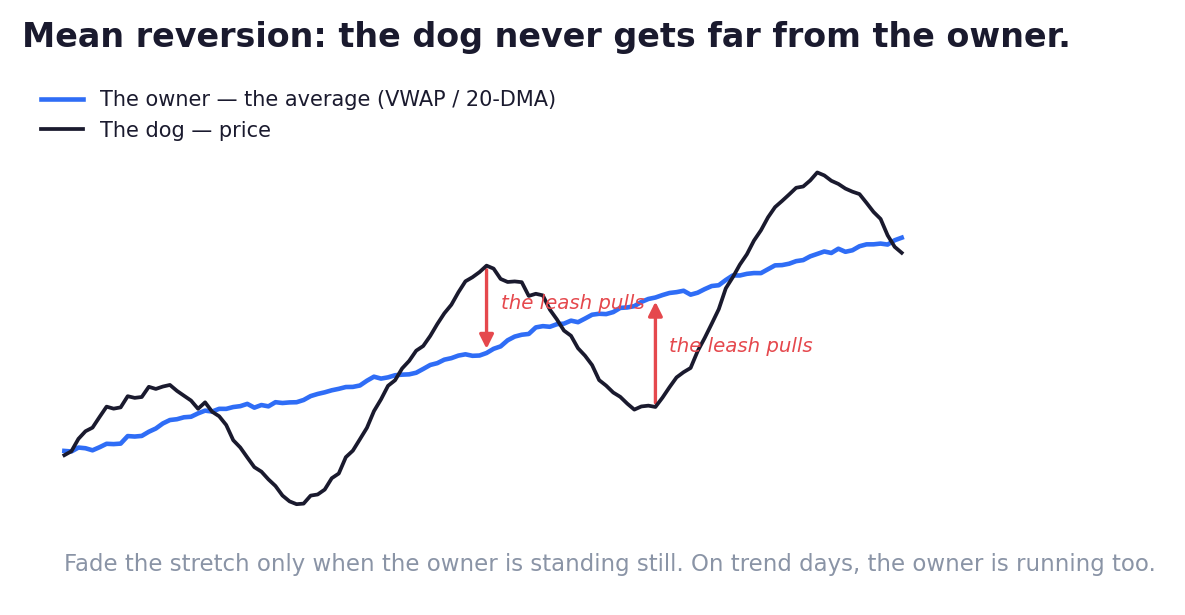
Watch a man walking his dog in a park, on one of those long retractable leashes.
The man walks in a fairly straight line.
The dog does not.
It sprints ahead. Darts left at a squirrel. Lags behind to sniff something. Sprints again.
If you drew the dog's path on paper, it would look like pure chaos.
But there is one thing the dog can never do:
Get further from the man than the leash allows.
Every sprint ends the same way — the leash tightens, and the dog comes back toward the owner.
This is one of the oldest and most useful pictures in all of trading.
Price is the dog. Its average is the owner.
Intraday, the "owner" is usually VWAP — the day's volume-weighted average price.
On daily charts, it might be the 20-day moving average.
Price sprints away from its average all the time — a burst of excited buying here, a small panic there.
But on a normal day, without real news, the stretch doesn't last.
The further the dog runs, the harder the leash pulls.
That pull back toward the average is the mean reversion play:
- Price has stretched unusually far from its average — further than it typically does — without any real news or event driving it.
- You fade the stretch: sell into the sprint up, or buy into the panic down.
- Your target is honest and small: the average itself. You're betting the dog returns to the owner — not that it sprints to the other end of the park.
- Hard stop-loss, small size. If the stretch keeps stretching, you were wrong — and you leave cheaply.
Simple. Calm. And it works on most days — because most days, as Chapter 4 showed, are range days, and range days are exactly when the leash is strongest.
Now slow down, because what comes next is the most important warning in this entire school.
On a trend day, the owner is running too.
Look at the picture again. Mean reversion works because the owner walks slowly, so every sprint gets pulled back.
But on a trend day, the average itself is moving — fast, and in price's direction. VWAP is climbing all session.
The dog sprints, and instead of the leash tightening...
...the owner catches up.
The stretch never snaps back. It simply re-forms, higher and higher, all day.
Traders who fade a trend day because "it's too stretched, it has to revert" are the child on the travelator from Chapter 3 — except now they're adding to the position every time it gets "even more stretched."
This is, without exaggeration, one of the fastest known ways to hand back a month of profits in a single afternoon.
So understand what these chapters have quietly been telling you.
Trend following (Chapter 3) and mean reversion (this chapter) are not rivals.
They are tools for different days.
One works precisely when the other fails.
Which is why the very first skill of this school — naming the day before trading it — always comes first.
Fade the stretch when the owner is standing still.
When the owner is running... run with him.
Key Takeaway
Price is a dog on a leash — every sprint away from the average gets pulled back. But on trend days the owner is running too, and the leash never tightens. Name the day before you pick the play.
Think About It
Have you ever added to a losing counter-trend trade because it was 'even more overextended now'? At that exact moment — was the leash pulling, or was the owner running?
Playbook Lab — Measure the Leash
Open a Nifty daily chart with a 20-day moving average.
Find the three widest gaps between price and the average over the past six months.
Then find one trend day where "stretched" simply became more stretched.
Ask what was different — was there news? Was the average itself climbing?
Learning to measure your market's normal leash length is the entire edge of this playbook.