

Picture a dam holding back a river.
For weeks, the water level rises.
Slowly. Quietly. Nothing dramatic on the surface.
But pressure is building against the same wall, day after day.
Then one day the water reaches the top.
And it doesn't trickle over.
It floods — because weeks of stored pressure release all at once.
A stock stuck below the same price level for days or weeks is that dam.
Every time price touches the level, sellers defend it.
Every time it dips, buyers quietly accumulate.
The chart looks boring. The pressure is anything but.
And here's the crucial detail, straight from the School of Market Psychology: everyone is watching the same wall.
The level is obvious. It's on every chart, every screener, every Telegram group.
Which is exactly why, when it finally breaks, three groups all buy at the same moment:
- Breakout traders enter, because that's their signal.
- Short sellers who bet against the level rush to exit — and exiting a short position means buying.
- FOMO traders who watched the whole build-up finally jump in.
Three groups. One direction. At once.
That's the flood. That's why real breakouts move so fast.
But now the uncomfortable part — the part every breakout trader eventually learns with real money if nobody warns them first.
Sometimes the flood is fake.
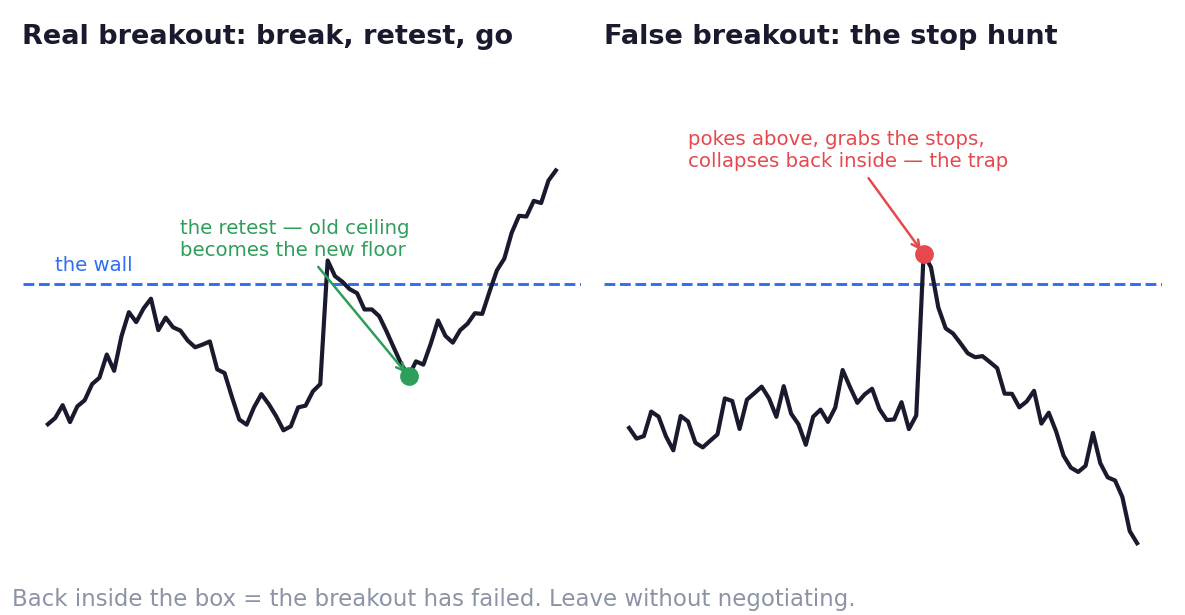
Price pokes just above the wall.
The stop-losses trigger. The FOMO buyers pile in.
And then... it collapses straight back inside the box, leaving everyone who bought the top stranded above the market.
This is the false breakout — and traders have a nickname for it: the stop hunt.
It exists for the very same reason real breakouts exist: the level is obvious to everyone.
Including participants large enough to push price through it briefly, collect all that forced buying, and sell straight into it.
The obvious level is the bait.
Sometimes the trap is loaded.
So the real playbook here is not "buy breakouts."
It's separating the flood from the fake:
- Don't buy the first tick above the level. The first tick is where the trap is set.
- Wait for proof. A strong, decisive close beyond the level is proof. Even better is the retest: price breaks out, comes back to touch the old ceiling — and the old ceiling now behaves as a floor. Old resistance becoming new support is the breakout shaking your hand.
- Stop-loss below the broken level. If price falls back inside the box, the breakout has failed. You leave. Without negotiating. Without averaging. Without "giving it a little room."
A failed breakout isn't an insult.
It's information — and quite often, it's the beginning of a very good move in the opposite direction.
Key Takeaway
Breakouts are powerful because trapped traders fuel them. False breakouts are powerful for exactly the same reason — except this time the trapped trader is you. The retest is how you tell the flood from the fake.
Think About It
The last breakout you bought — did you buy proof, or did you buy the fear of missing the move? What would waiting for the retest have cost you... and what would it have saved you?
Playbook Lab — Flood or Fake
Pick three recent breakouts on stocks or indices you follow.
For each one, answer:
Then find one false breakout from recent weeks and put it side by side with a real one.
Study the difference in those first 30 minutes. That difference is the whole playbook.