

Watch a good ping-pong rally.
The ball travels the same journey again and again.
One end. The net. The other end. Back.
Each paddle sends it back the moment it arrives.
Nobody watching expects the ball to fly off the table on every shot.
The rally is the game.
Now here's a number that surprises almost everyone:
Most trading days are ping-pong days.
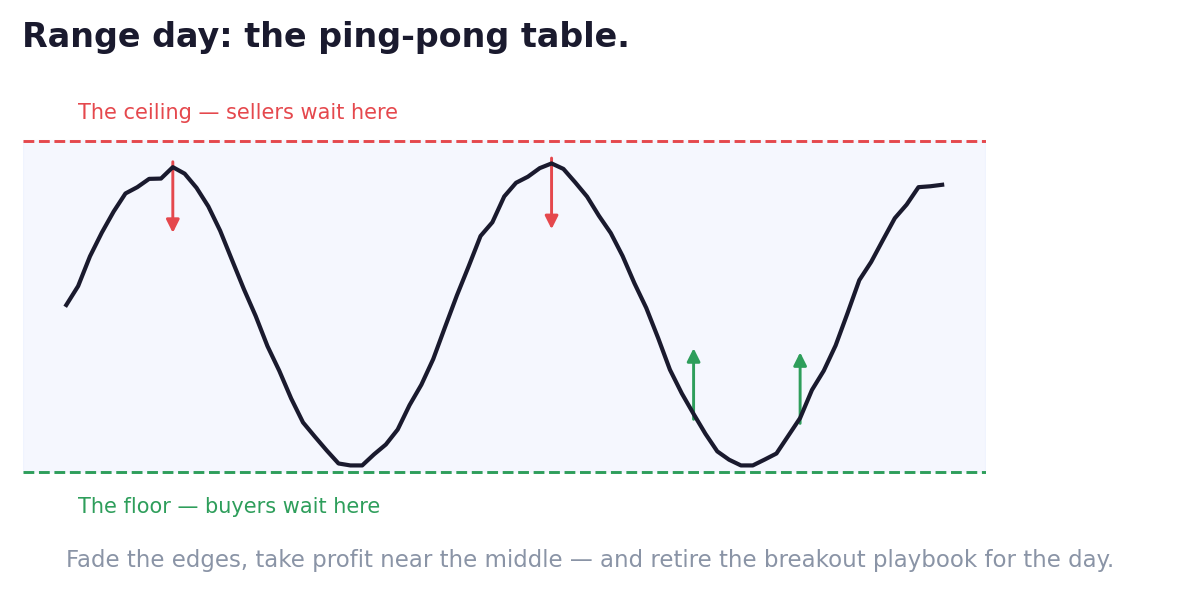
Depending on how you count, roughly six or seven days out of ten, the market opens, wanders up until it hits a ceiling where sellers are waiting, drifts down until it finds a floor where buyers are waiting — and repeats that journey until 3:30.
No story. No drama. No travelator.
Just a rally between two paddles.
These are range days, and their fingerprints show up early:
- The morning gap, if there was one, fills quickly. (Chapter 5 explains why that's a tell.)
- Price crosses VWAP again and again — neither side can hold the ball.
- The morning high and the morning low keep rejecting price. Every visit gets slapped back.
- "Breakout" attempts die within minutes — a quick poke past the edge, then straight back inside.
Once you recognize the table, the playbook is calm and almost boring:
- Buy near the floor. Sell near the ceiling. The edges are where the paddles are.
- Take profit near the middle, not at the far side. The room is small; your targets must be smaller.
- Small size, small expectations. A range day pays in coins, not notes.
And now the one rule that matters more than all the others combined:
On a range day, retire the breakout playbook.
Every "breakout" on a range day is a paddle waiting to smack the ball back.
Chasing the edge — buying the ceiling because "it's finally breaking!" — is the single most common way traders donate money on quiet days.
One last honest warning, and it's about you, not the chart.
Range days are boring.
And boredom is a trading emotion — the School of Market Psychology showed you what your wiring does when it's under-stimulated. It invents excitement.
Bored traders invent trades to make something happen.
On a range day, the professionals' most common position is smaller.
Or none at all.
Key Takeaway
Most days are range days. The edges pay, the middle chops, and every breakout is lying until proven otherwise. If the day is boring, the correct trade is often boring too — or absent.
Think About It
Look at your losing trades from the last month. How many were breakout trades taken on days that, in hindsight, were obvious ping-pong days? Was the problem the playbook — or the day you used it on?
Playbook Lab — The Table Count
Take the last ten Nifty sessions.
For each one, answer two questions: did the opening gap (if any) fill within the first hour or so — and did price cross VWAP more than three times?
Two yeses = range day.
Before counting, write down your guess for how many of the ten will qualify.
Most traders guess three or four. Count, and see what the market actually serves most often.