

You go to sleep at 11 p.m. The family group chat is quiet.
You wake up, reach for your phone, and see it:
547 unread messages.
Something happened at 2 a.m.
An argument. An announcement. A wedding date. Who knows.
The conversation didn't wait for you.
And here's the important part: the first message anyone sends this morning starts from wherever the conversation is now — not from where it was when you fell asleep.
The Indian market sleeps from 3:30 p.m. to 9:15 a.m.
The world doesn't.
While our exchanges are closed, US markets trade a full session. Company results drop. Crude oil moves. Central banks speak. News breaks.
So at 9:15, the market does exactly what you do with the group chat: it reads all the overnight messages at once — and opens directly at the new level, in a single jump.
That jump is the gap.
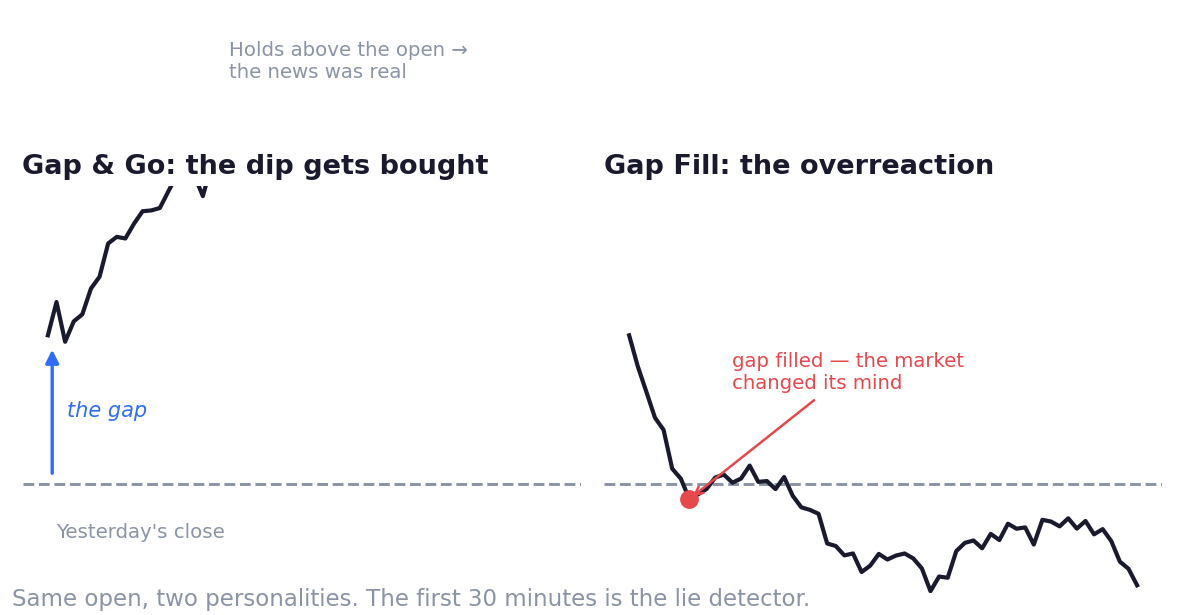
A gap up: today's open is above yesterday's close.
A gap down: below it.
Nothing mysterious. Just overnight information being priced in one step instead of many.
Now, here's what makes gaps a playbook and not just trivia.
A gap has two possible personalities, and telling them apart early is the entire game.
Personality one: Gap & Go.
The overnight news was real — and the gap actually underpriced it.
Price dips briefly after the open, the dip gets bought, and the market holds above its opening price.
The gap wasn't the whole move. It was the first step of one.
Gap & Go mornings frequently grow into full trend days (Chapter 3).
Personality two: Gap Fill.
The overnight reaction was an overreaction.
Sellers show up within minutes, price loses the opening level, and it walks steadily back toward yesterday's close — "filling" the gap.
The market read the 547 messages, thought about them for half an hour... and changed its mind.
So how do you tell which personality showed up today?
You already own the tool: the opening range (Chapter 2).
- Gap up, and price holds above the open and above the opening-range low? The go is on.
- Gap up, but price loses the opening level within the first half hour and keeps bleeding? The fill is in progress — and fighting it is expensive.
The first thirty minutes is the gap's lie detector.
One famous myth needs a funeral before this chapter ends:
"Gaps always fill."
They often do — eventually.
But "eventually" can arrive after your stop-loss, your margin, and three months of waiting.
A gap on genuinely big news may never revisit yesterday's close at all.
Trade the personality the gap is showing you today — not a proverb about what gaps do "always."
Key Takeaway
A gap is the market reading its overnight messages in one jump. The first thirty minutes tells you whether the jump was the start of a story — or an overreaction about to be walked back.
Think About It
When the market gaps against a position you're holding, what's your honest first instinct — to re-read the new information, or to wait for the price you feel you 'deserve' to come back?
Playbook Lab — The Gap Diary
Over the coming weeks, log the next five mornings where Nifty opens with a gap of roughly a third of a percent or more.
For each one, record just three things: