

THE THEORIST
Who
Richard Demille Wyckoff (1873–1934), American trader, tape-reader, publisher
When & where
New York, 1900s–1930s — Wall Street's ticker-tape era, when he interviewed and studied the legendary operators of the day
Why he built it
Wyckoff started as a stock runner at 15, got rich reading the tape, then grew disgusted watching small investors get systematically fleeced by large operators' campaigns — and turned teacher, founding 'The Magazine of Wall Street' to level the field
The work
His courses and writings from the 1910s–30s, taught continuously for a century since — one of the few pre-computer methods still actively used
The device
The 'Composite Man': treat ALL big money as a single strategic operator, and interpret every chart as his campaign
Portrait sourcing
Public domain (pre-1928): Wikimedia Commons 'Richard Wyckoff'
Every school of charting eventually asks: who is on the other side of my trade? Richard Wyckoff answered it a century ago with a teaching device so vivid it never aged.
The man first: Wyckoff was no professor. He started on Wall Street at fifteen as a runner, learned to read the ticker tape like a novel, made his fortune, interviewed the legendary operators of his era — and then did something unusual for a rich insider:
He got angry. Watching small investors be fleeced, cycle after cycle, by the campaigns of large operators, he switched sides and became a teacher — founding a magazine and a course with one goal: show the small trader how the big game actually works.
His central teaching trick is the Composite Man, and it works like this:
Stop imagining 'the market' as millions of anonymous participants. Instead, imagine every large, informed player — the funds, the operators, the patient money — fused into one single man, sitting behind the tape, running deliberate campaigns.
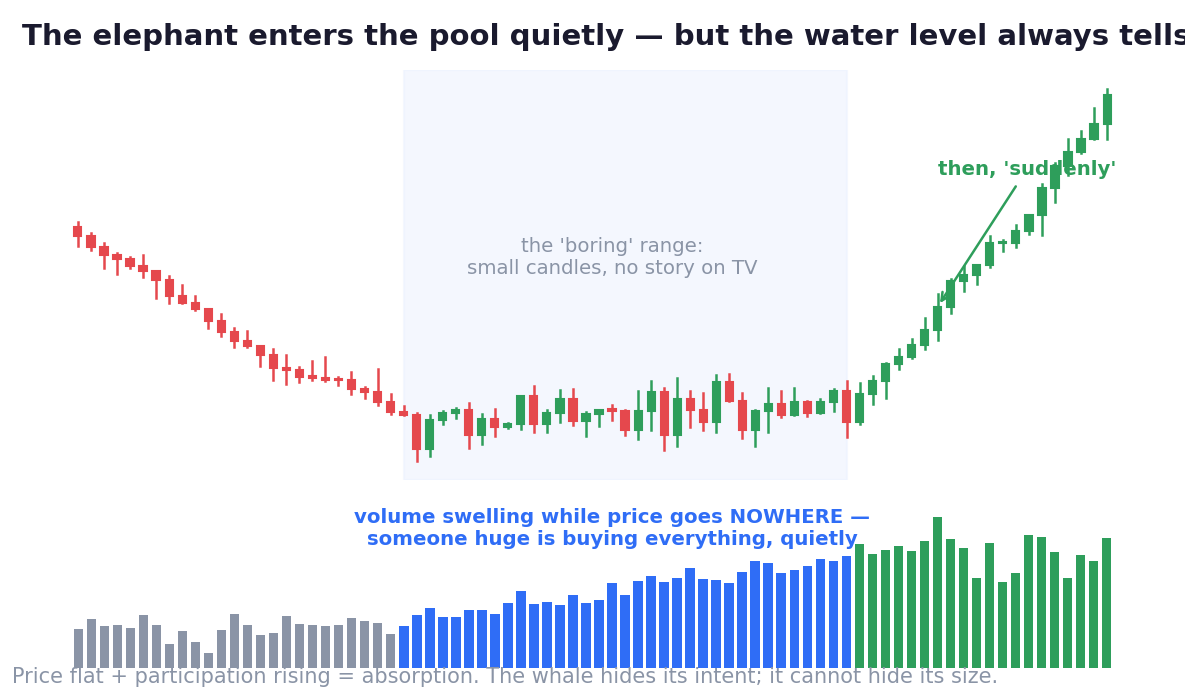
Is he real? Of course not. That's not the point. The point is that big money, in aggregate, behaves as if he were — because all large players share the same prison: they are too big to act quickly (a truth you may know from technical study: the elephant cannot enter the pool without raising the water). Size forces patience, and patience produces campaigns.
Wyckoff mapped the campaign in four repeating acts — and once you know them, you'll see them on nearly every chart, in every market, in every decade:
Act one — Accumulation. After a long decline, the Composite Man wants to buy huge quantities cheaply. So he does it slowly, inside a sideways range, absorbing every panic without pushing price up. The chart looks like nothing — boring, directionless. The boredom is the product: it shakes out the last impatient holders, who sell to him. Late in the act, Wyckoff's most famous signature often appears: the spring — a quick dip below the range that terrifies weak holders into dumping their final shares... straight into his waiting bids, before price snaps back inside. The fake breakdown IS the completed purchase.
Act two — Markup. Supply exhausted, he lets price rise — even helps it. Now the public notices; the trend becomes 'obvious'; the news improves. This is the phase everyone wishes they'd caught, purchased in the phase everyone found boring.
Act three — Distribution. Near his targets, he must now SELL enormous size — and the only people capable of absorbing it are an excited crowd. So he sells into strength, slowly, inside another sideways range, while headlines glow. The mirror of the spring — the upthrust, a fake breakout above the range that sucks in the last euphoric buyers — often marks his final sales.
Act four — Markdown. His inventory gone, support is withdrawn, and price falls to wherever the next campaign begins.
Sound familiar? It should — it's Dow's phases (Chapter 2) with a protagonist, and it's the same institutional footprint-reading modern price-action schools teach. Wyckoff simply got there first, from inside the machine, and gave it a face.
An honest word about the theory's status, in Chapter 1's spirit:
The Composite Man is a model, not a literal claim — there's no single operator (and modern markets, dense with algorithms and index flows, are messier than 1920s campaigns). Critics note Wyckoff phases, like Elliott waves, are far easier to label in hindsight than in real time. Both criticisms are fair. Yet the core mechanism — large money must act slowly, must disguise its actions, and therefore leaves structural footprints in ranges, springs and volume — rests on arithmetic, not mysticism, and it's why this hundred-year-old method still fills modern trading courses.
How to use the lens:
Interrogate every long sideways range with one question: is someone big doing something in here? Boring range after a long fall, on healthy volume = accumulation suspect. Choppy range after a euphoric rise = distribution suspect. What came before the boredom tells you who's likely working inside it.
Re-read fake breaks as campaign signatures. The breakdown that instantly reverses (spring) and the breakout that instantly fails (upthrust) stop being 'whipsaw bad luck' and become information: someone just finished shopping — or finished leaving.
And adopt Wyckoff's actual mindset, which is the real gift: stop asking "where will the market go?" and start asking *"what is the big money trying to do — and how do I walk behind it instead of in front of it?"* You're not predicting an ocean anymore. You're shadowing one very large man through a crowd.
Key Takeaway
Wyckoff fused all big money into one teachable character — the Composite Man — whose size forces campaigns: accumulate boredom (springs shake out the last sellers), mark up into belief, distribute into euphoria (upthrusts trap the last buyers), mark down. Use it by interrogating ranges (who's working in here?), re-reading fake breaks as signatures, and asking not where the market will go, but what the big money is trying to do.
Think About It
Recall a fake breakout or breakdown that stopped you out. Through Wyckoff's eyes: were you the victim of random whipsaw — or a small, necessary part of someone's campaign completing exactly on schedule?
Theory Lab — Shadow the Campaign
Find one completed cycle on any liquid stock or index: a long decline → a sideways range → a major uptrend → a topping range → a decline.
Label the four acts. Then hunt for the signatures: a spring (fake dip below the accumulation range that reversed) or an upthrust (fake break above the top that failed). Note the volume on those days.
Write the campaign's story in five sentences, from the Composite Man's point of view — what he wanted, how he used the crowd's fear, then its greed.
Then the forward-looking habit: find one CURRENT boring range in your market and write, without trading it, your hypothesis: accumulation, distribution, or genuinely nothing? Date it. Check back in two months. Shadowing is a skill of patience — start practising the patience.