

THE DAMAGE
When
Thursday, May 6, 2010, ~2:32 pm New York time
Where
US equity and futures markets
The fall
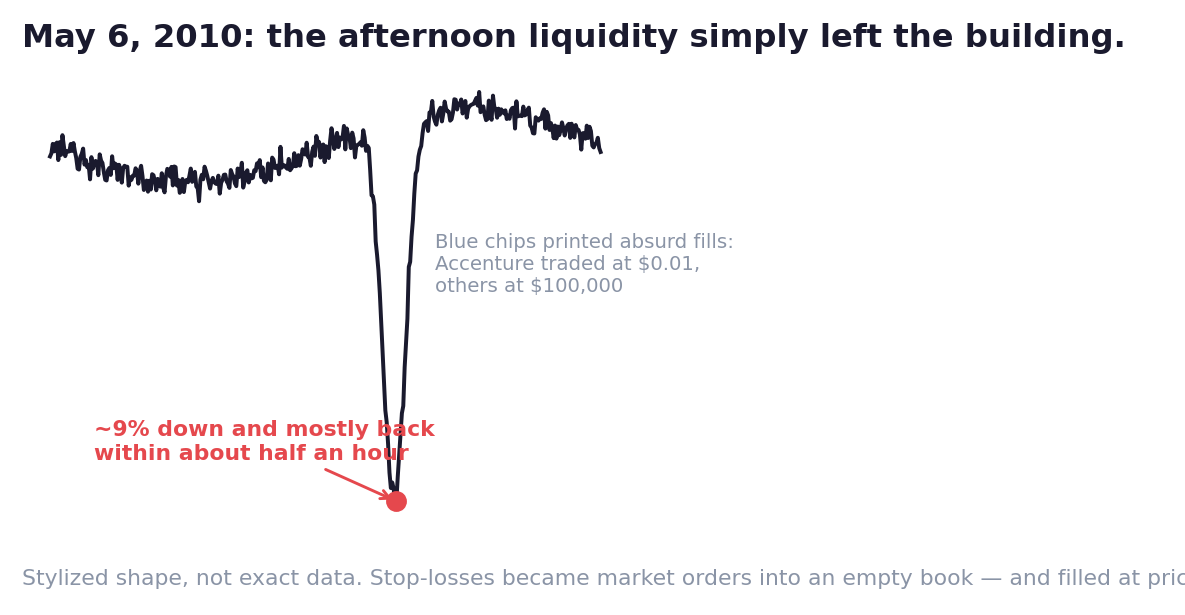
Dow −~1,000 points (~9%) within minutes; individual blue chips printed at $0.01 and at $100,000
Recovery
Most of the fall retraced within roughly half an hour; ~20,000 absurd trades were later cancelled
What changed
Single-stock circuit breakers ('limit up / limit down') introduced in the US
May 6, 2010 was a nervous but ordinary Thursday — Greek debt worries, a soft market, nothing historic.
At about 2:32 pm, a large fund began selling a very big futures position using an algorithm with one instruction: sell a fixed percentage of market volume, regardless of price or time.
What happened next took 36 minutes and became one of the most studied half-hours in market history.
High-frequency trading firms — the computers that normally provide liquidity, standing ready to buy and sell all day — bought the first wave of selling. Then, as prices kept falling and their inventories swelled, they did what their risk programs told them to do:
They switched off.
And here is the truth the Flash Crash exposed, the one every trader should tattoo somewhere visible:
*Liquidity is a fair-weather friend.*
The buyers at the top of the order book are volunteers. They are there because it's profitable and safe to be there. The moment it isn't — the moment they're most needed — they are allowed to vanish. And on May 6, they vanished at machine speed.
Prices fell into empty air.
The Dow dropped roughly a thousand points in minutes. And in individual stocks, the results turned surreal: with no real bids left, sell orders chased 'stub quotes' — placeholder prices — and Accenture, a $40 blue chip, printed trades at one cent. Other stocks traded at $100,000 a share. About 20,000 trades were later declared 'clearly erroneous' and cancelled.
Then the buyers' machines switched back on, and the market climbed most of the way back before the close.
Thirty-six minutes. Round trip.
Now — who actually got hurt, in a crash that reversed itself?
People with stop-losses.
Specifically, people with market-order stop-losses. A stop-loss, when triggered, becomes an order to sell at any available price. On a normal day, 'any available price' is a tick or two below your level.
At 2:45 pm on May 6, 'any available price' was, in some stocks, one cent.
Careful, disciplined investors — the ones who'd 'done the right thing' by setting stops — were sold out near the lows of a crash that un-happened twenty minutes later. Their protection executed perfectly, and perfectly destroyed them.
(India, take note: our markets have their own miniature flash events — freak trades on illiquid strikes and stocks where a fat-finger or a thin book prints absurd prices for a second. The physics is identical.)
🦢 Why Nobody Saw It Coming
Everyone assumed liquidity was a property of the market — always there, like water in the tap. It's actually a service provided by volunteers, and the volunteers are algorithms with off-switches. Nobody had modelled all of them switching off at once, in seconds, on no news.
⏳ The Time Machine
If you were there: The winners of May 6 did nothing for thirty minutes. The losers had SL-M (stop-at-market) orders in thin names — protection that executed perfectly at one cent. In a broken tape, every minute of inaction was worth money: most absurd fills were near the lows of a move that un-happened, and thousands of trades were later cancelled anyway.
If it repeats tomorrow: India prints its own freak trades — illiquid strikes, thin smallcaps, fat fingers. Use stop-limit protection where books are thin, check market depth before size, and adopt the broken-tape rule: when prices go visibly insane, your first action has the worst expected value of the day. Sit still, verify, then act.
🛡️ The Survival Rules
- Understand what your stop-loss really is: an instruction to sell at whatever price exists when it triggers. In a vacuum, that price can be absurd. For positions vulnerable to spikes, prefer stop-limit orders — accepting the trade-off that they might not fill at all.
- Respect thin liquidity. The lesson is loudest in illiquid stocks and far-OTM options, where 'flash crash' conditions exist on ordinary days. Check the depth of the order book, not just the last price.
- Don't act inside a broken tape. When prices go visibly insane — gaps of 30% in seconds, absurd prints — the worst decisions are made in the next five minutes. Halts and cancellations exist; panicking faster than the exchange helps nobody.
- Volatility is not always information. May 6 carried no news about any company's value. Sometimes the market's plumbing sneezes. Build rules that distinguish 'the world changed' from 'the machines glitched.'
Key Takeaway
The Flash Crash proved liquidity is a volunteer service that can vanish at machine speed — and that a market-order stop-loss means 'sell me at anything, even one cent.' Know exactly what your protection does when the order book is empty.
Think About It
Have you ever actually checked what your stop order turns into when it triggers — and what the order book of your least-liquid holding looks like at 9:16 am?
Swan Lab — The Order Autopsy
Open your broker's order window and answer three questions you've probably never asked:
May 6, 2010 lives in those three answers. Adjust your order types where the book is thin.