

THE DAMAGE
When
Late February – March 2020; circuit halts on March 13 and March 23, 2020
Where
Every market on Earth; this file focuses on India
The fall
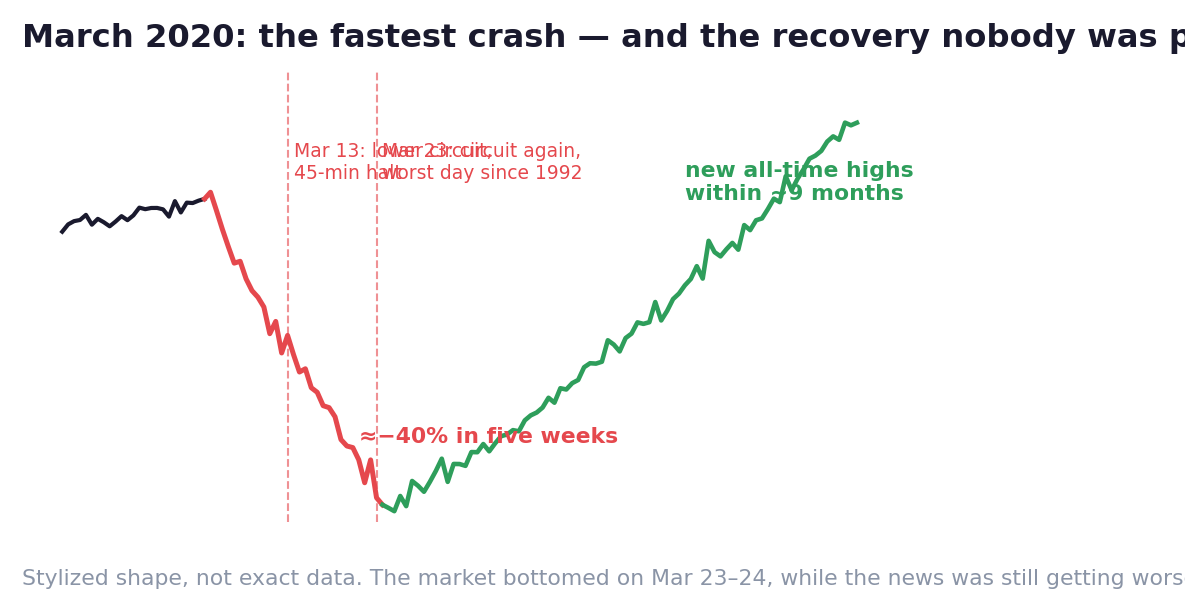
Nifty ~12,400 (Jan) → ~7,500 (Mar 23–24): roughly −40% in about five weeks; Mar 23 alone ≈−13%, worst day since 1992
Recovery
New all-time highs by November 2020 — roughly nine months
What changed
A generation of investors learned — some expensively — that the market and the economy are not the same thing
Every crash so far on this timeline had a market-shaped cause: margin, computers, fraud, valuations.
March 2020's cause was a virus — and the honest, terrifying novelty of it was that nobody alive had traded a global pandemic before. There was no playbook. The word 'lockdown' didn't exist in market vocabulary until it suddenly described the entire planet.
The fall was the fastest in market history. The Nifty went from about 12,400 in January to about 7,500 by March 23 — roughly 40% in five weeks. For comparison, 2008 took over a year to do its damage. COVID did it in 25 trading sessions.
And twice during that slide, Indian traders saw something most had only read about.
The market hit its circuit breaker.
India's system — a descendant of the reforms after 1987 (Chapter 03) — halts all trading when the index falls 10% (45-minute halt), with longer halts at 15% and a full-day stop at 20%.
Friday, March 13: the market opened in freefall, hit −10% within minutes, and everything froze. Screens live, prices frozen, orders useless. Forty-five minutes of national breath-holding. Then — one of the strangest sessions ever — the market reopened and rallied, closing the day green.
Monday, March 23: the circuit tripped again. This time there was no rescue rally. The Nifty closed about 13% down — the worst single day since the Harshad Mehta crash of 1992.
That evening, a nationwide lockdown was announced. The market's future looked like a void.
And now, the part of this file that matters more than the crash.
March 23–24 was the bottom.
Read this sequence slowly, because it contains the most valuable lesson in this entire school:
- When the market bottomed, cases were still exploding. The lockdown hadn't even started.
- Through April and May — lockdown extended, economy frozen, GDP forecasts apocalyptic, migrant crisis on every screen — the market rose.
- By November 2020, with the pandemic still raging and vaccines barely arriving, the Nifty made a new all-time high. Nine months from the bottom.
Everyone who waited for the news to improve before buying missed the entire recovery — because the market wasn't trading the present. It was pricing the future: the trillions in global stimulus, the rate cuts, the eventual reopening.
The market and the economy are related the way a dog and its owner are (you know this leash from the School of Playbooks) — connected, but never in the same place at the same moment.
Meanwhile the sellers of March learned the other half of the lesson. The investor who sold on March 23 'until things become clear' locked in a 40% loss, and 'clear' never sent a memo. Many were still waiting in cash when the index passed its old high.
And one more group deserves a line in this file: the crash created a generation — crores of new demat accounts opened in 2020 by people who saw the recovery and concluded markets only go up. Some of them are the subjects of the next chapter.
🦢 Why Nobody Saw It Coming
Pandemics were in history books, not in risk models — nobody sized positions for 'the world closes.' But the double black swan was the recovery: with the worst economic data in decades arriving daily, almost no one imagined new market highs within the year. The crash surprised everyone once; the recovery surprised them twice.
⏳ The Time Machine
If you were there: The correct March 2020 playbook fit on a sticky note, written in February: don't sell into halts, keep the SIP running, deploy reserved cash in tranches into the fear, and refuse to wait for 'clarity' — the bottom (Mar 23–24) arrived while headlines were still apocalyptic. Everyone executing a plan beat everyone forming one live.
If it repeats tomorrow: The next crash will be faster still — protection must be pre-installed, not improvised. Circuit halts are timeouts, not exits. Expect the turn to come with terrible news, not good news. And write the letter to your panicked self today (this chapter's lab) — March 2020 punished exactly the people who had to think at the bottom.
🛡️ The Survival Rules
- Circuit halts are time-outs, not exits. When trading freezes, the freeze itself is not information that you should sell at reopen. The Mar 13 halt was followed by a green close; panic-selling into a halt reopen is decision-making at its statistically worst.
- The market turns while the news is still terrible. If you wait for headlines to improve, you will structurally miss every bottom. Your plan must work without requiring you to 'feel okay' first.
- Speed is the new normal. COVID compressed a 2008-sized fall into five weeks. Assume future crashes arrive faster than your ability to react — which means your protection (size, cash, no forced deadlines) must be in place before, permanently.
- An emergency fund is a market strategy. The households that sold in March were disproportionately those who needed the money. Six months of expenses in cash is what buys you the right to not sell at the bottom.
- Keep an SIP-sized commitment running through crashes. Everything bought in the 7,500–9,000 zone of despair looked genius by Diwali. You don't need to catch the bottom; you need to still be buying when it happens.
Key Takeaway
COVID crashed the Nifty 40% in five weeks, froze India at the circuits twice — and then made new highs in nine months while the news was still terrible. The market turns before the world does; your job is to still be standing (and ideally still buying) when it does.
Think About It
Be honest: on the morning of the second circuit — March 23, 2020, everything red, lockdown hours away — what would you actually have done? Not what you hope. What you'd have done.
Swan Lab — The Letter to Your Panicked Self
Write a short letter today, addressed to yourself, to be opened on the next −30% day. It must answer, in advance:
Save it where you'll find it — in your QbarTrade journal works.
COVID proved the plan you make inside the panic is the worst plan you'll ever make. This lab makes sure you never have to.