

THE DAMAGE
When
Monday, October 19, 1987
Where
Started in Hong Kong, swept through every open market; US worst hit
The fall
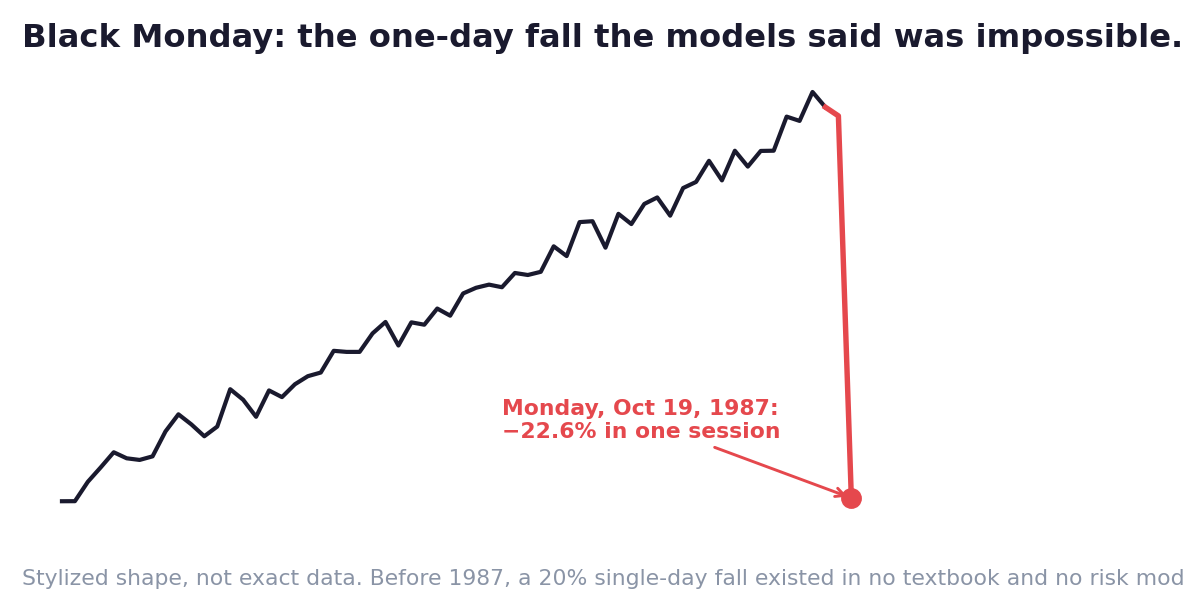
Dow Jones −22.6% in a single session — still the largest one-day % fall in its history
Recovery
The Dow regained its pre-crash level in about two years
What changed
Circuit breakers — automatic trading halts — were invented because of this day
In 1987, Wall Street had fallen in love with a machine.
It was called portfolio insurance — a computer strategy that promised big funds a magic trick: stay fully invested, and if the market falls, the program will automatically sell to protect you.
Thousands of funds bought the same insurance.
Nobody asked the obvious question:
If the market falls and all our computers try to sell at the same time... who exactly is buying?
On Monday, October 19, they found out.
The answer was: nobody.
A weak Friday triggered the first automatic selling on Monday morning. That selling pushed prices lower. Lower prices triggered more automatic selling. Which pushed prices lower. Which triggered more selling.
A doom loop, running at machine speed, with no human in charge and no natural buyer anywhere.
By the close, the Dow had lost 22.6% in one session.
To feel that number: the 2008 crisis, at its very worst, never produced a day even half that size.
And here's the detail that should stay with you forever.
There was no war. No default. No pandemic. No news.
The crash wasn't caused by an event in the world.
It was caused by the market's own plumbing — everyone holding the same automatic exit, through the same door, at the same time.
The world's regulators learned the lesson and built circuit breakers: mandatory time-outs that halt trading when an index falls too far, too fast. The halts that froze India in March 2020 (Chapter 09) are direct descendants of this one Monday.
Traders learned — or should have learned — something more personal:
On the worst days, your stop-loss is not a shield. It's an order, waiting in line behind ten thousand identical orders.
If prices gap through your level, you don't exit at your price.
You exit at whatever price the panic leaves you.
🦢 Why Nobody Saw It Coming
The models of the time treated daily moves like heights of people — a 22% day was like meeting a 20-foot-tall man, effectively impossible. So nobody sized positions for it. The 'insurance' everyone bought to stay safe was the very mechanism that caused the catastrophe. The protection was the risk.
⏳ The Time Machine
If you were there: Everything that mattered was decided before Monday: position sizes that could absorb a −22% day, and no faith that a stop-loss guarantees its price. On the day itself, the winning move was refusing to panic-sell into the close — the market was fully back within two years; those who dumped at Monday's bottom converted a terrifying day into a permanent loss.
If it repeats tomorrow: Circuit breakers now exist — a crash like this will pause, and the pause is your gift: use it to breathe, not to queue a market sell order. Size every position for a gap that skips your stop entirely, prefer stop-limit orders where spikes are possible, and be suspicious whenever you notice your 'protection' is identical to everyone else's.
🛡️ The Survival Rules
- Stops don't work in gaps. A stop-loss protects you in a normal market. In a crash, expect your fill to be far worse than your level — size positions so that even a terrible fill is survivable.
- Beware crowded safety. When everyone owns the same protection — the same stop level, the same hedge, the same exit — the exit is already too small. Ask: what happens if everyone does what I plan to do?
- No-news crashes are real. The market's own structure can crash it. 'But nothing happened' is not a defence your account can use.
- Overnight/gap risk is the risk. Leverage that is comfortable for a 2% move is lethal for a 20% one. Decide your size using the impossible day, not the average day.
Key Takeaway
October 1987 proved the market can lose a fifth of its value in a day with no news at all — killed by its own automatic selling. Size every position for the day your stop-loss doesn't get its price.
Think About It
Your stop-loss: is it a tested plan — or a quiet hope that someone will be standing on the other side of your order when it matters most?
Swan Lab — The Gap Stress Test
Run a 1987 on your current portfolio, on paper:
Write down the total damage as a % of your capital.
If the number is survivable, you've sized correctly. If it isn't, you've just met your future — while it's still cheap to change it.