

THE DAMAGE
When
Report published January 24, 2023 — days before Adani Enterprises' ₹20,000 crore FPO
Where
Adani group's listed companies, India
The fall
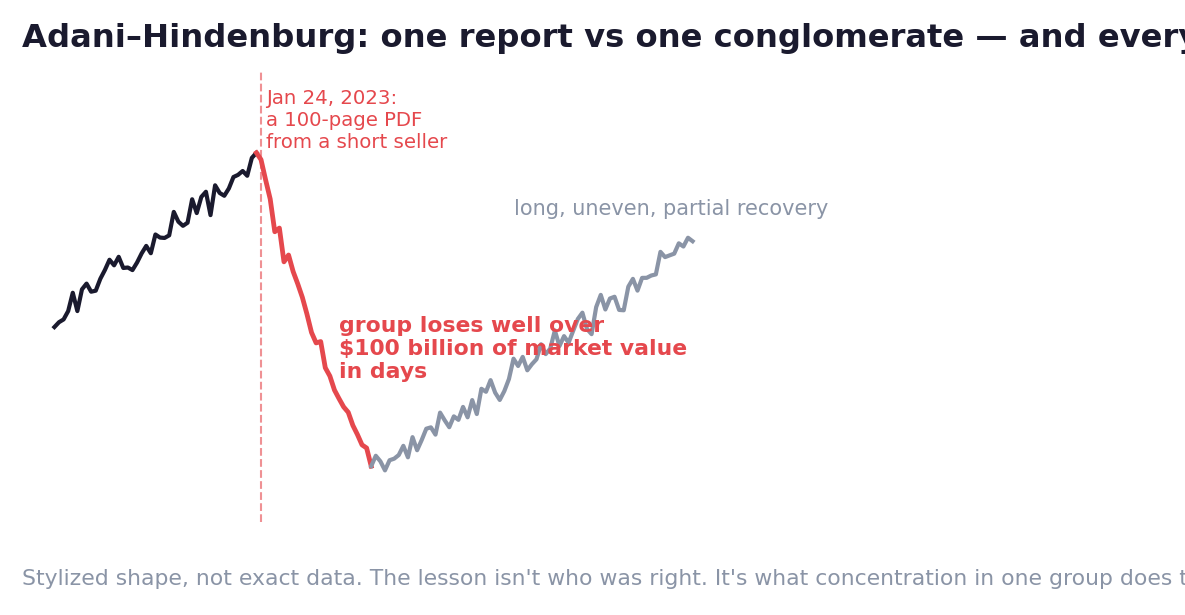
Group market value fell by well over $100 billion within weeks; flagship stocks halved or worse; the fully-subscribed FPO was cancelled and money returned
Recovery
Long, partial and uneven — some group stocks took a year or more to repair; probes and litigation ran on for years
What changed
Renewed scrutiny of promoter pledging, offshore holding structures and index concentration rules
By early 2023, the Adani group was the momentum story of Indian markets.
Ports, airports, power, green energy, cement — and stock charts that went up and to the right at an angle that made everything else look lazy. Several group stocks had multiplied many times over in three years. The group's founder had, by some counts, become the world's third-richest person. Retail portfolios across India were heavy with Adani names, and the stocks sat inside major indices, so even index investors owned them without choosing to.
On January 24, 2023, a small American short-selling research firm called Hindenburg Research published a roughly hundred-page report.
It alleged, in essence: offshore shell entities linked to the promoter family quietly holding group shares (raising questions about true public float and price discovery), heavy debt, and stock prices inflated far beyond fundamentals. Hindenburg disclosed openly that it was short — positioned to profit if the stocks fell.
The group denied everything, in detail, calling the report a malicious attack on India itself.
This file has no interest in refereeing that fight — courts, SEBI and years of headlines did battle over it, with the group denying wrongdoing throughout, later even a regulatory clearing of several allegations.
Because here's the thing this school cares about:
You didn't need to know who was right to lose money. You only needed to be concentrated.
Within days, the group's listed companies lost over $100 billion in combined market value. Flagship stocks halved or worse. A fully subscribed ₹20,000 crore share sale — India's largest-ever follow-on offer — was cancelled at the last moment and the money returned. Some group stocks hit lower circuits day after day, meaning holders couldn't exit even if they wanted to — sellers queued at the circuit with no buyers.
An investor with 5% of their portfolio in Adani names had a bad month.
An investor who had watched the three-year charts and gone 40–60% into the group — and there were many — watched half their net worth evaporate over allegations they had no way to personally verify, published from an office on another continent.
That's the modern black swan this file records: in a world of viral PDFs, the trigger for a 50% fall in your largest holding can be written by a stranger, published overnight, and be unverifiable by you in the time the market takes to react.
The market reprices first and investigates later. You will be marked to market long before anyone is proven right.
🦢 Why Nobody Saw It Coming
The group was a national champion, an index heavyweight, and one of the most-analysed conglomerates in India — the idea that a hundred-page PDF from a tiny foreign firm could erase $100 billion in days fit nobody's model. Holders also assumed they could always exit; days of lower circuits proved even the exit was conditional.
⏳ The Time Machine
If you were there: All the real work predated January 24: a cap on single-group exposure meant the PDF was a bad month, not a halved net worth. Once it dropped, the survivable path was refusing both panic moves — not 'averaging down on an empire' through lower circuits, and not dumping every unrelated holding in sympathy. Repricing happens in hours; verification takes years; position size was the only opinion that mattered.
If it repeats tomorrow: Count your concentration by promoter group and by theme, not by ticker — six stocks, one bet. Assume any large holding can wake up to an overnight PDF from a stranger you can't fact-check in time. For concentrated names, war-game the double event: the price halves and the circuits won't let you leave.
🛡️ The Survival Rules
- Cap exposure by group, not just by stock. Six different Adani stocks was one bet, not six. Companies sharing a promoter, cross-holdings or common financing fall as one unit. Count your true concentration at the group level.
- A vertical multi-year chart is not evidence of safety — it's often evidence of narrowing float, momentum money and crowding, all of which reverse together. The fastest risers are structurally the fastest fallers.
- You can't out-research a repricing. When allegations drop, prices move in hours; verification takes years. Your defence is position size before the PDF, not analysis after it.
- Liquidity can be conditional. Lower circuits meant days when exiting was simply impossible. For concentrated positions, ask not just 'what if it falls?' but 'what if it falls and I can't sell?'
- Index investing spreads this risk but doesn't erase it — concentrated heavyweights inside an index import their drama into 'passive' portfolios too. Know what your index actually holds.
Key Takeaway
One overnight PDF took over $100 billion off one group — and holders didn't need the allegations to be true to be hurt, only to be concentrated. Cap your exposure per promoter group at a level that lets you watch any single empire halve with a shrug.
Think About It
How many of your holdings are actually one bet wearing different names — same promoter, same theme, same interest-rate sensitivity, same story?
Swan Lab — The One-Bet Map
List your holdings, then regroup them ruthlessly:
Compute the % of your portfolio in the largest line.
That's your Hindenburg exposure — the share of your wealth one overnight PDF about one group could take hostage, circuits included.
If any single line exceeds ~15%, you've found this chapter's homework.