

THE DAMAGE
When
June 3–7, 2024 (results day: Tuesday, June 4)
Where
Indian markets, around the general election results
The move
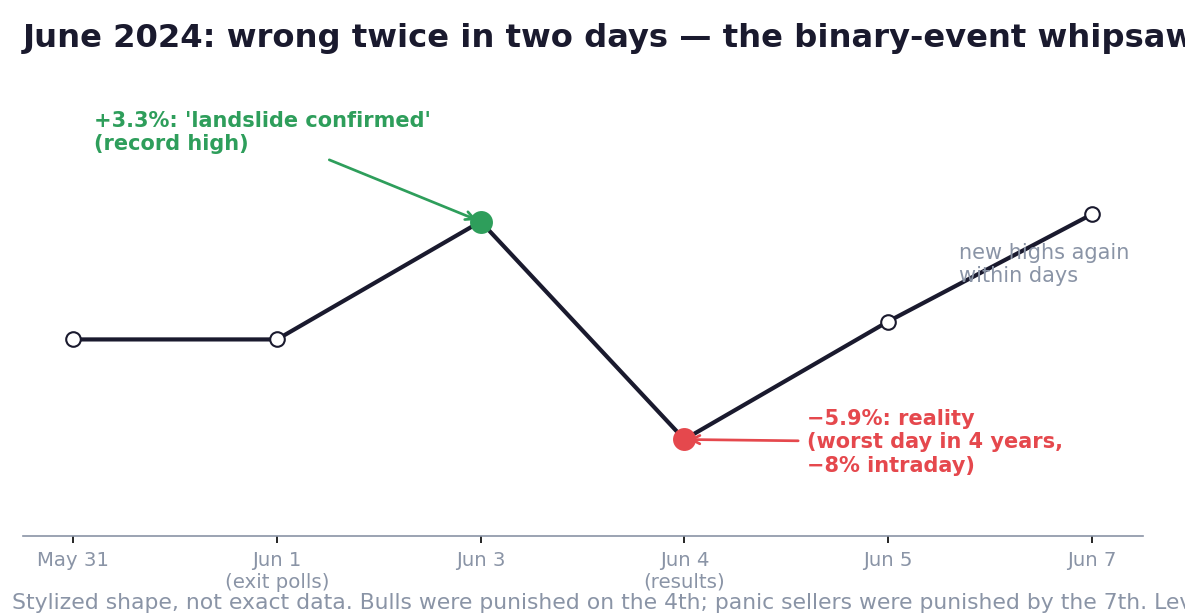
Jun 3: ~+3.3% to record highs on exit polls. Jun 4: ~−5.9% (over −8% intraday) — worst day in four years. New record highs within days
The casualties
Retail F&O accounts positioned with leverage for a 'certain' outcome — many wiped on the 4th; panic sellers then missed the rebound by the 7th
What changed
Fuel for SEBI's push (already underway) on retail index-options excess; exit polls' credibility crashed harder than the index
By June 2024, India's election result felt like the most predictable event in markets.
Every exit poll, published after voting ended, pointed the same way: a massive, historic majority for the incumbent government. Continuity. Policy certainty. The market's favourite outcome, pre-confirmed.
On Monday, June 3, the market celebrated the certainty: Nifty rose about 3.3% to a new record high — one of its best days in years. On television, targets were raised. In F&O, retail traders loaded up on calls and leveraged longs. Why not? The result was already known. The only debate was how big Tuesday's rally would be.
On Tuesday, June 4, the actual votes were counted.
The incumbent alliance won — but with a far thinner result than the exit polls had promised: short of a majority on its own, dependent on allies. Not a loss. Just... not the script.
The market didn't crash because the news was bad.
It crashed because the news was different — and everyone was positioned for identical.
Nifty fell over 8% intraday and closed down about 5.9% — the worst session since the COVID crash. PSU and infrastructure favourites — the most crowded 'election trades' — fell 15–25%. Option premiums that had been bid up on Monday's euphoria were vaporised; leveraged longs got margin calls into a falling market; stop-losses fired into air pockets. Estimates of that single day's retail derivatives losses ran into thousands of crores.
A trader who was 'right' about the election winner — and the winner did win — could still be destroyed, simply by being leveraged for the wrong margin of victory.
Then the third act, crueller than the second.
Alliance partners pledged support. The same government formed. Policy continuity — the thing Monday had celebrated — turned out to be intact after all.
The market rebounded 3%+ the very next day, and within that same week was making new record highs.
So tally the week's casualties:
- The leveraged bulls of Monday were wiped out Tuesday.
- The panic sellers of Tuesday — including those who dumped quality holdings at the day's lows 'before it gets worse' — watched new highs by Friday.
- The only comfortable people were those who had treated the event as what it was: a coin toss they didn't need to bet their account on.
Binary events — elections, budgets, central-bank meetings, court verdicts, big earnings — share one structure: a known time with an unknown outcome, where the move happens in one gap that no stop-loss can protect you through. June 2024 is simply the cleanest specimen Indian markets have ever produced.
And notice the black swan wasn't the election result. Results surprise all the time.
The black swan was the market's certainty — the +3.3% Monday — being built on exit polls. The trap wasn't the event. The trap was the confidence before it.
🦢 Why Nobody Saw It Coming
The event's date was known to the minute — yet it still produced a black swan, because every model of the outcome rested on one input: exit polls, which everyone believed simultaneously. When the single shared assumption broke, there were no buyers on the other side. Both the crash and the instant recovery blindsided the crowd — twice.
⏳ The Time Machine
If you were there: The week's only comfortable traders decided before June 3 that a binary event deserved reduced size or a flat book. On Monday, the discipline was refusing to add leverage into consensus euphoria. On Tuesday, it was refusing to dump quality at −8% intraday. Anyone forced to act on either day had already lost — the position size was the mistake; the days merely presented the bill.
If it repeats tomorrow: Keep an event calendar and write your size rule before each binary date — normal, reduced, hedged, or flat — then obey the written rule, not the eve-of-event confidence. Bet only the gap between what's priced in and what's likely, or don't bet. And after any shock, invoke the 48-hour rule: the first reaction is routinely the worst price.
🛡️ The Survival Rules
- On binary events, size down or step aside. A known date with an unknown outcome, gapping in one move, defeats stop-losses by design. The professional trade is often smaller size, hedged structures, or a deliberate day off. Flat is a position.
- Being right isn't enough — you must be right by the priced-in margin. The winner won and bulls still got destroyed. Before any event trade, ask: what outcome is already in the price? You're betting on the gap between expectation and result, not the result.
- Forecasts around events are inputs, not facts. Exit polls, street estimates, 'sources say' — treat all pre-event certainty as one fragile assumption, especially when everyone shares it. Consensus is the risk, not the comfort.
- Never make permanent decisions on the event day itself. Tuesday's panic sellers were punished by Friday. The first reaction to a surprise is routinely the wrong price; if you have no leverage forcing your hand, doing nothing for 48 hours is a strategy with an excellent track record.
- Leverage turns volatility into mortality. Unleveraged, June 4 was a scary Tuesday followed by a record Friday. Leveraged, it was the end. Same week, same trader, same view — the only difference was position size.
Key Takeaway
June 2024 punished the confident twice: leveraged bulls on results day, panic sellers by the rebound. On binary events, the priced-in expectation is the real opponent — size down, step aside, or hedge, because the move arrives as a gap no stop-loss can catch.
Think About It
Before the next big event on the calendar — ask of your positions: what outcome is already in the price? If your answer is a forecast instead, you're carrying the June 3 trade.
Swan Lab — The Event Calendar
Open a calendar and mark the next three binary events that touch your positions: the budget, the next RBI meeting, election results, a big earnings date, a court verdict.
For each one, write two lines now, while you're neutral:
Then — the hard part — follow the written rule when the day comes, not the confidence you'll feel the evening before.
June 3, 2024 was one evening of confidence. June 4 was the invoice.