

Your strategy passed Chapter 5's honest test. The urge right now — every builder feels it — is to fund it fully on Monday.
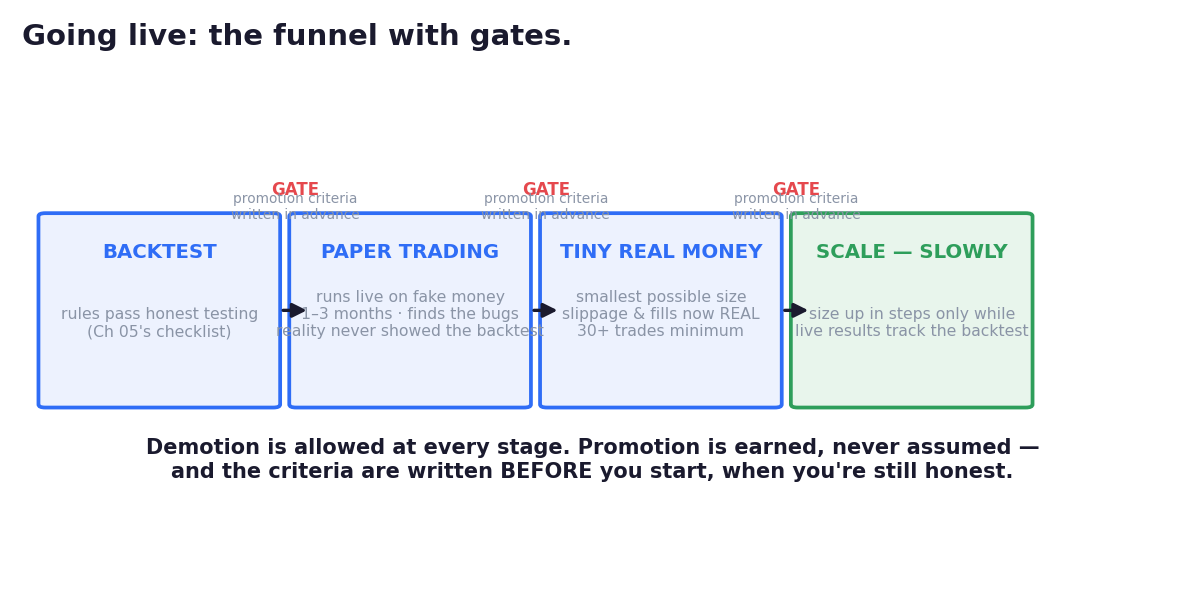
Medicine solved this exact problem a century ago. A drug with brilliant lab results is not sold on Monday; it enters trials — phases of increasing exposure, each with success criteria defined before the phase begins, because everyone knows the researchers will fall in love with their molecule. Your strategy is the molecule. Your savings are the patient. Here is the trial protocol — the figure shows it: a funnel with gates.
STAGE ONE — PAPER TRADING: the strategy meets the present. Run the system live, in real time, on fake money, for one to three months. Beginners treat this stage as a formality. It isn't — it exists to catch a specific class of problem the backtest structurally cannot show you: the difference between history and the live present. Orders that don't fill at the printed price. Signals arriving during a frozen data feed. The API hiccup at 9:15. Your own code doing something at Tuesday's open that it never did in simulation. Paper trading is where the plumbing gets debugged while mistakes are still free — and where you discover whether live results even rhyme with the backtest's promises.
One warning about this stage, so you read its results correctly: paper fills are polite fictions (everything fills, nothing slips). Paper profits therefore run optimistic. Treat paper as a test of mechanics and rhyme — does the machine behave, do results roughly track expectations — never as proof of profit. The proof stage comes next.
GATE ONE — written before paper trading begins: e.g. 'Promote only if: zero unexplained system behaviours for 4 straight weeks, AND live signals matched what the rules should have produced, AND results are within shouting distance of backtest expectations after assumed costs.' Write it now, while you're honest. In six weeks you'll be in love, and lovers grade generously.
STAGE TWO — TINY REAL MONEY: reality sends its bill. Fund the system at the smallest size that produces real fills — an amount whose total loss would sting like a bad dinner, not a bad year. Everything paper faked now becomes real: actual slippage, actual spreads, actual partial fills, the actual costs Chapter 5 made you over-estimate. And one more thing becomes real that nothing else can test: you. Watching a machine lose your actual money — even trivial money — activates every override urge Chapter 6 predicted. Stage two is where you discover whether the human component passes trials.
Run it for a genuine sample — thirty-plus trades minimum, more for slow systems — because you know from the coin-flip chapter what small samples prove (nothing).
GATE TWO — also pre-written: e.g. 'Promote only if: realised slippage and costs are within the modelled range, AND the live equity path sits inside what the backtest's ups-and-downs would consider normal, AND I overrode the system zero times.' That last clause is not a joke. An override during trials fails the trial — not the strategy, the operator.
STAGE THREE — SCALE, SLOWLY, IN STEPS. Not a leap to full size: steps — say, doubling — with a full review at each landing, because size changes things. Fills worsen slightly. Drawdowns arrive in amounts that feel different (the bent curve doesn't care that the percentage is identical). Each step is its own mini-trial with the same style of gate. You are fully deployed only when the money is meaningful AND the system is boring — and in this field, boring is the trophy.
Three permanent rules govern the whole funnel:
Demotion is always allowed; promotion is only earned. Any stage can send the system back a stage — or to retirement — at any time. Down is free. Up requires a gate.
The gates are written before each stage, never during. Mid-stage, you are the researcher in love with the molecule. Pre-stage you is the only version whose judgment counts. (This is the Psychology school's deepest trick — decide before the feeling arrives — applied to system management.)
And going live starts the monitoring job forever. Chapter 6's failure map becomes a routine: the daily thirty-second glance (is it alive, is Box 5 armed), the weekly ten minutes (fills vs assumptions, anything unexplained), the monthly hour (live vs backtest expectations; any pre-defined regime-change evidence). The retirement decision, too, was pre-written on your failure map — a drawdown beyond design, a structural change in the market, an edge visibly grazed away. Systems die; the Theories school told you why. Retiring one on pre-agreed evidence isn't failure. It's the funnel, still working — protecting you at the exit as it did at the entrance.
Foundations complete. You can now design, test, and deploy a real system inside the real walls.
Time for the frontier.
🇮🇳 The India Angle
- Paper-trading a system India-side means simulating against live market data with your full cost stack (brokerage, exchange charges, STT, stamp duty) applied per trade — several broker/API ecosystems and platforms support live simulation; verify yours reflects real lot sizes and margins.
- Stage two's 'smallest real size' has a natural unit in index derivatives: one lot — with margin rules (upfront/peak margin) as part of what you're testing, since margin behaviour is a live-only phenomenon.
- Under the retail-algo framework, going live may involve broker-side registration/approval of the strategy — build that lead time into your funnel, and keep your documented boxes and gates handy: they're exactly what a broker's process wants to see.
Key Takeaway
Deploy like a drug trial: paper trading debugs the plumbing (mechanics and rhyme, never proof), tiny real money tests costs, slippage and YOU, then scale in steps — each stage behind a gate written before it begins, because mid-stage you is in love. Demotion is always free, promotion only earned, monitoring is forever, and retirement criteria were written on day one. Boring is the trophy.
Think About It
Be honest about the stage you're most tempted to skip — and notice it's probably tiny-real-money, the only stage that tests the operator. What does that temptation tell you about which component of your system is least tested?
Algo Lab — Write the Gates
Before any deployment, produce the one-page trial protocol for your Chapter 3 system:
Then sign and date it — sincerely. Six weeks from now, in love or in drawdown, this page outranks you. That's not a limitation of the process. It IS the process.