

Every school in this Academy has an honesty chapter. This is algo trading's — and because the field is hyped harder than any other, this chapter has to work harder. Three walls. Learn where each stands, because everything you build must fit inside them.
WALL ONE: THE TECHNOLOGY IS NOT WHAT YOU THINK IT IS.
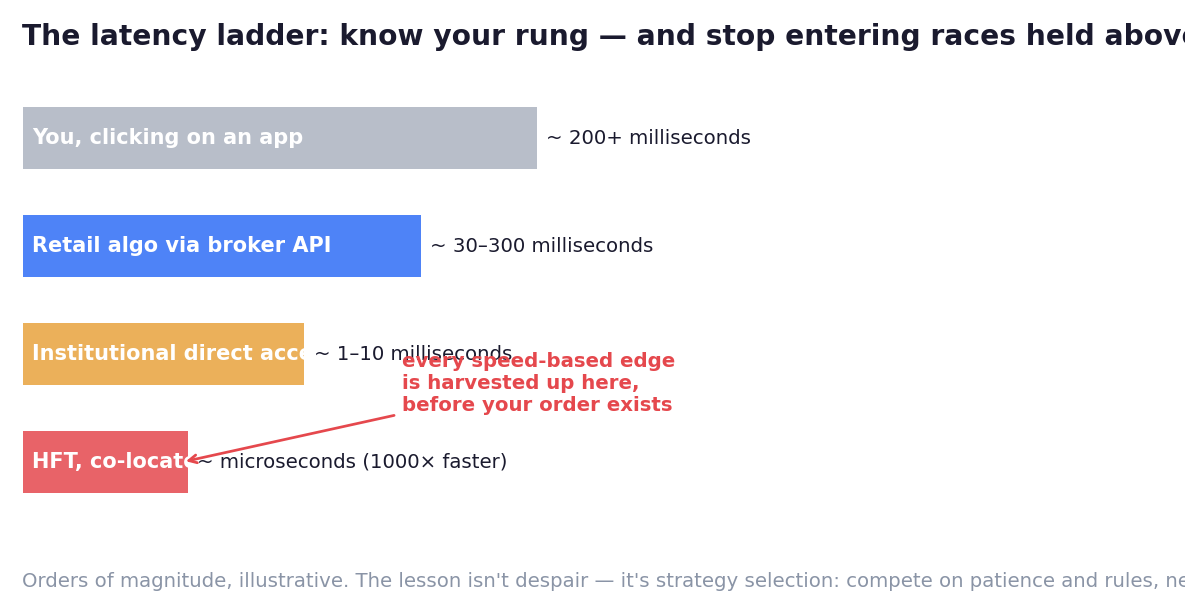
Start with the figure — the latency ladder — because it recalibrates everything. You, tapping an app: a couple hundred milliseconds from finger to exchange. A retail algo through a broker API: faster, but still tens to hundreds of milliseconds, travelling public internet to a broker's servers to the exchange. Institutional direct connections: single-digit milliseconds. And at the top: high-frequency firms whose machines sit physically inside the exchange's building (co-location), seeing and acting in microseconds — thousands of times faster than anything reachable from your desk, at any price a person can pay.
The conclusion isn't despair; it's Chapter 4's dividing line, now with physics attached: every edge that depends on reacting quickly to public information is harvested at the top of the ladder before your order exists. Your algo is not fast. It is merely tireless — a completely different, and for the green families entirely sufficient, superpower. Build for tireless. Never build for fast.
The rest of Wall One is less glamorous and more dangerous: your system runs on a stack of things that fail — home internet, power, your machine, the broker's API (which has rate limits, maintenance windows, and occasional outages precisely during wild markets, when everyone hammers it at once), the data feed (bad ticks, frozen quotes, missing candles — garbage in, confident garbage out), and your own code.
About that last one, the story every algo trader must know by heart. Knight Capital, 2012: a giant, sophisticated market-making firm deploys new software; one server carries a leftover configuration flag; at the open, its machines begin buying high and selling low across a hundred-plus stocks, relentlessly, at machine speed. Humans need most of an hour to fully stop it. Loss: roughly $440 million. The firm — one of the biggest traders in American equities — effectively ceased to exist within days. (The Market History school keeps the full exhibit.) The lesson is not 'be smarter than Knight' — you aren't, and neither was Knight. The lesson is Chapter 3's: bugs don't announce themselves, so the kill-switch is written first, with a runaway-order guard, a daily loss cap, and an alert that reaches a human. At machine speed, the question is never whether something will go wrong. It's how far wrong it can travel before something dumb and reliable stops it.
WALL TWO: THE MARKET DOES NOT HOLD STILL.
Three market truths no technology can engineer away:
Edges decay. The Theories school's jungle (Ch 11) applies with special force here: a profitable algorithm is a feeding ground, and the market's other organisms — thousands of them, running their own backtests on the same data — will find it. Published anomalies famously shrink after publication; private edges erode as conditions shift. A strategy is not a machine you build once. It's a garden that gets grazed — which is why Chapter 7 makes monitoring a permanent job, not a launch-week task.
Regimes change. Your backtest learned certain weather — a decade of certain volatility, certain trends, certain correlations. Markets change climates: quiet years become violent ones, trends give way to years of chop. A system honestly profitable in its home regime can be honestly terrible in the next, with no bug anywhere. The machine cannot notice the world changed. That's your job.
And no backtest contains the next black swan. Every history the machine learned excludes, by definition, the day unlike any in the data (the turkey's day 1,001 — the Market History school's founding lesson). Circuit halts, frozen liquidity, gap opens through every stop: your algorithm will meet, someday, a market its entire training insists is impossible. Position sizing for the impossible day is not paranoia. It's the tuition every exhibit in the museum was paid to teach.
WALL THREE: THE HUMAN IS STILL IN THE SYSTEM.
The final limit is the one nobody advertises: automation doesn't remove you — it relocates you, and your wiring comes along.
You'll meet the override urge: three losses in a row (a normal week for a trend system, Chapter 4 told you) and your hand hovers over the off switch — usually right before the strategy's best stretch. Turning a system off in a drawdown is the discipline failure of Chapter 2, wearing an engineer's coat.
You'll meet false confidence: months of smooth automated profits, attention fades, size creeps up... exactly when the edge is quietly decaying or the regime quietly turning.
And you'll meet the tinkering itch: every losing week whispering 'just adjust one parameter' — which, done live and repeatedly, is overfitting in real time to last week's noise.
The resolution of Wall Three isn't willpower (the Psychology school cured you of that hope). It's rules about the rules, written in advance: under what pre-defined conditions the system gets paused, changed, or retired — and under what conditions you're obliged to leave it alone. Chapter 7 turns this into a checklist.
Three walls: the tech is tireless but not fast and it breaks; the market grazes edges, changes climates, and keeps a day 1,001 in stock; and the human never left the loop. Everything real that's ever been built in this field was built inside those walls — knowingly.
Now let's go build there.
🇮🇳 The India Angle
- The ladder is identical in India: co-location at the exchanges serves members and institutions; retail rides broker APIs over public internet. (India even had its own co-location access controversy — a reminder that the top rungs are fought over precisely because they matter.)
- Wall One's plumbing has vivid local exhibits: brokers' systems straining on high-volatility and expiry days, and freak trades printing absurd prices on thin option strikes — both are why Box 4 and Box 5 exist.
- Wall Two's regime warning is current here: expiry schedules, lot sizes and derivatives rules have all shifted in recent years — any Indian backtest spanning those changes learned weather that no longer exists.
Key Takeaway
Three walls contain everything: technology (your algo is tireless, never fast — and the stack breaks, so the kill-switch is written first, in Knight Capital's memory), markets (edges get grazed, regimes change climate, and no backtest contains day 1,001), and the human (override urges, false confidence, live tinkering — automation relocates your wiring, it doesn't remove it). Build knowingly inside the walls.
Think About It
Picture your future system three losses into a normal drawdown, on the day your internet flickers and the market gaps. Which wall fails you first — your stack, your sizing, or your finger on the off switch? That answer is where your engineering effort belongs now.
Algo Lab — The Failure Drill
Write your system's failure map — one page, three columns, before you ever go live:
A system without this page isn't an algorithm yet. It's an incident report, waiting for its date.