

Every field has a frontier where the marketing gets loudest and the truth gets quietest. Here's the honest survey — three territories.
TERRITORY ONE: MACHINE LEARNING — the pattern-finder pointed at noise.
Strip the mystique: machine learning is software that finds patterns in data without being told the rules in advance. Instead of you writing Box 1 ('price crosses the 50-day average'), you hand the machine mountains of examples and it discovers its own predictive combinations — often ones no human would articulate. That's genuinely powerful. It's how computers learned to recognise faces and translate languages.
So why hasn't ML trivially conquered trading? Because markets differ from faces in three brutal ways — and understanding them makes you immune to a decade of sales pitches:
The signal is a whisper in a hurricane. A photo of a cat is nearly all cat. A day of price data is nearly all noise — the predictable component, if present at all, is tiny. ML excels at extracting strong patterns; asked to find whisper-faint ones, it does something dangerous instead: it finds patterns that aren't there. Chapter 5's overfitting problem, except now the machine can test millions of rule-combinations per second. ML in markets is overfitting with a jet engine — which is why the field's serious literature (Chapter 9 points you to it) is mostly about defence: brutal validation, deliberately crippled model flexibility, and treating every discovery as guilty until proven robust.
The cat doesn't change when you photograph it. Markets do — the Theories school's reflexivity and jungle chapters, in one line. A pattern ML finds gets traded, and the trading erodes the pattern. The training data describes an ecosystem that your own success helps to kill.
And the black box has no story. When a rules-based system loses, you can inspect the rules. When an ML model loses, often nobody — including its builder — can say why it decided anything, which makes the Chapter 7 question ('broken, or normal drawdown?') nearly unanswerable. Serious shops answer with heavy monitoring and humility; sellers of 'AI trading bots' answer with a new subscription tier.
Where ML honestly earns its keep today: mostly inside the boxes rather than replacing them — helping estimate transaction costs, clean data, forecast volatility for sizing, or rank instruments for a momentum-style Box 1 — supporting roles inside rule-based skeletons. The 'AI that autonomously prints money' remains, as Chapter 1 said, a movie.
TERRITORY TWO: EXECUTION ALGORITHMS — how elephants cross rivers.
Recall the mandi buyer from the Technical Science school: institutions can't click 'buy' on enormous orders without moving the price against themselves. Execution algorithms are that patience, mechanised — and they're some of the most-used algos on Earth: slicing a giant order into pieces spread evenly across time (TWAP — time-weighted), or proportionally to the market's own volume rhythm (VWAP — volume-weighted, the same fair-price concept you know from the Playbooks), or showing only a sliver of the true order at a time (iceberg). No prediction anywhere — pure cost-minimising plumbing. Why should a retail trader care? Two reasons: those slicing rhythms are part of the intraday tape you trade against — and the principle scales down: your own Box 4, patiently working a limit order instead of smashing a market order, is a tiny execution algorithm. The elephant's manners, at any size.
TERRITORY THREE: THE ZOO — the actual advanced move.
Here is the frontier's best-kept non-secret. Ask what separates seasoned systematic traders from beginners and the answer is not a smarter model. Beginners pursue one brilliant algorithm. Practitioners run several deliberately simple ones that don't rhyme.
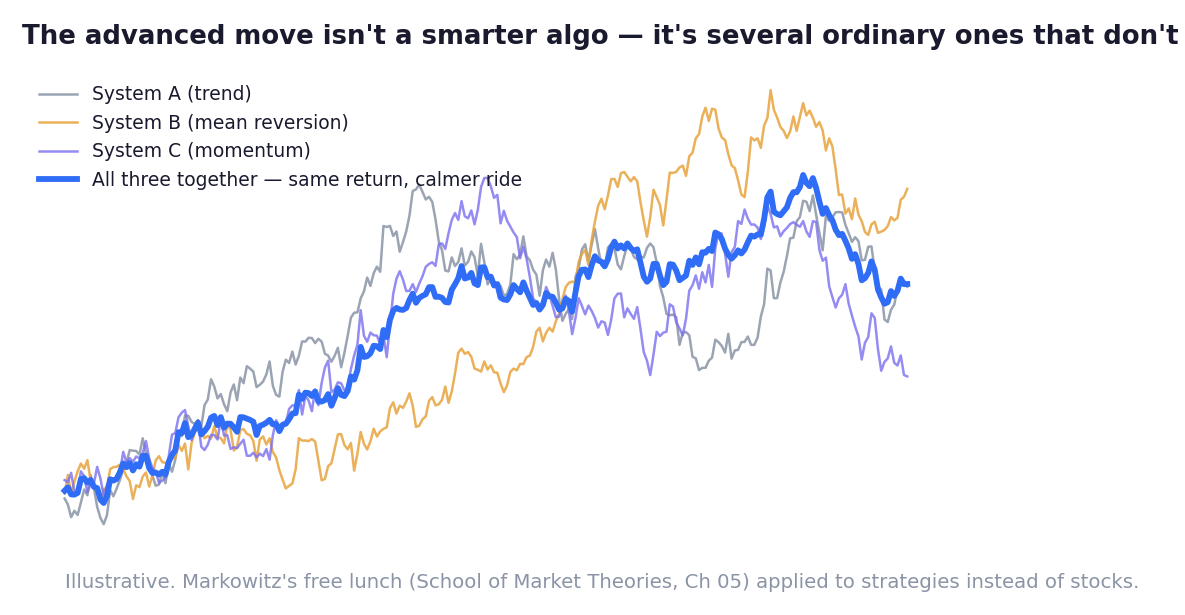
Look at the figure: three ordinary systems — a trend follower, a mean reverter, a slow momentum ranker — each individually bumpy, each mediocre-looking alone. Combined, because their bad weeks don't coincide (trend systems feast exactly where mean reversion starves, and vice versa — Chapter 4's weather map), the portfolio's ride smooths dramatically at similar return. You know this mathematics by name: Markowitz's free lunch (Theories, Ch 05) — applied to strategies instead of stocks. Diversify across systems, across families, across timescales, even across markets.
The zoo also solves problems no single genius-algorithm can: one system's regime-death (Wall Two) becomes a limp instead of a funeral; the pressure to overfit any single system relaxes, because no single system carries the household; and Chapter 7's monitoring gains a benchmark — each animal judged against its siblings. The beginners' path and the practitioners' path genuinely diverge here: one keeps polishing a single molecule; the other becomes a zookeeper of boring, tested, unrelated animals.
Boring, tested, unrelated. Write that above the frontier's gate — it filters ninety percent of what's sold there.
One chapter remains: the library, and the road.
🇮🇳 The India Angle
- The zoo translates naturally to Indian instruments: a slow momentum ranker on equities, a trend system on index futures, and a strictly kill-switched premium-selling system occupy different weather — the combination is the point, not any single animal.
- 'AI trading' marketing is booming here as everywhere; the regulator's investor-protection warnings about assured-returns schemes apply with fresh paint. The three ML brutalities above are your immunity card.
- Execution manners matter more, not less, in Indian options: wide spreads away from the money mean a patient limit-order Box 4 routinely outperforms any signal improvement of equal effort.
Key Takeaway
The frontier, honestly: ML is a phenomenal pattern-finder pointed at whisper-thin, self-erasing signal — overfitting with a jet engine, valuable mostly in supporting roles inside rule-based skeletons. Execution algos are the elephant's mechanised manners (and your Box 4 is a tiny one). And the true advanced move is the zoo: several boring, tested systems that don't rhyme — the free lunch served to strategies.
Think About It
You've now seen the frontier. Notice which territory excited you most — and check the motive honestly: does it promise better evidence, or just better mystique? The pull toward the black box is itself data about you.
Algo Lab — Design Your Zoo
On one page, sketch a three-animal zoo you could realistically run within a year:
You're not building three systems this weekend. You're doing what practitioners do: designing the ecosystem before perfecting any single animal — because the portfolio, not the algorithm, is the actual product.