

Two traders finish this school on the same day.
Same seven playbooks. Same charts. Same market.
One year later, ask each of them the most important question in trading:
"What actually works for you?"
Trader A thinks for a moment.
"Breakouts, I'd say. Mostly. Trend days have been good... I think. Expiry days feel bad, but there was that one Tuesday that paid for the whole month, so..."
Feelings. Impressions. A highlight reel edited by memory.
Trader B opens a report and reads from it:
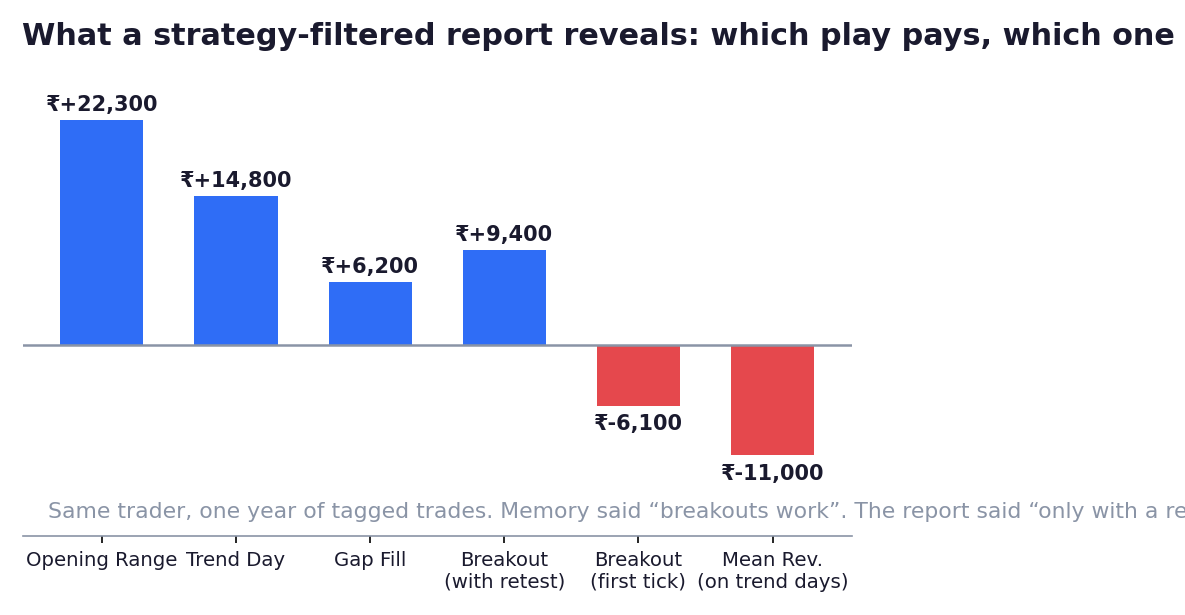
"Opening Range: forty-one trades, sixty-one percent winners, plus ₹22,300 — my best play. I'm sizing it up."
"Breakouts: slightly negative overall — but split them and it's obvious. My retest entries made money and my first-tick entries lost it. First-tick entries are now banned."
"Mean reversion: profitable on range days. A disaster on the five trades where I broke my own rule and faded a trend day — those five trades alone cost ₹11,000. That rule is now a hard rule."
Same school. Same knowledge. Same market.
One trader has stories. The other has proof.
Here is the truth this entire school has been building toward:
A playbook you don't track is just an opinion with a nice name.
And your memory cannot keep this score.
The School of Market Psychology showed you why — memory highlights the jackpot Tuesday and quietly deletes the eleven small bleeds around it.
The only way a playbook becomes an edge is if every trade wears its name tag — so the numbers, not your feelings, decide what stays on the menu.
This is exactly what QbarTrade is built for, and it takes about ten seconds per trade:
- In the Planner, you pick the playbook before you enter. Opening Range, Trend Day, Gap Fill, Breakout, Mean Reversion, Expiry — your plays live as Strategies in QbarTrade. Choosing one before the trade is Chapter 1's rule — "name the day first" — turned into a product feature.
- The tag travels with the trade. Whether the trade is synced from your broker or imported, it carries its strategy through your Journal automatically.
- Reports → filter by Strategy. This is where the magic happens. Win rate, expectancy, average risk-reward, profit and loss, drawdown — every metric, sliced per playbook. The question stops being a vague "how am I doing?" and becomes a sharp "which of my plays is paying me — and which one is quietly bleeding?"
- The menu prunes itself. Give each playbook thirty to fifty tagged trades, and the report starts making decisions for you: double down on your two best dishes, fix or retire the rest.
Which brings us back, one final time, to the Saturday night kitchen.
Have you ever noticed something about the world's best restaurants?
Their menus are short.
They didn't start short.
They started with everything — and then, dish by dish, the numbers told them what to keep.
Your trading will end up the same way: two or three plays that fit your market, your hours and your temperament, executed over and over with boring precision.
But you can't shorten a menu you never measured.
So here is the last recipe of this school — the only one that makes all the others count:
Tag every trade. Read the report. Trust the numbers over the memory.
The market keeps serving the same dishes.
Now you know their names.
Go find out which ones pay you.
Key Takeaway
An untracked playbook is an opinion. A tagged playbook is data. Tag every trade with its play in QbarTrade, filter your reports by strategy, and let the numbers — not your memory — tell you where your edge lives.
Think About It
If someone offered you ₹10,000 to state your win rate on breakout trades — just breakouts — could you answer with a number? If not, what have your trading decisions been based on?
Playbook Lab — Build Your Menu
This lab is the graduation exercise for the whole school.
Twenty tagged trades will teach you more about your own edge than a year of untagged ones.