

There's an old story told across many cultures, and it explains modern finance better than most textbooks.
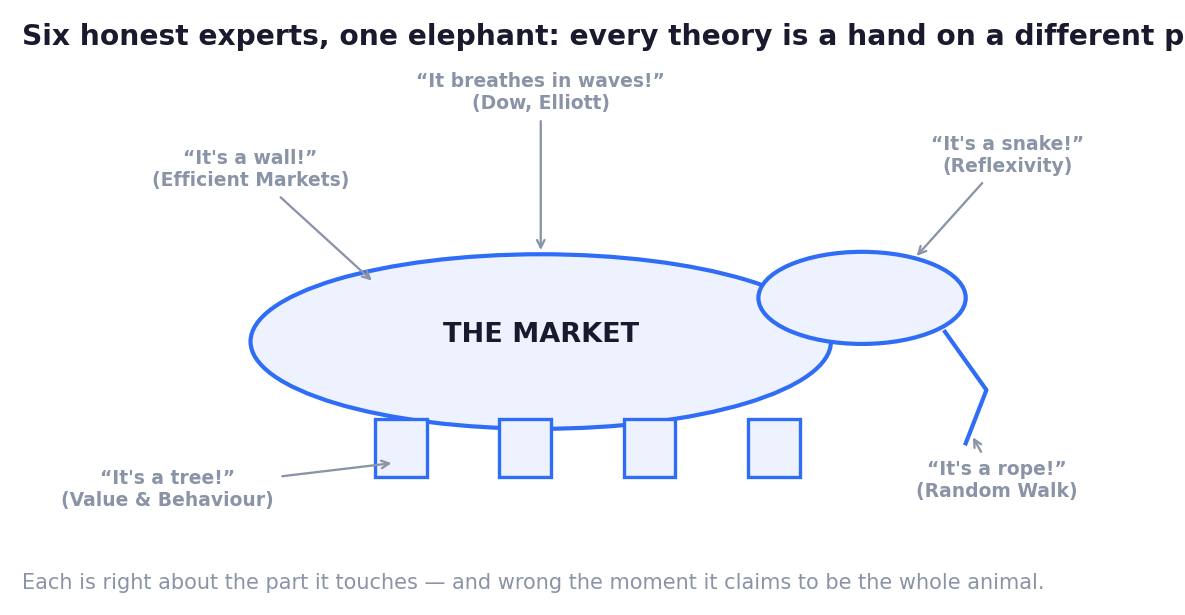
Six blind men are brought to an elephant and asked to describe it.
The first touches the leg: "It's a tree — thick, solid, rooted."
The second holds the trunk: "Nonsense. It's a snake — it moves, it curls."
The third feels the ear: "You're both wrong. It's a fan."
The fourth, the side: "A wall." The fifth, the tusk: "A spear." The sixth, the tail: "A rope."
Here's what makes the story great: nobody is lying, and nobody is stupid. Each man is reporting, accurately, the part of the animal he can reach. The mistake isn't in the touching. The mistake is when any one of them declares his part to be the whole elephant.
Now — replace the elephant with the market, and the six men with a century of brilliant people:
One school of thinkers measured how fast information gets into prices and said: the market is a wall — you can't beat it (Efficient Markets, Chapter 3). Another studied price charts statistically and said: it's a rope — it wanders randomly (Random Walk, Chapter 4). Others watched crowds panic and celebrate and said: it breathes in waves (Dow and Elliott). A psychologist measured how losing actually feels and said: the animal is emotional (Chapter 6). A trader noticed prices changing the very businesses they measure and said: careful — it's alive, and it reacts to being touched (Reflexivity, Chapter 7).
Every one of them was touching something real.
So the first question this school must answer honestly is the one beginners are usually too shy to ask:
Why can't finance just agree? Physics agreed on gravity. Why does the market have a dozen competing theories — and why do serious professionals entertain several at once?
Three honest reasons. Learn them, and this entire school makes sense.
Reason one: you cannot put a market in a laboratory. A physicist can drop the same ball a thousand times, changing one thing at a time. Nobody can re-run October 2008 with slightly different interest rates to see what happens. Every market event occurs exactly once, tangled with a thousand causes. So market ideas can never be proven the way gravity was — they can only be supported or weakened by messy, one-time evidence. That's why the most famous one is politely called the Efficient Market Hypothesis, not the Efficient Market Law. The humility is built into the name.
Reason two: the subject being studied is studying you back. A planet doesn't read astronomy papers and change its orbit. Markets do exactly that. The moment a theory about markets becomes popular, millions of people trade on it — which changes the market's behaviour, sometimes strengthening the theory (everyone believes in a support level, so it holds), sometimes destroying it (everyone exploits a winning pattern until it stops working). Imagine studying an animal that reads your research and adapts. That animal will never sit still long enough for one final theory. Chapters 7 and 11 are built entirely on this strange loop.
Reason three: the elephant genuinely has parts. The market is sometimes calm and rational, sometimes panicked and absurd. Sometimes information is priced in seconds; sometimes a mania ignores information for years. Different theories were built by people staring at different moods of the same animal — so of course a theory born in a crash disagrees with one born in a calm decade. Both saw truly. They saw different parts.
Which brings us to how professionals actually use theories — and it's not how beginners expect.
Amateurs treat theories like religions: pick one, defend it online, mock the others.
Professionals treat theories like lenses in a toolbox: each one makes a specific part of the elephant visible, and the skill — the entire skill — is knowing which lens fits the current situation. When markets are calm and liquid, the efficiency lens works beautifully. When a mania is running, the psychology and reflexivity lenses see what efficiency is blind to. No single lens is the animal.
So here is the deal this school offers you:
Twelve chapters. Each one hands you a lens: who built it (a real person, with a story — you'll meet them all), when and why (theories are always answers to their moment), what it gets right, where it breaks, and — the part most courses skip — how you actually use it with real money on the line.
You will not be asked to join a religion.
You will leave with a toolbox — and, in the final chapter, with the discipline of knowing which hand to trust on which part of the animal.
Let's start with the oldest hand of all: a journalist, in 1900, standing at the edge of the ocean.
Key Takeaway
Markets breed many theories because they can't be lab-tested (so nothing is ever proven, only supported), because the market studies you back and adapts to popular ideas, and because the elephant genuinely has parts — different moods reward different lenses. Professionals don't join theory-religions; they collect lenses and match them to conditions.
Think About It
Which market theory have you already been treating like a religion — defending it before testing it? What would it cost you to demote it from 'the truth' to 'one good lens'?
Theory Lab — Your Current Lens
Before learning any formal theory, write down the one you already carry — everyone has one, usually unexamined. Complete these three sentences honestly:
Keep the note. That's your 'before' photo — your current hand on the elephant.
At the end of this school (Chapter 12's lab), you'll write the three sentences again and compare. The distance between the two notes is what the school built.