

THE THEORIST
Who
Andrew W. Lo (b. 1960), American financial economist, MIT
When & where
MIT, 2004 (the founding paper), expanded into a full book in 2017
Why he built it
Lo spent a career watching both camps be right: markets that priced information beautifully for years, then behaved like panicked herds. Trained in both statistics and neuroscience, he reached for the one framework built to handle 'sometimes rational, sometimes not': evolution
The work
'The Adaptive Markets Hypothesis' (Journal of Portfolio Management, 2004); 'Adaptive Markets: Financial Evolution at the Speed of Thought' (2017)
The move
Replace physics-envy with biology: markets as ecosystems, strategies as species, capital as food, and efficiency as a VARIABLE that depends on competition and environment
Portrait sourcing
Wikimedia Commons: 'Andrew Lo' (CC-licensed, MIT-era)
By the early 2000s, finance was a house divided — and you've now lived both halves of the argument.
Chapter 3's camp had decades of evidence: markets price information astonishingly fast, professionals mostly fail to beat index funds, free lunches vanish on contact. Chapter 6's camp had decades of evidence too: measured biases, documented bubbles, panics that no rational model could dress up. Two Nobel-decorated armies, each holding a genuinely real piece of the elephant, each unable to explain the other's piece.
Then Andrew Lo, an MIT economist fluent in both statistics and neuroscience, made the move this whole school has been preparing you for. He didn't pick a side.
He changed the question.
Is a jungle efficient?
Sit with how strange that sounds. A jungle is brutally competitive — waste is punished, opportunities are exploited within hours, nothing edible stays uneaten for long. In that sense: profoundly efficient. But a jungle also has stampedes, plagues, population explosions and collapses, and species with ancient instincts firing in situations they weren't built for. 'Efficient' and 'irrational' are both true and both beside the point, because a jungle isn't a machine seeking equilibrium.
A jungle is an ecosystem, adapting. And so — said Lo in 2004 — is the market.
The Adaptive Markets Hypothesis in plain words: market participants aren't calculators (EMH's assumption) or broken calculators (behaviourism's punchline). They're organisms — evolved creatures using old survival wiring in a new habitat, competing for a food supply called profit. From that one reframe, everything both camps observed falls into place:
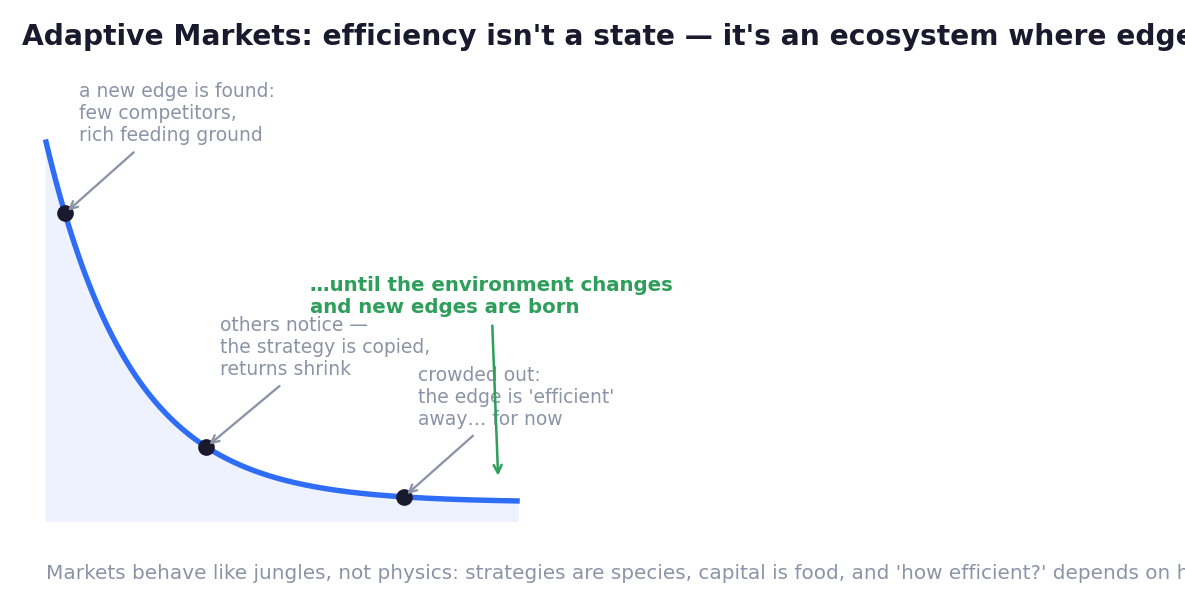
Strategies are species, and edges are food. A genuinely profitable strategy is a rich, undiscovered feeding ground. What happens to feeding grounds in any ecosystem? Competitors arrive. The figure shows the life cycle every trader eventually learns the hard way: a new edge feeds its few discoverers richly → success attracts imitators → the ground gets crowded → the returns are grazed down to nothing. The strategy didn't 'stop working' — it got eaten. This is EMH's efficiency, explained as ecology: markets become efficient where and while competition is thick. (It's also, note, exactly Chapter 3's paradox — efficiency as a tug-of-war — given a biology.)
Biases are instincts, not defects. Loss aversion (Chapter 6) kept your ancestors alive for two million years; it just misfires in a brokerage account — an ancient reflex in a new habitat, like a moth circling a lightbulb built for navigating by the moon. Under calm conditions, the reflexes stay quiet and markets look rational. Under stress — crashes, manias — the old wiring seizes control of millions of organisms simultaneously, and the market stampedes. Both camps were photographing the same animal in different weather.
And efficiency is a dial, not a fact. How efficient a market is depends on the environment: how many predators are competing, how rich the food, how stable the climate. A giant, liquid market crawling with professionals? Ruthlessly efficient — index it and move on. A tiny, ignored corner with few competitors? Feeding grounds can persist. The same market in a panic, when half the species are running on pure instinct? Temporarily, wildly inefficient. The question is never 'are markets efficient?' It's 'how crowded is THIS hunting ground, right NOW?'
What this lens demands of you, practically — three adaptations:
Expect your edges to decay, and plan for it. Whatever works for you is a feeding ground others will find. Monitor your strategies' results over time (a tagged trade journal is your population survey); when returns thin, that's not betrayal — that's ecology. Evolve or migrate.
Hunt where the crowd isn't. Your natural advantages as a small participant are the grounds too small or too slow for the big predators: longer time horizons, neglected corners, and above all behavioural discipline — the one food source that regenerates, because it's grown by other organisms' instincts.
Match the lens to the weather. In calm, liquid conditions run Chapter 3's playbook (humility, indexing, demand proof of edge). When instinct weather arrives — mania or panic — Chapters 6, 7 and 10 become the operative field guides. Adaptive Markets is the theory that finally licenses the toolbox this school has been handing you: not indecision, but ecology.
Which leaves only one chapter: learning to run the toolbox — all the hands, one elephant.
Key Takeaway
Lo ended the civil war by changing the question: markets are ecosystems — participants are organisms with old instincts, strategies are species, edges are feeding grounds that get eaten, and efficiency is a dial set by competition and conditions. Expect your edges to decay, hunt where the crowd isn't, and match your lens to the weather. The toolbox isn't indecision; it's ecology.
Think About It
Think of a strategy or 'sure thing' you've watched stop working — a setup, a fund style, a market habit. Through this lens: did it break... or did it get eaten? And what does that tell you about whatever's working for you right now?
Theory Lab — Survey Your Ecosystem
Take whatever approach currently makes (or is supposed to make) you money — a setup, a style, an asset class.
Answer three ecologist's questions in writing:
Then mark one hunting ground the big predators ignore that fits YOUR size: longer horizons, a neglected niche, or simply out-behaving other organisms in a panic.
Ecosystems don't reward the strongest species. They reward the ones that notice the environment changing.