

Here's an aviation fact that surprises people: on a modern commercial flight, the autopilot flies most of the journey.
Not because the autopilot is a better pilot. In a crisis, in ambiguity, in anything novel — the human wins, easily. The autopilot flies because of what it doesn't do:
It doesn't get tired on hour nine. It doesn't get distracted by a conversation. It doesn't get frightened by turbulence at 2 a.m. over the ocean and start 'adjusting' things. It holds the plan, exactly, indefinitely.
Now be honest about your trading, because the case for automation begins with a confession:
The biggest leak in most traders' results is not their strategy. It's the gap between their strategy and what they actually do.
You've met the culprits in the Psychology school and the bent curve of Prospect Theory: after two losses, you skip the third signal (which wins without you). After a big win, you double size (and give it back). At 2:47 pm, bored, you take a trade your rules never suggested. Your stop-loss is 'mental' — meaning negotiable — meaning gone when it matters. The strategy was fine. The pilot kept grabbing the wheel.
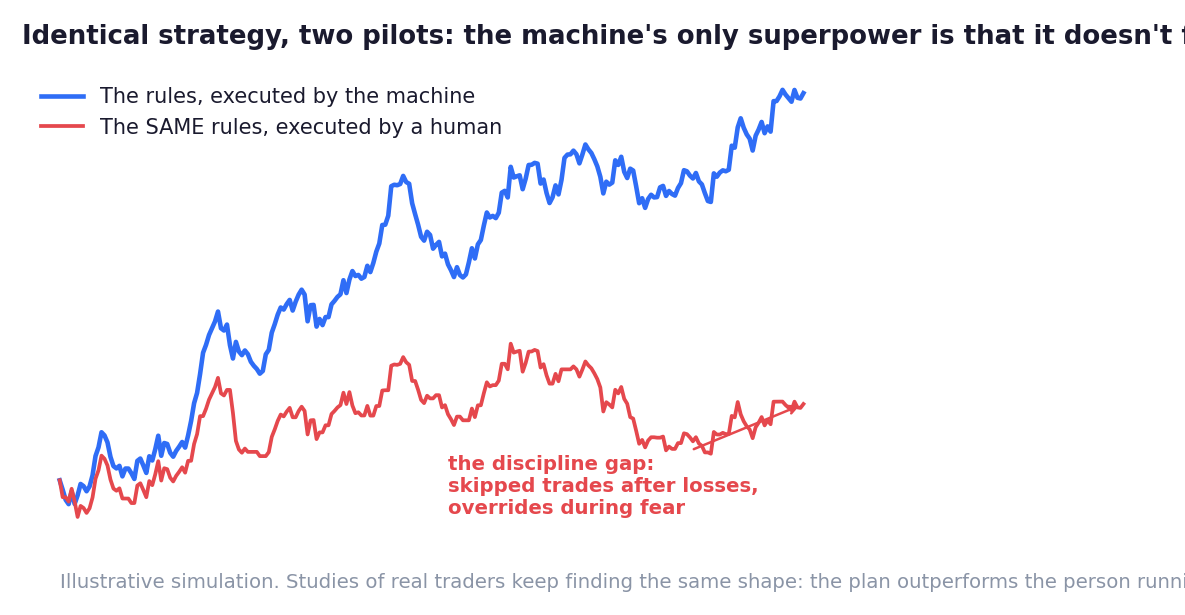
Look at the figure: the same rules, run twice — once by the machine, once by a simulated human who skips signals after losses and overrides during fear. Identical strategy. The gap between the two lines has a name: the discipline gap — and it's the single thing automation most reliably closes. Studies of real investors keep finding the same embarrassing shape: the plan outperforms the person operating it.
So the honest case for automation, in order of importance:
One — it removes you from the loop at execution time. Every rule fires, every time, at full and equal conviction. The machine takes the signal after three losses — which is precisely the signal your wiring wants to skip, and often precisely the one that pays.
Two — it makes your strategy testable. (Chapter 1 said it; it deserves repeating as a reason.) Exact rules can face ten years of history before they face your savings. Judgment can't. Automation doesn't just execute your recipe — it forces your recipe to become honest enough to examine.
Three — it scales attention. One human watches a handful of charts with fading focus. One process watches hundreds, identically, at 9:16 and at 3:14, on the day you're sick and the day you're euphoric.
And four — it produces a clean record. Every machine trade is born tagged: which rule, which parameters, which conditions. The verdict machine every school in this Academy ends with — tag, sample, judge — comes free with automation.
Now the bill, because this school promised honesty and the bill is real:
Rigidity. The autopilot holds the plan — including into situations the plan never imagined. A human sees the news and pauses; your algo sees a price and fires. (Chapter 6 covers the famous disasters; Chapter 3's kill-switch box exists because of them.)
A new job, not no job. You don't stop working when you automate; you change roles — from pilot to flight engineer: monitoring, maintaining, deciding when the autopilot itself is malfunctioning. Traders who automate to 'free themselves' discover they've traded screen-watching for system-watching.
Tech risk. Your strategy now depends on an internet connection, a broker's servers, an API that can change, and code that can contain a typo. Each is a new way to lose money that has nothing to do with markets.
And the subtlest cost: false confidence. A machine executing a bad recipe produces losses with beautiful consistency — and the very automation that removed your panic can also remove your attention. The machine's discipline is not evidence of edge. It's an amplifier, remember, pointing wherever the recipe points.
The mature conclusion — and the one this school builds on:
Automate to protect the strategy from the human. Then structure the human to supervise the machine. Autopilot flies the plane; the pilot still sits in the seat. Both jobs, clearly divided, neither abandoned.
Next: the anatomy. Every autopilot ever built — five boxes.
🇮🇳 The India Angle
- The discipline gap has an unusually well-documented Indian exhibit: regulator studies repeatedly found the overwhelming majority of individual derivatives traders losing money — with overtrading and abandoned plans among the classic drivers. Automation attacks exactly that failure mode.
- India's rapid retail adoption of broker APIs and strategy platforms is largely a discipline purchase: traders paying technology to enforce rules they couldn't enforce on themselves.
- The 'new job, not no job' warning applies doubly where retail algos run from home setups: power, internet and broker-app reliability become part of your strategy (Chapter 6's checklist).
Key Takeaway
Automate for the autopilot's real virtues: it closes the discipline gap (the leak between your strategy and your behaviour), makes rules testable, scales attention, and records everything. Pay the honest bill knowingly: rigidity, tech risk, a new supervision job, and the false confidence of a machine consistently executing a bad recipe. Protect the strategy from the human; then supervise the machine.
Think About It
Pull up your last 20 trades against your own stated rules. How many broke them — skipped signals, moved stops, impulse entries? That count is your personal discipline gap: the exact amount of money automation is offering you.
Algo Lab — Measure Your Discipline Gap
Take your last 20–30 trades and your written rules (Chapter 1's recipe, if that's all you have).
Sort every trade into three piles: BY THE RULES · RULE BROKEN (moved stop, wrong size, early exit) · NO RULE EXISTED (impulse).
Compute the profit/loss of pile one alone versus all trades together.
The difference is your discipline gap in actual money — the number automation is bidding for.
If pile one is empty because no written rules exist yet: that IS the finding, and Chapter 3 is your next stop.