

In 1983, one of the most successful traders in America made a bet with his best friend.
His name was Richard Dennis.
Dennis believed that great trading could be taught to almost anyone.
His friend disagreed.
He believed great traders were born — that no set of rules could replace natural talent.
So they did something remarkable.
They ran an experiment on real people, with real money.
They placed an advertisement in the newspaper.
From over a thousand applicants, they selected a small group of complete outsiders.
An accountant. A security guard. An actor. A pianist. A game designer.
People with no trading background at all.
Dennis taught every single one of them the exact same rules.
When to buy. When to sell. How much to risk. Everything, written down, step by step.
Then he gave them his own money and let them trade.
Now pause for a moment and ask yourself a simple question.
If everyone had the same rules, the same training, and the same money... shouldn't everyone get the same results?
They didn't.
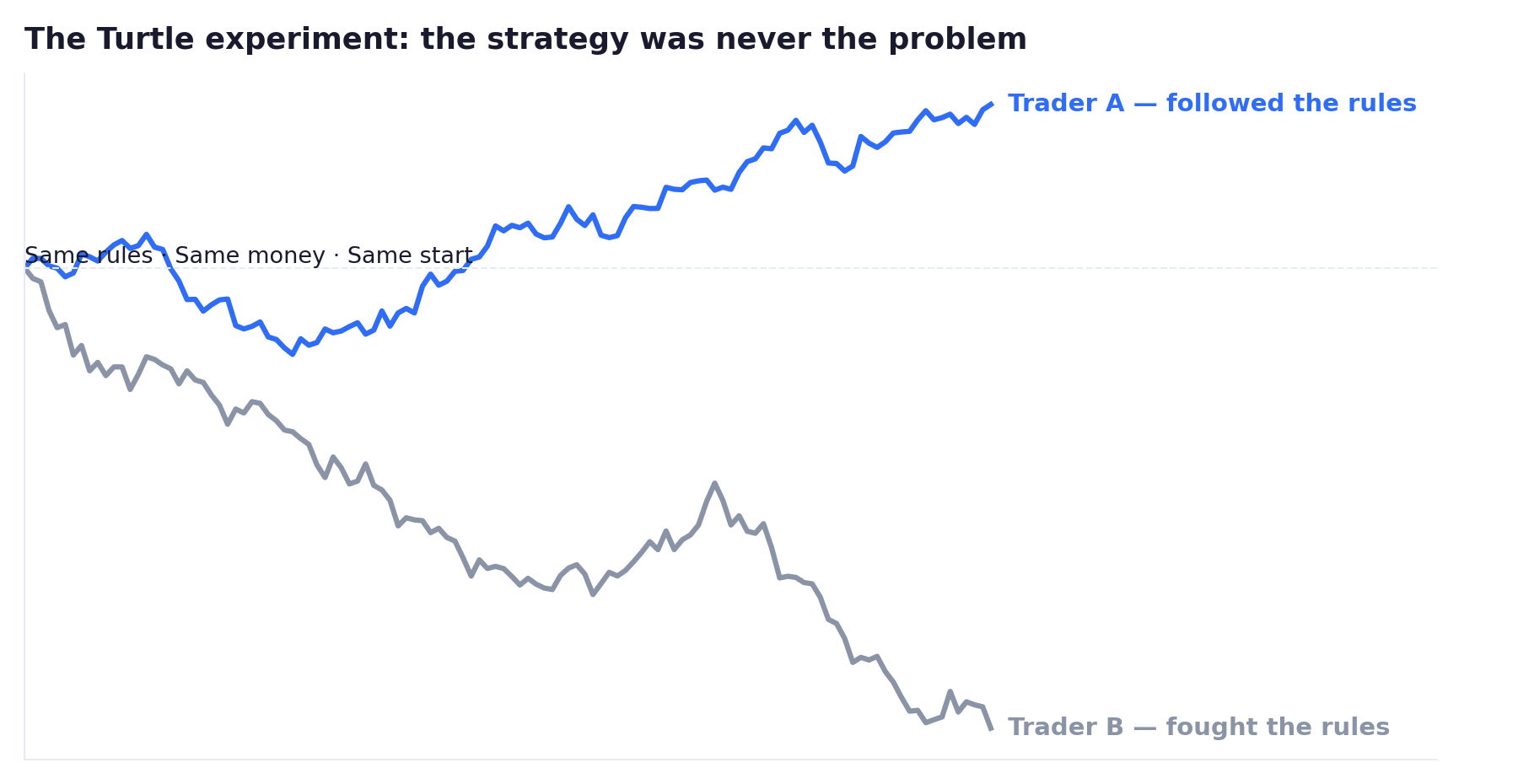
Some of them followed the rules and went on to make fortunes — hundreds of millions of dollars over the following years.
Others sat at the same desks, holding the same rulebook...
...and struggled.
Not because they forgot the rules.
They could recite them perfectly.
But when real money was on the line — when a trade turned red, when fear showed up, when everyone around them was panicking —
something inside them refused to follow the rules they knew by heart.
That experiment revealed one of the most important truths in all of trading.
The strategy was never the problem.
The human running it was.
Here's why.
Your brain is ancient.
It was built over hundreds of thousands of years for one job: keeping you alive.
Fear losses, because losing food meant death.
Follow the crowd, because the crowd usually knew where the danger was.
Spot patterns instantly, because a rustle in the grass might be a tiger.
React first, think later, because slow thinkers got eaten.
For almost all of human history, this wiring was brilliant.
It's the reason your ancestors survived long enough for you to exist.
But the market is a very strange place.
It is possibly the only environment on Earth where this survival wiring — the very instincts that kept humans alive —
quietly and consistently loses you money.
In the market, fear makes you sell at the worst moment.
Following the crowd makes you buy at the top.
Seeing patterns makes you find meaning in randomness.
Reacting fast makes you abandon plans you spent weeks building.
You cannot uninstall this wiring.
Nobody can.
The traders who succeed are not the ones who deleted their emotions.
They are the ones who know their own wiring so well that it stops surprising them.
In the School of Market Science, you learned how markets actually work — how prices move, why every trade needs two people, what liquidity really is.
That was one half of the picture.
This school is the other half.
Here, you won't study the market.
You'll study the machine that trades it.
You.
Welcome to the School of Market Psychology.
One warning before you begin.
Everything you are about to read is already inside you.
This wiring doesn't announce itself.
It will never tap you on the shoulder and say, "I'm about to make you hold a losing trade."
It works in silence — while you're feeling completely rational —
and you usually won't realize it was ever there until the damage is already done.
That's why this school ends with something practical: a short card to keep beside you every time you trade.
Read the chapters first.
The card will make sense when you get there.
Try this right now.
For the next sixty seconds, do not think about a pink elephant.
Don't picture its ears. Don't picture its trunk. Whatever you do, keep that pink elephant out of your mind.
...
How did it go?
If you're like every human who has ever tried this, the elephant walked straight in — the moment you were told to keep it out.
Now ask yourself:
If you can't fully control something as small as a thought about an elephant...
...what happens when the thing in your mind is a losing trade, and it's your real money on the screen?
This is why market psychology exists as a subject.
Your mind doesn't always obey you.
The first step is simply knowing that.