

It's 1 a.m.
You've just lost a ranked match you were winning until the final minute.
You know you should sleep.
Your finger clicks Play Again.
You lose the next one too — faster, uglier.
One more. Just one more, to end the night on a win.
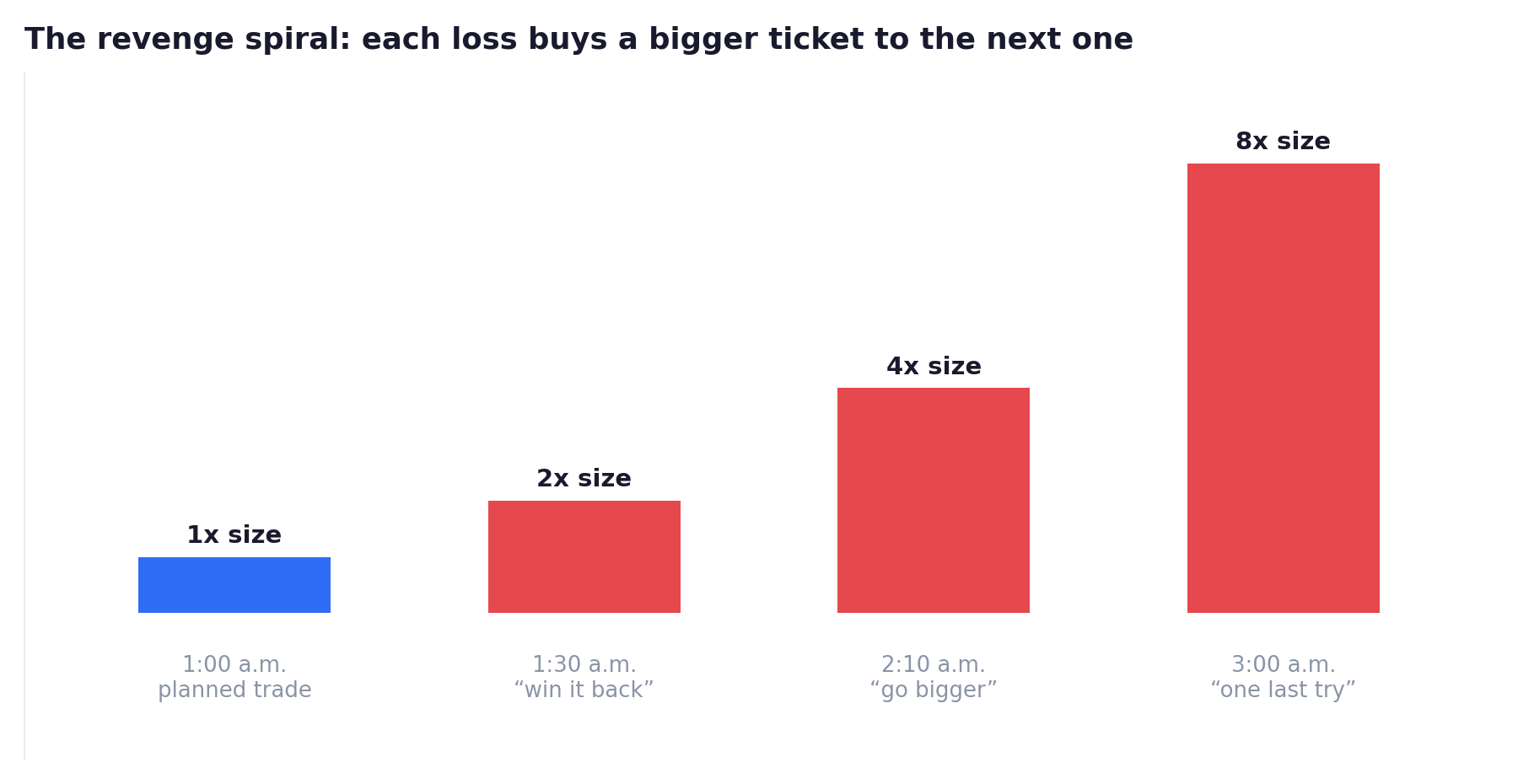
By 3 a.m. you've dropped two ranks, your hands are tense, and you're angrier at yourself than at the game.
Now here's the strange part.
Your skill didn't change at 1 a.m.
Your knowledge didn't change.
Something else changed.
The game stopped being a game.
It became personal.
You were no longer playing to play.
You were playing to erase a feeling.
Traders have a name for this exact spiral: revenge trading.
Poker players call it going on tilt.
Whatever you call it, it works like this.
A trader takes a loss — maybe a careless one, maybe just unlucky.
And instead of registering the loss as information, their brain registers it as an attack.
Deep inside your brain sits a small, ancient region — the amygdala. Think of it as your brain's security guard.
Its job is simple: detect threats, and when it finds one, take over.
It doesn't ask permission.
When the security guard senses danger, it grabs the steering wheel from the slow, careful driver — the thinking part of your brain — and floors the accelerator.
This is a magnificent system for dodging a speeding car.
You don't want to calmly evaluate a speeding car.
But the security guard cannot tell the difference between a speeding car and a losing trade.
A threat is a threat.
So it takes the wheel — right before your next trading decision.
You can recognize a revenge trade by its fingerprints:
The position is suddenly bigger than usual — because you're not trying to make money, you're trying to make the loss disappear in one move.
The plan is gone. No setup, no reason, no rules. The rules feel slow, and you need this now.
There's a clock in your chest. Waiting feels unbearable.
And underneath it all, one telltale thought: "The market owes me."
Read that last one again, because it hides the deepest error of all.
The market cannot owe you anything.
Remember what you learned in the School of Market Science: the market is a conversation between millions of buyers and sellers, each with their own reasons.
It is not watching you.
It doesn't know you exist.
It didn't take your money the way an opponent takes it — there is no opponent.
Feeling that the market owes you revenge is like feeling that the ocean owes you an apology for a wave.
Now, the uncomfortable truth about fixing this.
You cannot out-think the security guard while the alarm is ringing.
In that moment, willpower loses. It almost always loses.
The thinking driver isn't holding the wheel — so making "better decisions" isn't even available.
Which means the fix isn't cleverness.
It's distance.
Professional traders don't win this battle in the moment. They win it by refusing to fight in the moment.
After a painful loss, they have rules that remove them from the wheel entirely:
Close the screen. Physically walk away.
No new trade for a fixed cooling-off period — an hour, the rest of the day, whatever it takes.
Decisions resume only when the loss has shrunk back into what it always was: a number. Information. Tuition.
It sounds almost too simple.
But there's a reason experienced traders repeat one strange-sounding sentence:
After a painful loss, the best trade is usually no trade.
The 1 a.m. version of you doesn't need a better strategy.
It needs a bedtime.
Key Takeaway
A revenge trade is not a trading decision. It is an emotional reaction wearing a trading costume. You cannot out-think it while the alarm is ringing — you can only step away until the thinking part of your brain is back at the wheel.
Think About It
After your last painful loss — in trading, in a game, anywhere — was your very next decision designed to improve your position... or to make a feeling go away?
Psychology Lab — The 1 a.m. Audit
Run the 1 a.m. audit on yourself.
Think of the last time you kept going at something to fix a bad feeling — replaying a match, refreshing an app, arguing a point long after it mattered.
What finally stopped you? A decision... or exhaustion?
If you already trade, do the trader's version:
Look at your last 20 trades and mark every trade you entered within an hour of taking a loss.
For each one, answer honestly: was it planned before the loss, or born from it?
Compare how that group performed against the rest.
For most traders, this one exercise is worth more than any indicator they will ever download.