

A man leaves a party late at night.
He's been drinking — well past the limit.
He gets in his car anyway, drives home through empty streets, and arrives safely.
Nothing happens.
Question: was driving home drunk a good decision because it worked?
You answered instantly. Of course not.
Now flip it around.
A woman wears her seatbelt every single day for twenty years.
She never has an accident. Not once.
Were twenty years of seatbelts a waste because nothing happened?
Again — instantly — no.
Congratulations. You've just done something most traders never learn to do.
You separated the quality of a decision from the quality of its outcome.
You understood, without any effort, that a terrible decision can produce a happy ending, and a wise decision can appear to "do nothing" for decades.
Every human finds this obvious...
...right up until money enters the room.
Watch what happens in the market.
A beginner breaks every rule they own. No plan, no research — they buy a random stock because of a rumour in a group chat.
The stock jumps 20% in a week.
What does their brain record?
"I'm a natural."
The drunk driver made it home — and concluded he drives better after a few drinks.
Another trader does everything right. A researched plan, a sensible position, a clear exit.
The trade loses money — because sometimes good trades simply lose. Chance exists.
What does their brain record?
"The plan is broken."
The seatbelt was pointless — no crash happened.
Do you see the trap?
In any activity that mixes skill with luck — trading, poker, even careers —
single outcomes are terrible teachers.
They praise recklessness whenever it gets lucky, and punish discipline whenever it doesn't.
A brain that learns from single outcomes in the market is a brain being trained backwards.
So how do you keep score in a game where results lie?
Visit a casino — as an observer.
Watch the blackjack tables for an hour.
The casino loses constantly. Hand after hand, all night, real money sliding across the felt to grinning customers.
And the casino never panics.
It doesn't change the rules of blackjack at 2 a.m. because a table is running cold.
It doesn't fire the dealer after three losing hands.
Why?
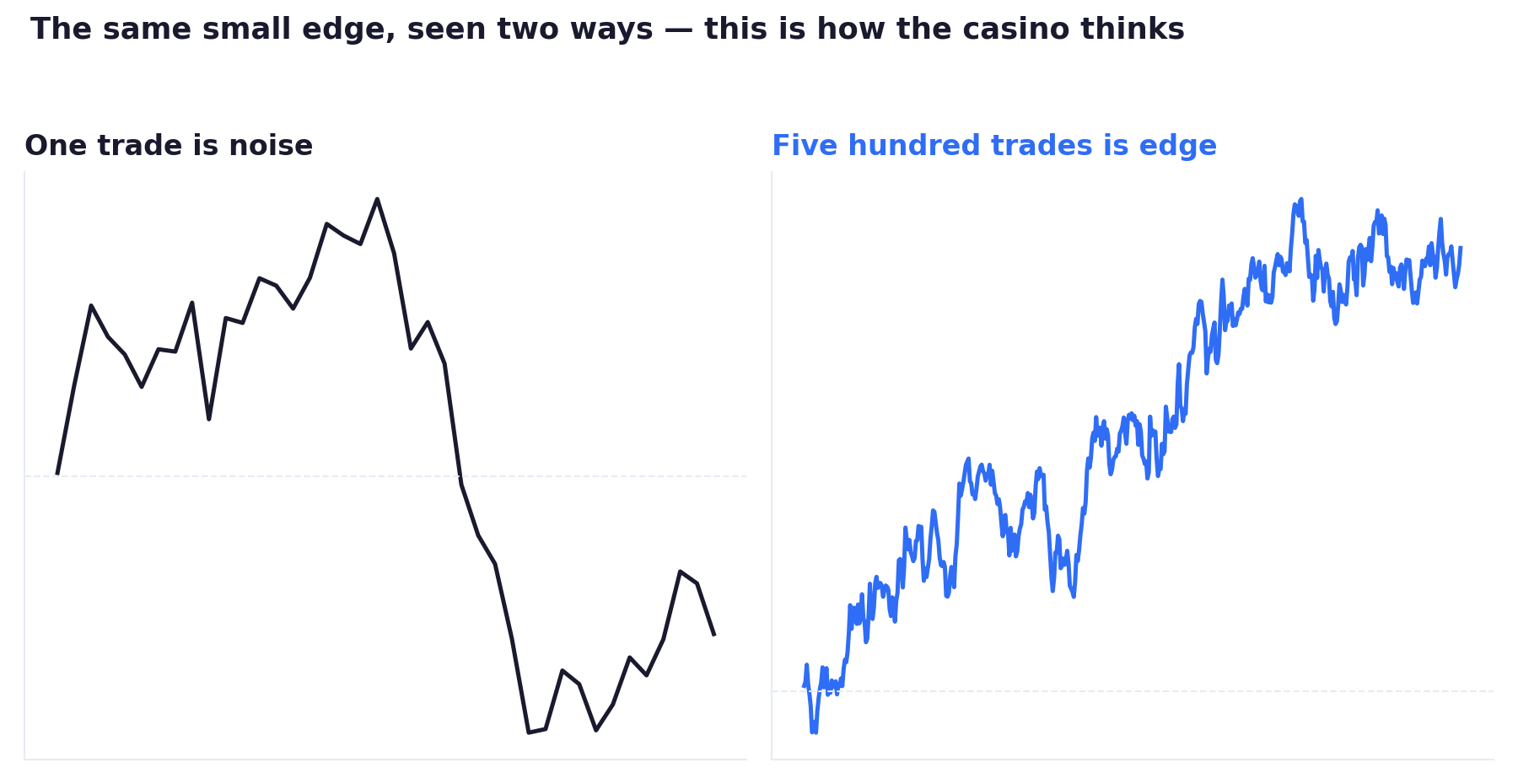
Because the casino's edge on each hand is tiny — but certain.
It knows that across thousands of hands, that small edge must show up, as surely as gravity.
So it doesn't think in hands.
It thinks in thousands of hands.
The gambler across the table thinks in this hand. That's the entire difference between the two sides of the felt — and only one side built the building.
Professional traders keep score the casino's way.
Not: "Did this trade make money?"
But: "Did I follow a process that makes money across hundreds of trades?"
A losing trade that followed the process is a good trade.
A winning trade that broke every rule is a bad trade — one whose bill simply hasn't arrived yet.
This is also the real reason serious traders keep a journal.
Not as a diary of feelings — as a scorekeeping system.
Memory keeps score by outcomes and emotions; it remembers the lucky win fondly and buries the disciplined loss.
A written record is how you judge your decisions after the luck washes out — hundreds of trades at a time, the way the casino counts.
And with that, you know the machine.
Across this school you've watched your own wiring at work:
it feels losses twice as hard as gains,
it finds faces in the moon and patterns in coin flips,
it joins queues without tasting the food,
it hands the wheel to a security guard at 1 a.m.,
and it grades decisions by luck.
You cannot uninstall any of it. Nobody can.
But there's a reason the greatest traders spend more time studying themselves than studying charts.
The market is the same for everyone.
The machine that trades it is not.
Yours came with no manual.
Consider this school the first chapter of one.
Key Takeaway
In any game that mixes skill and luck, single results lie — they reward lucky recklessness and punish disciplined losses. Judge your decisions by the process behind them, not the outcome in front of them.
Think About It
If a bad decision can make money and a good decision can lose it — what, exactly, should you be keeping score of?
Psychology Lab — The Outcome Detox
Play the Outcome Detox for one week.
Each evening, write down one decision you made that day — any decision. What you studied, what you ate, something you said, something you bought.
Grade the decision itself, from 1 to 10, based only on what you knew at the moment you made it.
Then, separately, note how it turned out.
By the end of the week, you'll have collected proof from your own life: good decisions that turned out badly, and careless ones that got lucky.
That gap between the two columns is where every great trader lives.
Learning to see it is the final lesson of this school — and the first habit of a professional.