

Two restaurants sit side by side on the same street.
Same kind of food. Same prices.
One is empty.
The other has a queue out the door.
You've never eaten at either one.
Which do you choose?
Almost everyone picks the queue.
And notice — you did it without a single piece of real information.
You haven't read a menu. You haven't tasted the food. You know nothing.
Yet the queue feels like proof.
"All these people can't be wrong."
In the 1960s, psychologists ran a mischievous experiment on a busy New York street.
They paid one man to stand on the pavement and stare up at the sky — at nothing.
A few passers-by glanced up.
Then they added more people staring upward.
With a small crowd gazing at an empty sky, most people walking past stopped and looked up too.
At nothing.
This is herding, and like everything in this school, it used to be genius.
For your ancestors, when the whole group suddenly ran, the correct move was to run first and ask questions later.
The one who stood still, wondering "hmm, I wonder what everyone is running from" — well, they usually found out.
Copying the crowd kept humans alive for a hundred thousand years.
And then humans built markets.
And in markets, the crowd's logic flips upside down.
Here's the part almost nobody stops to think about.
Remember the School of Market Science: prices rise when more people want to buy than sell.
So when "everyone is buying"...
...their buying is already inside the price.
The excitement you can see and hear — the news, the group chats, the neighbours discussing it — has already pushed the price up.
Now follow that logic one painful step further.
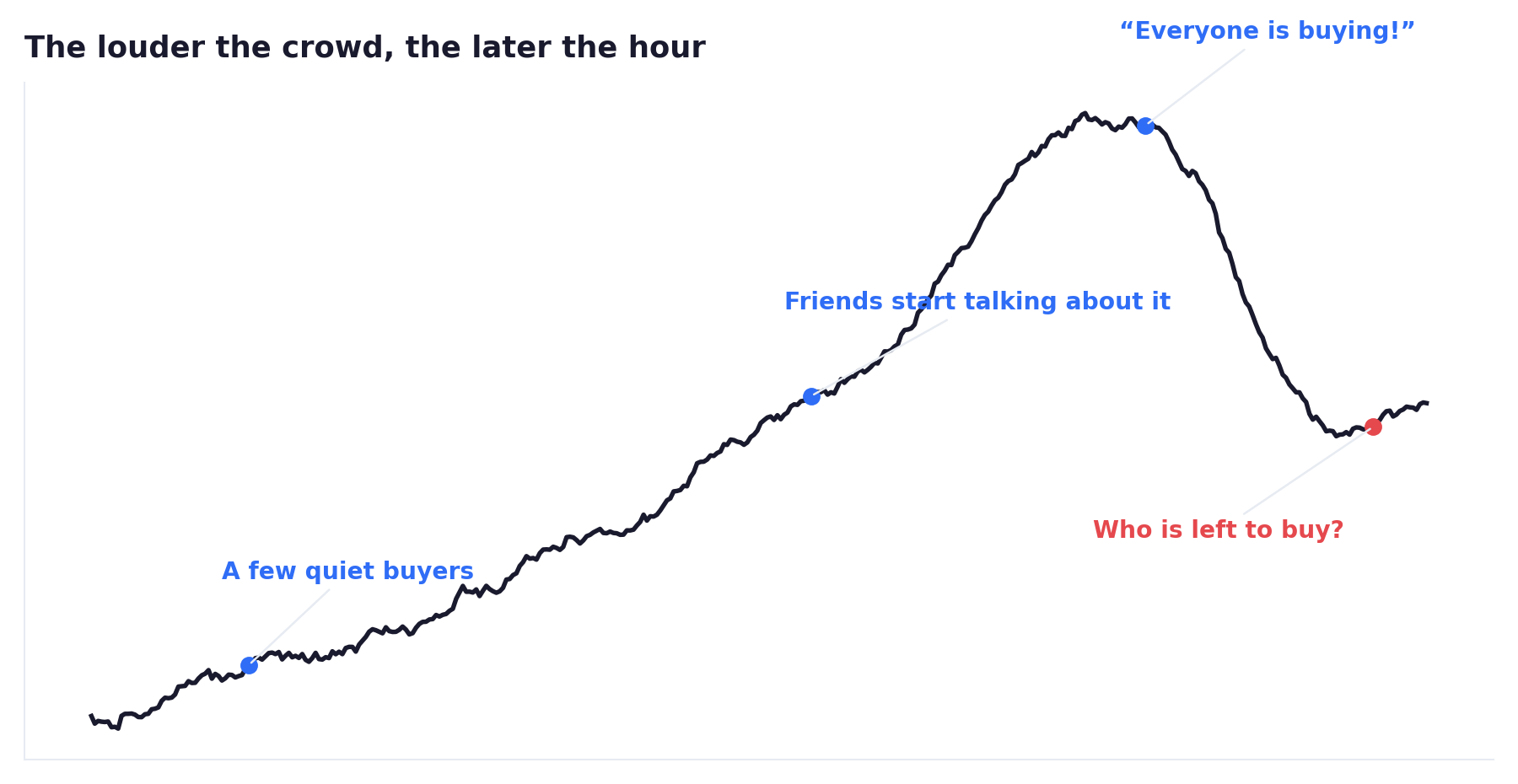
A price peaks at the exact moment the last excited buyer finishes buying.
After that person, there is no one left to push it higher.
Which means the moment when buying feels safest — when everyone around you agrees, when the queue is longest —
is often the moment closest to the top.
"Everyone is buying" is not proof that you're early.
It's usually proof that you're late.
And here is why knowing this is still not enough.
Because herding doesn't feel like a decision about money.
It feels like being left out of a party.
Your friend made money and you didn't.
Your classmate's portfolio is up and yours isn't.
Everyone seems to be getting rich without you.
There's a modern name for that feeling — FOMO, the fear of missing out — but the feeling itself is ancient.
To your tribal brain, being left out of what the group is doing feels like being left behind by the tribe.
And the market performs the same magic trick on every generation — it just changes the costume.
In 1600s Holland, the crowd fell in love with tulip bulbs. At the peak, a single bulb traded for more than the price of a house. Then, almost overnight, the crowd woke up.
Later generations queued up for railway shares, then internet companies with no profits, then meme stocks, then digital coins named after jokes.
Different century. Different asset.
Exactly the same feeling.
None of this means the crowd is always wrong — most of the time, markets full of people are smarter than any single person.
The danger is narrower than that:
the crowd is most confident, loudest, and most contagious precisely at the moments it's about to be wrong.
So when you feel that pull — everyone's in, hurry, you're missing it —
pause and recognize the feeling for what it is.
It's not analysis.
It's a queue outside a restaurant you've never tasted.
Key Takeaway
The crowd feels safe because your brain evolved in a world where it was. In markets, by the time "everyone" is buying, their buying is already in the price — the crowd's excitement is usually the reason it's too late, not the reason it's safe.
Think About It
If prices rise because people buy... who is left to buy after everyone already has?
Psychology Lab — The Herding Audit
Do an honest audit of your own herding — outside the market.
Write down the last thing you bought mainly because "everyone" had it or was talking about it. A phone. Sneakers. A game. A gadget.
Now answer honestly: did you research it the way you research things nobody talks about?
Or did the crowd do your thinking for you?
Then, for one week, notice every queue you join — literal or digital. Restaurants. Trending videos. Viral products.
Each time, ask one question: "What do I actually know about this, other than the fact that others are choosing it?"
You'll be surprised how often the answer is: nothing.