

So the machines run the markets. Doing what, exactly?
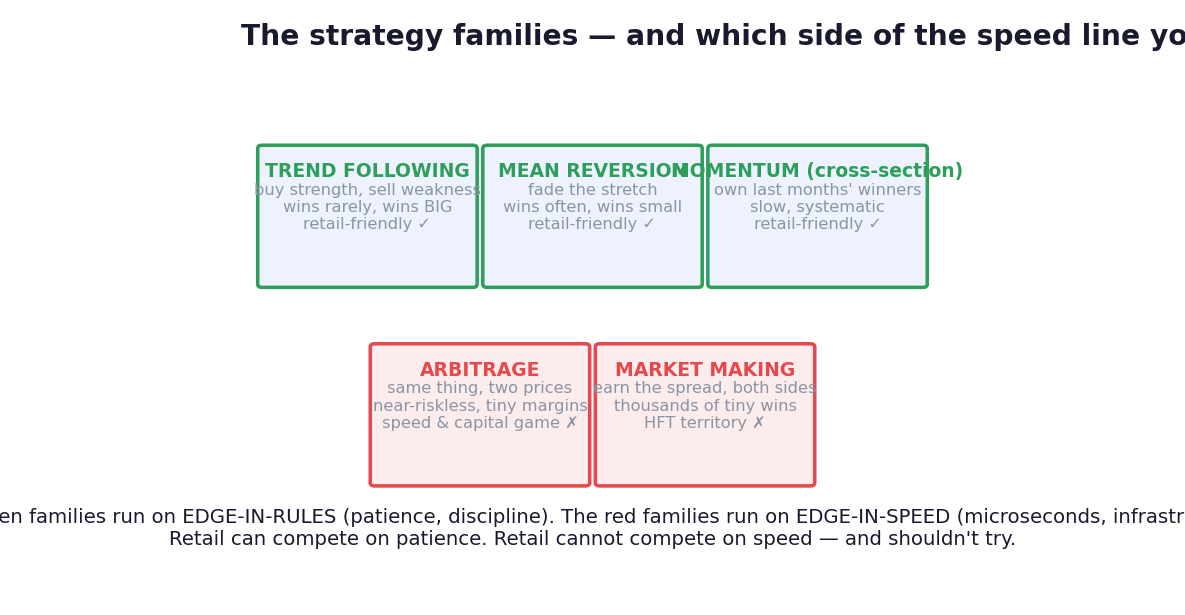
Strip away ten thousand product names and white papers, and nearly everything running out there belongs to five great families. Learn their personalities — each family has one, as distinct as relatives at a wedding — and you'll be able to place any strategy you ever meet. More importantly, you'll know which table you're allowed to sit at.
Family one: TREND FOLLOWING. Personality: the patient surfer. The oldest systematic family — buy what's rising, sell what's falling, ride until the trend visibly bends (Dow's tide, automated). Its signature is emotional, and you must know it before adopting: trend systems lose small, often — most breakouts fail, and the system takes dozens of paper cuts — then win enormously, rarely, when a real trend runs for months. Win rates of 30–40% with occasional giant winners are normal and healthy. Humans hate that shape (the bent curve of Prospect Theory screams at every small loss), which is exactly why the family automates so well: the machine endures the paper cuts that shake humans out before the payoff. Runs everywhere from hobbyist bots to some of the largest funds on Earth. Retail-playable: fully.
Family two: MEAN REVERSION. Personality: the rubber-band trader. The mirror image — when price stretches unusually far from its average without news, bet on the snap back (the dog on the leash, automated). Opposite emotional signature: wins small, often — high win rates, steady drips — loses big, rarely, when a 'stretch' turns out to be a real trend and keeps stretching. The family's whole survival lives in Box 5: hard stops and regime filters, because one un-stopped loss can eat fifty wins. Retail-playable: yes, with iron kill rules.
Family three: MOMENTUM (cross-sectional). Personality: the league-table investor. Slower and grander: every month, rank a whole universe of stocks by recent performance; own the leaders, drop the laggards, repeat. No charts, no intraday anything — a rules-based portfolio that harvests one of the most stubbornly persistent effects in market history (winners keep winning a while — documented across countries and decades, and still imperfectly explained). This is the family closest to systematic investing, and arguably the gentlest on-ramp in this school. Retail-playable: completely — even manually, monthly.
Now cross the line in the figure, because the next two families live in a different physical reality.
Family four: ARBITRAGE. Personality: the toll collector. The same thing priced differently in two places — a stock on two exchanges, a future versus its underlying basket — buy the cheap one, sell the rich one, pocket the gap. Near-riskless in theory. In practice the gaps are microscopic and vanish in milliseconds, because thousands of machines hunt them — so the family's real competition is infrastructure: the fastest data, the fastest lines, the most capital. The tolls exist; the toll booth was bought long ago, by someone with a co-located server.
Family five: MARKET MAKING. Personality: the shopkeeper of prices. Continuously quote both a buy and a sell price on everything, earn the tiny spread between them thousands of times a day, and manage the terrifying risk of being run over when prices jump. This family is most of what 'HFT' actually is — less prediction than plumbing, performed in microseconds from inside the exchange building. It's also, honestly, a public service with fangs: market makers are why your orders fill instantly... and why the speed race exists at all.
See the line dividing the figure? It's the most protective idea in this chapter:
The green families run on edge-in-RULES — patience, discipline, tolerance of drawdowns. The red families run on edge-in-SPEED — microseconds and infrastructure. Retail can genuinely compete on patience (institutions are often worse at it — career risk makes them impatient). Retail cannot compete on speed, at any price a normal person can pay — Chapter 6 shows the ladder — and every retail product promising arbitrage or HFT-style returns is selling seats at a table you physically cannot reach. The correct response to the speed race isn't envy or effort. It's choosing games where speed doesn't decide the winner.
(There's a sixth cousin worth naming: event-driven systems trading around scheduled news — but you already know this Academy's counsel on binary events, and automating a gamble doesn't unmake it one.)
One closing reframe, borrowed from the Theories school: these families are species in an ecosystem. Each thrives in certain weather — trend systems feast in long directional markets and starve in chop; mean reversion feasts in chop and gets hurt in trends. No family works always; every family works somewhere. Which is the honest seed of Chapter 8's advanced move: not a smarter single algorithm, but a small zoo of simple ones that don't rhyme.
First, though — the chapter everything depends on. Your family is chosen, your boxes are drafted. Time to test the recipe against history... and to learn why that innocent-sounding step destroys more algo traders than any market crash ever has.
🇮🇳 The India Angle
- India's retail algo scene clusters heavily in one habitat: systematic options selling (rule-based premium collection on index options) — a mean-reversion cousin with the family's exact risk signature: many small wins, rare violent losses. The Market History school's expiry lessons are its required reading.
- Momentum investing has strong Indian roots too — index products and factor funds now package the family for anyone; a monthly DIY version needs nothing but a ranking rule and discipline.
- The speed line is drawn in concrete here: exchange co-location exists for members/institutions, not home traders — so the red families are structurally out of reach, exactly as everywhere else. Choose green.
Key Takeaway
Five families: trend following (loses small often, wins big rarely), mean reversion (the opposite — kill rules are its survival), cross-sectional momentum (the gentlest on-ramp), arbitrage and market making (near-riskless in theory, owned by speed and infrastructure in practice). The dividing line is the protective idea: retail competes on patience and rules, never on speed — pick games where microseconds don't decide the winner.
Think About It
Which family matches your temperament — could you emotionally survive trend following's forty paper cuts waiting for the big wave, or mean reversion's rare violent loss after fifty wins? The best family on paper is worthless if you'll abandon it at its worst moment.
Algo Lab — Classify and Choose
Part one — classify: take three strategies you've encountered anywhere (courses, videos, friends). Place each in its family, then name its emotional signature: does it lose-small-win-big, or win-small-lose-big? (Every strategy is one or the other. Sellers only ever advertise the first half.)
Part two — choose: write which GREEN family fits you, with evidence: your patience with losing streaks, your capital, your available time, your temperament from previous schools' labs.
Part three — the immunity test: find one product or service promising arbitrage/HFT-level returns to retail. Locate its table in the figure. Write one sentence on why the seat it's selling cannot exist.
Your chosen family becomes the strategy you'll carry through Chapters 5–7. Choose like you'll have to live with it — because you will.